
UNIQUE: Tjia Kang Ho Mosque, One of Indonesia’s Many China-Influenced Mosques
A Chinese-styled mosque in East Jakarta reflects Indonesia’s plural Islamic heritage, blending faith, family history, and Chinese cultural identity.

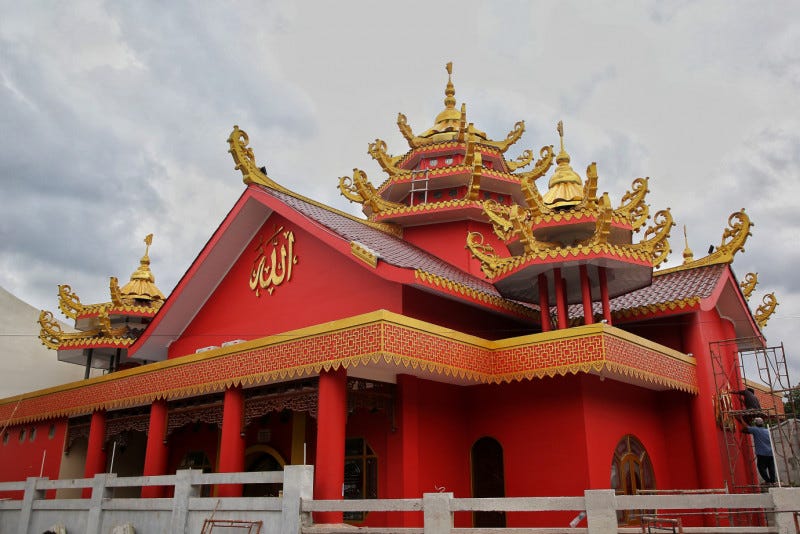
Indonesia, ISLAMICDIGEST.ORG — At first glance, Masjid Tjia Kang Ho looks more like a traditional Chinese temple than a mosque. Dominated by bright red walls and golden-yellow accents, the building immediately evokes classical Chinese religious architecture.
Yet behind its pagoda-like façade stands a place of Islamic worship that reflects Indonesia’s unique model of cultural coexistence.
Located in East Jakarta, the mosque represents a striking fusion of Chinese cultural identity and Islamic faith.
The story behind this distinctive mosque has recently been explored by a local media through an in-depth conversation with Muhammad Wildan Hakiki, chairman of the mosque’s management board (DKM) and grandson of the mosque’s namesake.


Architecture Rooted in Identity
Wildan explained that the choice of red and gold was deliberate, intended to preserve and highlight the Chinese roots of the family that founded the mosque.
“If you look at references, red is strongly associated with Chinese buildings, and gold complements it perfectly,” Wildan said. “Those two colors felt like the most appropriate representation of our heritage and the form of the building.”
The mosque’s front gate and façade have quickly become popular photo spots. Many visitors initially mistake the structure for a temple, only to realize moments later that it is, in fact, a mosque.
What often surprises visitors even more is that all decorative elements were produced locally. No materials were imported from abroad.
“As far as we know, everything here is domestically sourced,” Wildan explained. “The most striking feature is inside the main prayer hall—solid brass panels engraved with Asmaul Husna. They were handmade by artisans in Boyolali, each inscription carved one by one.”
Glass frames, ornaments, and architectural details were also custom-made by Indonesian craftsmen, reinforcing the mosque’s identity as both culturally distinctive and nationally rooted.
The Story of Tjia Kang Ho
The mosque is named after Wildan’s grandfather, Tjia Kang Ho, a man of Chinese descent who embraced Islam and later adopted the name Haji Abdul Soleh.
“My grandfather converted to Islam when he married my grandmother, a Betawi woman named Hajah Rodiah,” Wildan recounted.
The land on which the mosque stands was once Tjia Kang Ho’s private residence. After the passing of both grandparents, Wildan’s father, H. Budianto, decided to transform the family home into a mosque—while consciously preserving its Chinese architectural character.
“My father didn’t want us to forget where our family came from,” Wildan said. “Even though we are Muslim, we are still of Chinese descent. That history matters.”
A Living Symbol of Tolerance
Beyond architecture, Masjid Tjia Kang Ho has become a symbol of peaceful coexistence. The surrounding neighborhood along Jalan Tipar is predominantly home to Confucian families—many of whom are still relatives of the late Tjia Kang Ho.
Rather than resistance, the mosque has been warmly embraced by the local community. Non-Muslim neighbors often gather around the mosque, and its spacious courtyard has become a shared social space where children play in the afternoons.
The atmosphere, Wildan noted, reflects lived tolerance rather than symbolic gestures.
Part of a Wider Tradition
Masjid Tjia Kang Ho stands among several mosques across Indonesia that embody a distinctive Chinese-Islamic heritage.


These include Masjid Lautze in Jakarta, long known as a center for Chinese Muslim converts, and Masjid Babah Alun, built beneath a Jakarta toll road with intentionally Chinese aesthetics that often lead visitors to mistake it for a temple.
They also include Masjid Al Imtizaj in Bandung, which blends traditional mosque architecture with Chinese gate-style design; Masjid Ramlie Mustofa in North Jakarta, founded by a Chinese-Indonesian Muslim convert and featuring Mandarin inscriptions; and Masjid Cheng Ho in Surabaya, named after the legendary Chinese Muslim admiral Zheng He.
Together, these mosques illustrate how Islam in Indonesia has grown not by erasing local identities, but by integrating them—demonstrating a model of religious expression rooted in cultural continuity rather than uniformity.
A Destination Beyond Worship
For international travelers and cultural observers, Masjid Tjia Kang Ho offers more than a place of prayer. It presents a tangible example of Indonesia’s pluralistic Islam—where faith, history, and ethnicity intersect without conflict.
Standing quietly in East Jakarta, the mosque sends a subtle but powerful message: religious devotion and cultural heritage can coexist, enrich one another, and endure together. (IG)