

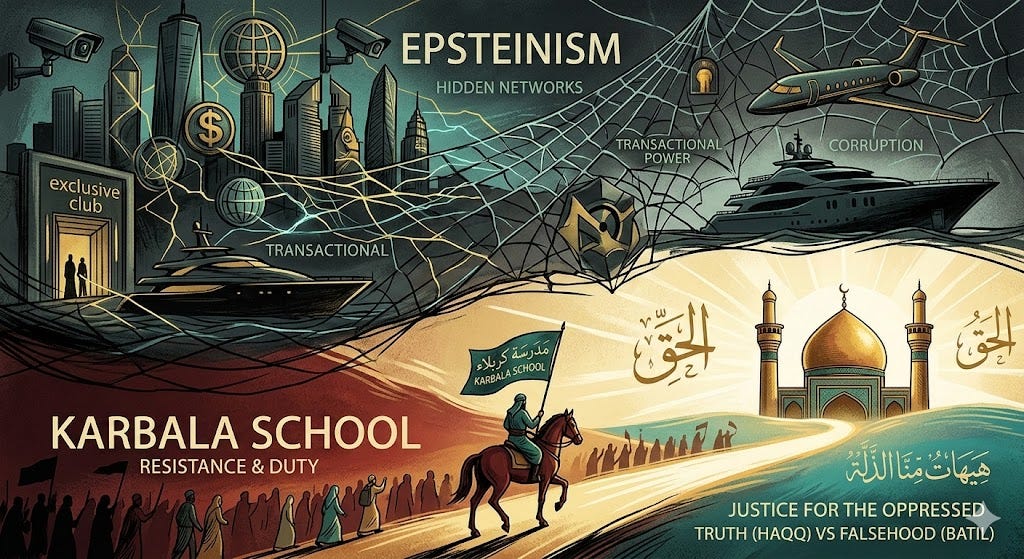
For decades, the friction between the West and the Islamic Republic of Iran has been framed through the lens of nuclear enrichment, ballistic missiles, and regional hegemony. However, according to a recent analysis by Argentine journalist and FIYAR President Ahmad Diab, these technical disputes are merely the surface of a much deeper, more tectonic shift in global values.
In a thought-provoking piece published by the AhlulBayt News Agency (ABNA), Diab argues that the true conflict is not about military hardware, but a fundamental clash between two irreconcilable worldviews: what he terms “Epsteinism” and the “Karbala School.”
The Shadow of Epsteinism
The term “Epsteinism,” as used by Diab, refers to the shadowy networks of influence, privilege, and corruption epitomised by the Jeffrey Epstein scandal. It represents a world governed by “exclusive clubs of the wealthy,” where international law is flexible for the powerful but rigid for the weak. In this worldview, power is transactional, hidden, and often fuelled by exploitation.
For many in the non-Western world, the Epstein case serves as a visceral symbol of a decaying moral order—one where elites operate above the law while imposing strict “rules-based orders” on sovereign nations that refuse to submit to their financial and political hegemony. This is seen as the modern face of Istikbar (arrogance), a system built on Fasad (corruption) and the systematic exploitation of the vulnerable.
The Karbala School: Resistance as a Moral Duty
Contrasting this is the “Karbala School,” an ideological framework rooted in the 7th-century martyrdom of Imam Husayn (AS). To the Shi’a mind, Karbala is not just a historical event but a living blueprint for resistance. It teaches that truth must never bow to injustice, even in the face of overwhelming military odds.
From an Islamic perspective, this clash is interpreted as a cosmic struggle between Haqq (Truth) and Batil (Falsehood). While the West views Iran through a political or military lens, the Karbala School views the struggle as a religious and moral duty. This perspective creates a different kind of combatant—one who does not measure victory by tactical gains alone, but by the preservation of dignity and the refusal to submit to humiliation.
The Theology of Justice and ‘Taklif’
To truly understand the “Karbala School,” one must look into the core of Islamic theology. At its heart is the principle of Hayat al-Tayyiba—a “Pure Life” rooted in divine alignment rather than material greed.
A central pillar of this resistance is the famous cry of Imam Husayn: “Heyhat minna al-Zilla” (Far be it from us to accept humiliation). This is not just a slogan; it is a spiritual mandate known as Taklif (divine duty).
The Shift in Strategy: In Western military doctrine, victory is defined by destroying the enemy’s capacity to fight.
The Resistance Model: Victory is defined by the fulfilment of duty. If a believer stands against oppression, they have “won” regardless of the physical outcome. This renders traditional “maximum pressure” campaigns ineffective, as hardship is viewed as a spiritual test rather than a reason to surrender.
A Conflict of Persistence
This ideological gap makes traditional military deterrence difficult. Diab suggests that while the United States and Israel possess superior firepower, they are facing an actor that does not accept a definitive “end” to conflict.
The Iranian leadership is viewed by its supporters through a lineage of scholarship and Prophetic heritage. The Leader acts as a guardian of the community’s moral welfare, creating a bond of trust that transcends typical social contracts. When the struggle is framed in the language of Karbala, it mobilizes the Ummah (global Muslim community) in a way that secular nationalism cannot.
The Geopolitical Stakes
The article warns that treating this as a standard geopolitical spat ignores the regional reality. Iran is not an isolated island; its influence extends through the “Axis of Resistance,” including Hezbollah in Lebanon, Ansarullah in Yemen, and various groups in Iraq and Syria.
Diab highlights that any significant escalation—such as the closure of the Strait of Hormuz—would not just be a regional skirmish but a global economic catastrophe. More importantly, he posits that if the Iranian political system remains intact after months of pressure, it would be viewed as a definitive victory over the forces of “Epsteinism.”
The Core Divide: At a Glance
On Power & Influence
Epsteinism: Secretive, transactional, and elite-driven. Power is used to control the weak.
Karbala School: Transparent, duty-bound, and divinely sanctioned. Power is a tool to protect the Mustad’afin (the oppressed).
On Victory & Defeat
Epsteinism: Success is measured by material wealth and geopolitical dominance.
Karbala School: Success is measured by moral integrity. Defeat is not the loss of territory, but the loss of one’s faith or dignity.
On the Rule of Law
Epsteinism: International laws are flexible tools for the powerful.
Karbala School: Laws are a divine framework (Sharia) intended to establish absolute justice.
Conclusion: The War of Narratives
Ultimately, the tension in the Middle East is a war of narratives. On one side stands a global system increasingly viewed as hypocritical and corrupt; on the other stands a 1,400-year-old tradition of martyrdom and steadfastness.
As Diab concludes, the West may find itself confronting an adversary that views “defeat” as a path to eternal victory. In such a clash, missiles and sanctions may prove to be the least effective tools in the arsenal.