

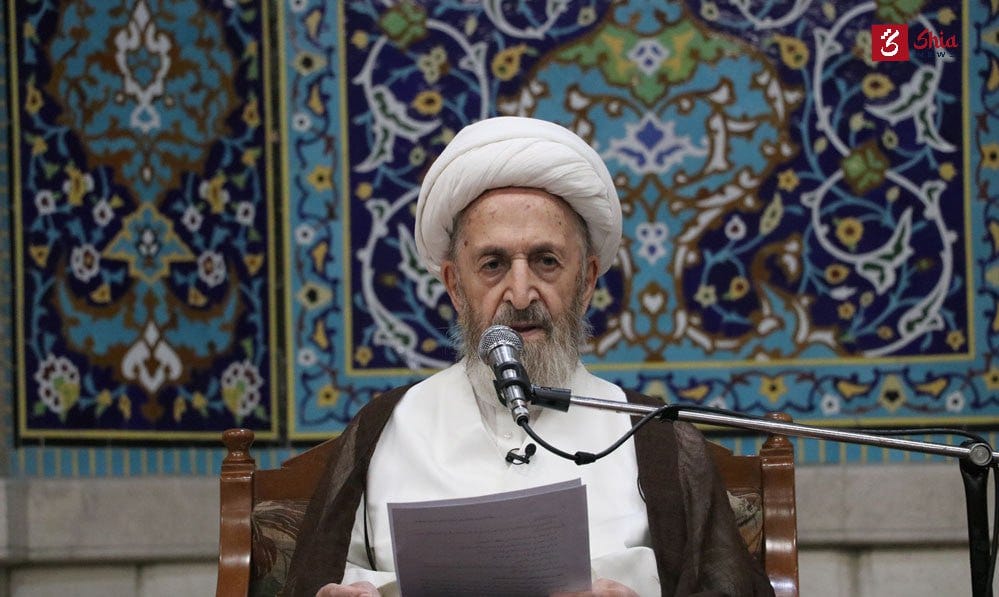
The 33rd International Exhibition of the Holy Quran recently opened its doors with a message that resonates far beyond the halls of the gallery. In a poignant address, Grand Ayatollah Jafar Subhani offered a roadmap for the future of Islamic education, emphasising a critical shift: the transition from traditional recitation to a dynamic, artistic, and modern engagement with the Divine Word.
The Youth as the “Main Asset”
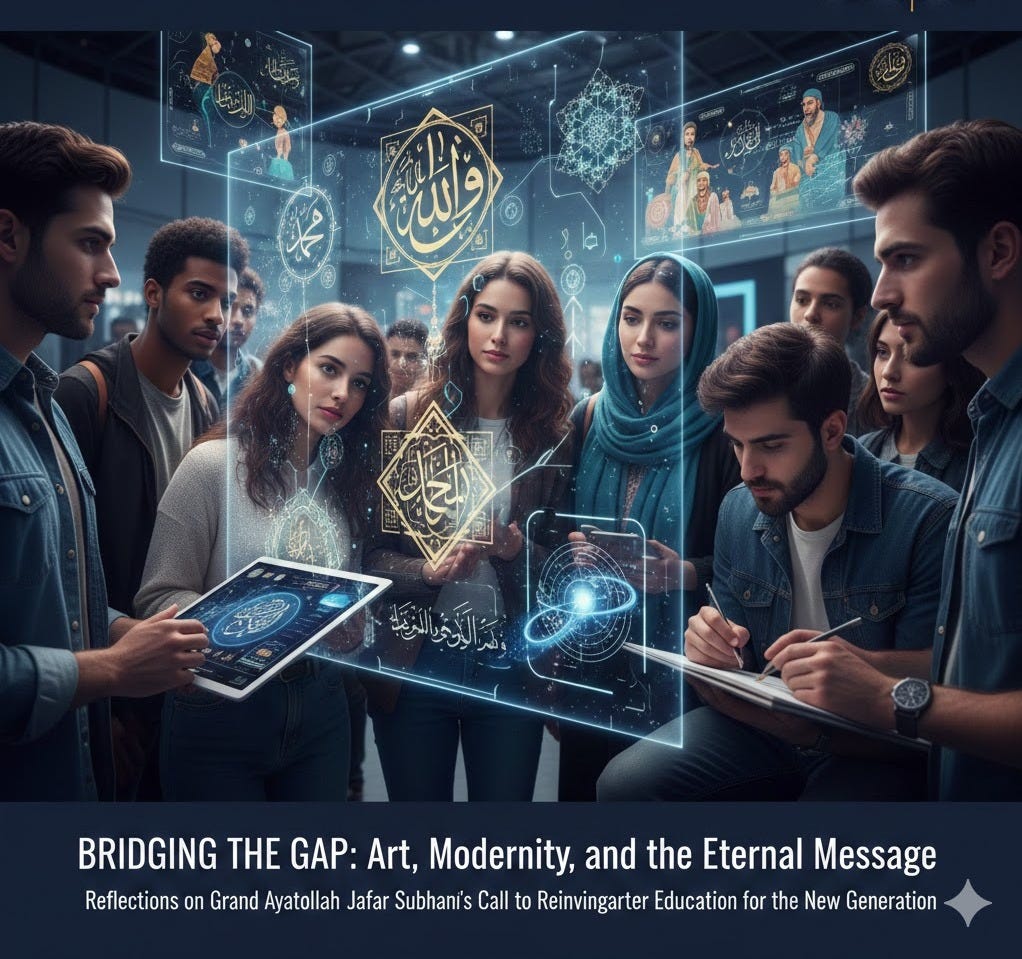
Ayatollah Subhani’s message was anchored in a profound appreciation for the younger generation. He identified them not merely as students, but as the primary asset of the Islamic Ummah. In an era defined by rapid technological shifts and an “information overload,” the Ayatollah acknowledged that the youth are grappling with unique intellectual and cultural questions.
The challenge, he suggests, is not with the Quran itself—which remains a “source of light”—but with the vessels through which its knowledge is delivered.
“If the truths of the Quran are presented in a modern language and using artistic forms, they can provide answers to many questions and concerns of the new generation.”
Art as a Universal Translator
One of the most striking elements of the Ayatollah’s message is the call for artistic forms. Historically, Islamic civilisation has always used calligraphy, architecture, and poetry to express the sublime. However, Ayatollah Subhani’s call suggests a modern expansion of this tradition. To reach a generation raised on visual media and digital storytelling, Quranic truths must be:
Visually Compelling: Using digital media, graphic arts, and immersive exhibitions to illustrate moral concepts.
Intellectually Accessible: Translating complex jurisprudential or philosophical concepts into a “modern language” that speaks to contemporary logic.
Contextually Relevant: Addressing the specific “intellectual and cultural needs” of today’s society rather than relying solely on historical commentary.
A Shield Against Cultural Attrition
The Ayatollah did not shy away from the external pressures facing the faith. He noted that in an age where media tools are often used to weaken religious foundations, the most effective “defence” is a proactive offence of beauty and wisdom. Rather than responding to hostility with more hostility, Ayatollah Subhani advocates for revealing the “merciful, wise, and constructive human face” of the Quran. The goal is to prove, through behaviour and morality, that the Quran is a blueprint for:
Human Dignity
Social Justice
Scientific and Personal Development
From Recitation to Realisation
Perhaps the most vital takeaway from the message is the reminder that the Holy Quran is not a static artefact. It is a “book of life.” Ayatollah Subhani calls for a move toward the Ahl al-Bayt (peace be upon them) as “living examples” of the Quranic way of life.
The success of the Islamic Ummah, he concludes, depends on moving the Quran from the shelf to the center of our public institutions—schools, universities, and families. By dressing eternal truths in the vibrant colours of art and modern discourse, we ensure that the “Spring of Hearts” continues to bloom in the hearts of our youth.