

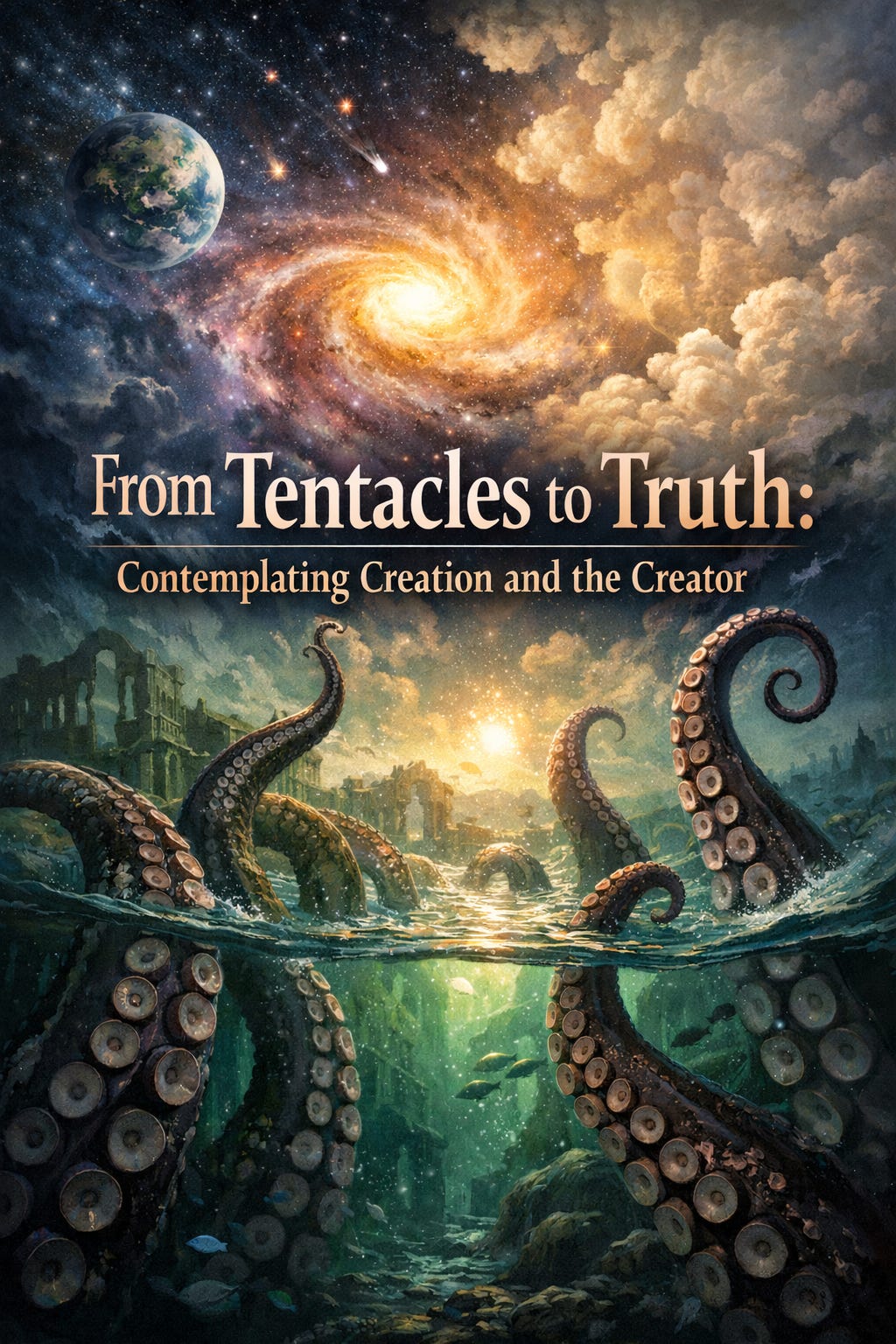
Human beings possess an innate disposition—known in Islam as fiṭrah—that inclines them toward recognising truth, purpose, and the existence of a Creator. This natural instinct is not meant to remain dormant; rather, it is awakened and strengthened through reflection. Islam encourages believers to contemplate the world around them, not as passive observers, but as thoughtful seekers of meaning. The natural world, in all its diversity and intricacy, serves as a mirror reflecting deeper realities. When one pauses to truly observe creation, the heart and mind are drawn toward a recognition of order, wisdom, and intentional design.
The natural world has long inspired awe in those who reflect deeply upon it. Among its most extraordinary creatures is the octopus—an animal whose remarkable abilities seem almost otherworldly. With its capacity to instantly change colour, texture, and even shape, the octopus stands as one of nature’s greatest masters of camouflage. For many, especially within an Islamic worldview, such complexity is not merely fascinating—it is meaningful. It becomes a sign pointing toward a divine and intelligent Creator.
In Islam, the universe is filled with āyāt—signs that indicate the presence, power, and wisdom of Allah. The Quran repeatedly calls on human beings to observe and reflect upon the natural world.
In Quran, Surah an-Nahl, Chapter 16, The Bee, Verse 13, it states:
“And He has subjected for you whatever is on the earth of varying colours. Indeed in that is a sign for a people who remember.”
This verse draws attention to the diversity and variation within creation. The octopus, with its unparalleled ability to manipulate colour and appearance, fits strikingly within this description. Its skin contains specialised cells that allow it to blend seamlessly into its surroundings in less than a second. It can mimic rocks, coral, or even other animals. Such diversity in function and form invites reflection: how does such a creature come to possess such precise and coordinated abilities?
Beyond appearance, the octopus also demonstrates a remarkable form of intelligence. Unlike most animals, its nervous system is distributed, with a significant portion located in its arms. Each limb can independently sense, explore, and even problem-solve. This decentralised intelligence challenges our conventional understanding of cognition and highlights a level of sophistication that seems far beyond basic survival mechanisms.
From an Islamic perspective, this complexity reflects the attribute of Allah as Al-Ḥakīm (The All-Wise). Nothing in creation is without purpose or proportion.
The Quran emphasises this balance in Surah al-Mulk, Chapter 67, The Kingdom, Verse 3:
“You do not see in the creation of the Most Merciful any inconsistency. So return your vision to the sky—do you see any breaks?”
Although this verse refers to the heavens, its message applies universally: creation is consistent, balanced, and free from flaw. The octopus exemplifies this harmony. Its camouflage is not only beautiful but functional; its intelligence is not random but purposeful. Every feature works in unison to ensure its survival in a complex marine environment.
Islam encourages tafakkur, or deep reflection, as a means of drawing closer to understanding the Creator. Observing a creature like the octopus can lead to profound questions. How can a soft-bodied organism coordinate thousands of skin cells with such speed and accuracy? Why does it possess abilities that resemble advanced technology, such as adaptive camouflage? These questions do not merely lead to scientific curiosity—they can also inspire spiritual contemplation.
Ultimately, the octopus serves as a powerful reminder that the wonders of creation extend far beyond what is immediately visible. Hidden beneath the ocean’s surface lies a creature that embodies complexity, beauty, and intelligence. For the believer, this is not a coincidence but a sign—an invitation to recognise the presence of a Creator whose knowledge and creativity encompass all things.
In reflecting on the octopus, one is reminded that every aspect of the natural world, no matter how distant or unfamiliar, can point toward deeper truths. It is through such reflection that the ordinary becomes extraordinary, and the study of life becomes a path to understanding the divine.