

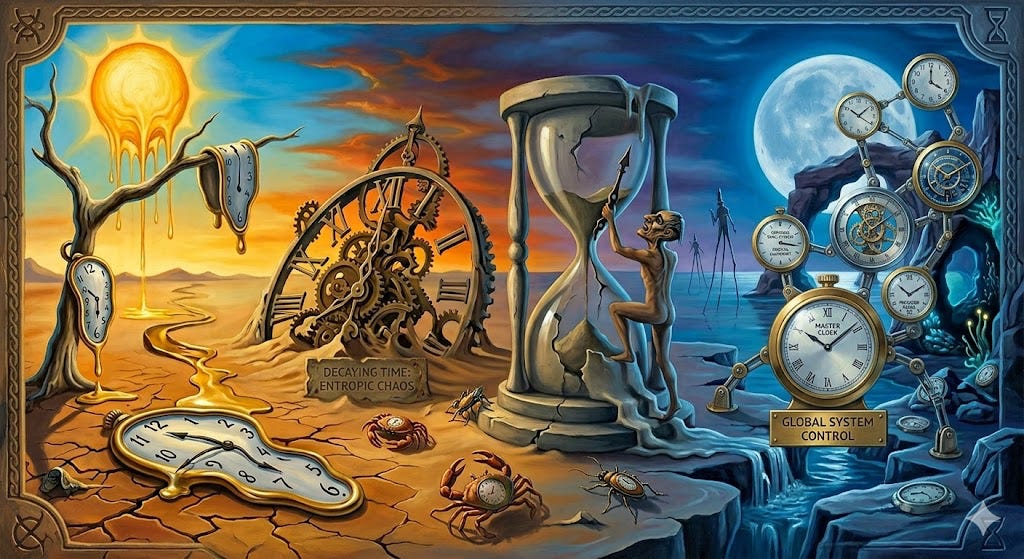
Every year, we have become accustomed to changing our clocks forward or backward, depending on whether it is spring or autumn—much to our inconvenience and frustration. Yet do we ever question why? Do we pause to consider why this is done and how it affects us?
Perhaps we take time for granted—overlooking its true value and importance. God doesn’t…
It is a remarkable reality that the Divine Creator—God, the Beneficent, the Most Merciful—addresses the Prophet and swears by ‘Time’.
This profound relationship with time is powerfully captured in the Quranic chapter, Surah al-Asr, Chapter 103:
In the name of Allah, the Most Compassionate, the Most Merciful,
“By time,
Indeed, mankind is in loss,
Except for those who have believed and done righteous deeds and advised each other to truth and advised each other to patience.”
This short yet deeply profound passage places time at the very centre of human accountability. It does not present time as something to be controlled or exploited, but as a witness—something that testifies to how life is spent.
The emphasis is on purpose, truth, and perseverance rather than productivity or efficiency. In this sense, time is not a commodity, but a trust.
Loss—literally speaking—means a decline in capital. It is therefore clear that a person’s true capital is their life, continuously diminishing from the moment they are born. This is a self-evident truth. Whatever portion of this capital is invested in provisions for the Hereafter becomes a form of wealth that is transferred beyond this world—where no loss exists.
Despite this, time as most people understand it today feels universal, fixed, and unquestionable. Clocks tick uniformly across cities, countries, and continents, structuring daily life with precision. Yet this system is not as natural or inevitable as it appears. The modern standardisation of time represents a profound shift away from humanity’s historical relationship with the cosmos—one that has enabled large-scale coordination, but also distanced people from natural rhythms.
Historically, time was local and deeply connected to the natural world. Each city followed its own solar time, determined by the position of the sun relative to its longitude. Noon was simply when the sun reached its highest point in the sky. This changed in the late 19th century with the introduction of standardised time zones based on Greenwich Mean Time (GMT). While often explained as a practical response to railway expansion, this shift also marked the beginning of a globally synchronised system—one that allowed human activity to be coordinated, measured, and regulated with unprecedented precision.
At the same time, the very meaning of time was simplified. Earlier civilisations tracked intricate celestial cycles using sophisticated methods, understanding time as something deeply intertwined with the movements of the sun, moon, and stars. Modern clocks, by contrast, reduce time to uniform units—detached from the sky and governed instead by administrative systems.
This detachment becomes especially evident in practices like Daylight Saving Time (DST), where clocks are artificially shifted forward and backward each year. Though often justified as a means of conserving energy, its benefits remain debated. What is clear, however, is its effect on human biology: it disrupts circadian rhythms and forces populations to adjust abruptly to imposed schedules. It is a striking example of how time can be altered not to reflect nature, but to serve economic and institutional priorities.
The structure of the modern calendar further highlights this disconnect. The Gregorian calendar, with its uneven months and irregular distribution of days, does not align neatly with natural cycles. In contrast, many historical systems were based on the moon, offering a more consistent and observable rhythm.
One such system still in use today is the Islamic lunar calendar. Unlike the Gregorian system, it is based entirely on the cycles of the moon, with each month beginning upon the sighting of the new crescent. This creates a calendar of twelve lunar months, each closely tied to visible, natural phenomena rather than abstract calculation.
The benefits of this system extend beyond its structure. Because the Islamic calendar is not fixed to the solar year, its months move through all seasons over time. This creates a dynamic relationship with the natural world, where time is experienced as a cycle rather than a fixed schedule. Observances such as fasting during Ramadan occur at different points in the year, requiring individuals to engage directly with changing daylight hours and environmental conditions. In this way, the calendar fosters a continuous awareness of natural rhythms rather than insulating people from them.
This connection to nature is further reinforced through daily acts of worship—particularly the five daily prayers in Islam—which are directly linked to the position of the sun. The dawn prayer (Fajr) begins at the first light before sunrise, marking the transition from night to day. The sunset prayer (Maghrib) occurs immediately after the sun dips below the horizon, signalling the close of daylight. Other prayers are similarly anchored to the sun’s movement across the sky.
These prayer times are not arbitrary; they are living markers of time rooted in the natural environment. Rather than relying solely on mechanical clocks, they require awareness of light, shadow, and the passage of the day. In this way, daily life becomes synchronised with the Earth’s rotation, reinforcing a rhythm that is both spiritual and biological. The day is punctuated not by abstract hours, but by observable changes in the world itself.
This stands in stark contrast to modern timekeeping systems, where schedules are often detached from natural cues. Artificial lighting, fixed working hours, and digital devices allow activity to continue regardless of the sun’s position, weakening the connection between human behaviour and the environment. The result is often a sense of disorientation and fatigue, as internal rhythms struggle to align with imposed structures.
When viewed in this broader context, the contrast becomes striking. Standardised time seeks uniformity, predictability, and control, whereas systems rooted in natural observation—such as the Islamic calendar and prayer times—embrace variation, awareness, and harmony with the world as it is.
This is not to suggest that modern timekeeping should be entirely abandoned. Global systems require a degree of standardisation to function effectively. However, the continued use of lunar calendars and sun-based daily practices offers an alternative perspective—one that reminds us that time can be experienced not only as something to be managed, but as something to be lived in harmony with.
Ultimately, the question is not simply how we measure time, but how that measurement shapes our relationship with existence itself. In a world increasingly governed by schedules and synchronisation, traditions that anchor time in the rising and setting of the sun serve as a powerful reminder: human life was once—and perhaps still can be—guided by the rhythms of the natural world.