

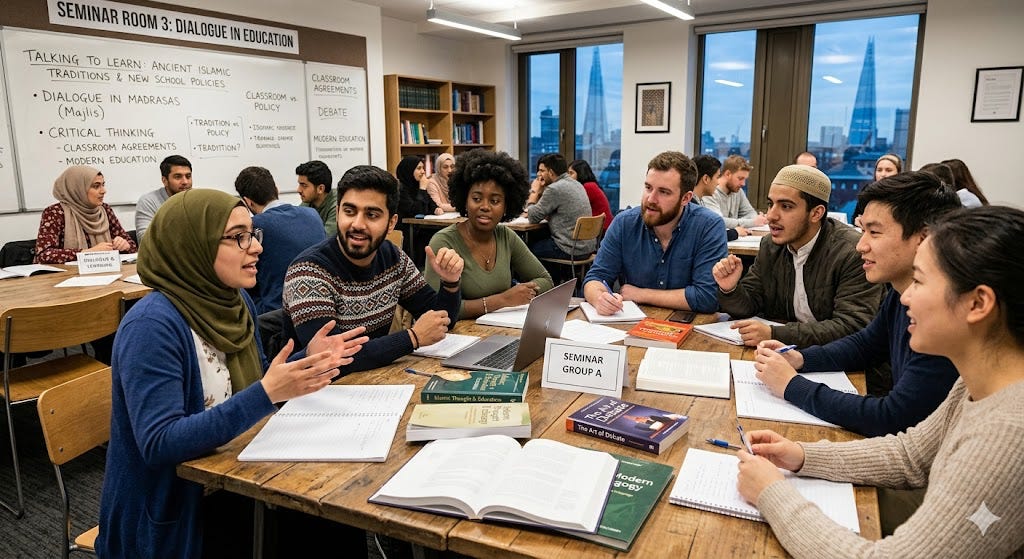
The concept of “oracy”—the ability to express oneself fluently and grammatically in speech—is currently at the heart of a major shift in British education. While the UK government is framing oracy as a modern tool for social mobility, the Islamic tradition, particularly within the Shia branch, has viewed the spoken word as the primary vehicle for human growth for over a thousand years.
The Sacred Art of the Spoken Word
In Islamic thought, knowledge is not something simply “stored” in a book; it is a living thing that must be passed from person to person. This tradition, known as Talaqqi, emphasises that true learning happens when a student sits with a teacher to hear, recite, and discuss ideas face-to-face. It is an “apprenticeship of the soul” where the student learns not just the facts, but the manners, tone, and character of the person speaking.
For Muslims, the act of listening is just as important as speaking. This is often called Husn al-Istima, or the “Art of Beautiful Listening.” It teaches that to truly learn, one must listen with one's whole body and heart, without interrupting, to fully absorb the speaker’s intent. This creates a classroom environment of deep respect where speech is seen as a responsibility rather than just a right.
The Shia Contribution: Dialogue and Eloquence
The Shia tradition adds a specific layer of intellectual rigour to this. It is heavily influenced by the “Peak of Eloquence” (Nahj al-Balagha), a collection of sermons and letters attributed to Imam Ali. This heritage teaches that speech is a mirror of a person’s inner intellect. If a person’s speech is clear, honest, and purposeful, it reflects a disciplined mind.
In a Shia learning environment, the “Halaqa” or learning circle is the standard. Unlike a traditional lecture where a teacher speaks at students, the circle encourages “Talk for Learning.” Students are prompted to ask “questions of understanding” rather than “questions of confusion.” This dialogue is seen as a way to “polish” the truth—by debating and discussing an idea from different angles, the students reach a deeper, more certain level of knowledge.
The UK Government’s “Fourth R”
These ancient practices find a surprising parallel in the UK’s current educational reforms. Between 2024 and 2026, the British government is moving to treat oracy as the “Fourth R,” elevating it to the same level of importance as Reading, Writing, and Arithmetic. The Department for Education is currently reviewing the National Curriculum to ensure that “speaking and listening” are woven into every subject, from Science to History.
The government’s policy focuses on two main areas: “Learning to Talk” (the physical skills of projection and vocabulary) and “Learning Through Talk” (using discussion to solve problems). The goal is to close the “attainment gap,” ensuring that children from all backgrounds have the confidence to articulate their ideas in a professional or civic setting.
Where Tradition Meets Policy
When we look at these two worlds together, we see a shared belief: that talking is thinking out loud. While the UK government views oracy as a path to a better career and a stronger democracy, the Islamic and Shia traditions view it as a path to a better character and a deeper connection to truth.
Both agree that a quiet classroom is not necessarily a learning classroom. Instead, a productive classroom is one filled with “structured talk,” where students are challenged to explain their reasoning, listen to their peers, and refine their thoughts through the power of the spoken word.