

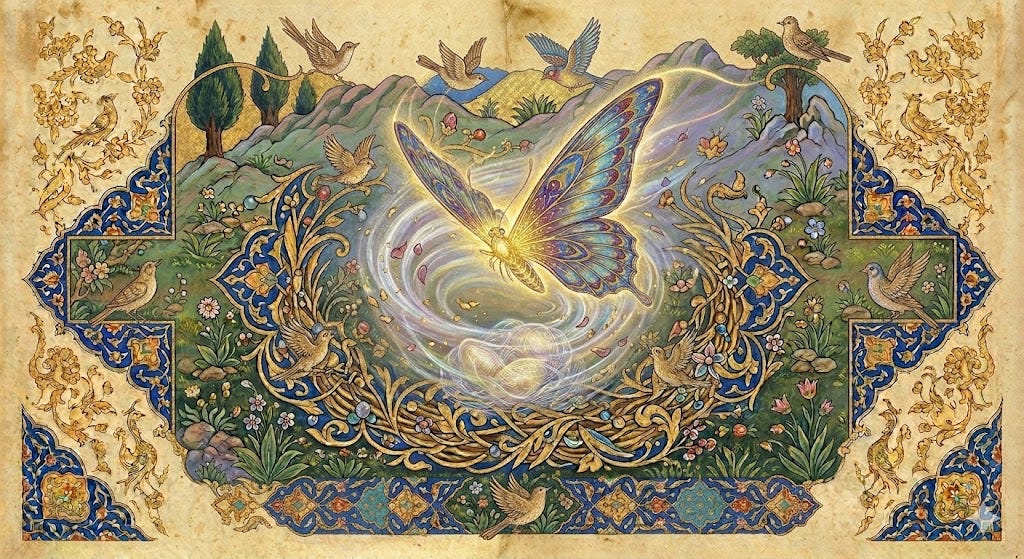
In God’s infinite mercy, remarkable lessons are given to us through the observation of the creatures, some of which are mentioned in the Quran and previous scriptures. The journey of the soul is often described through rich, organic metaphors drawn from nature. Among the most evocative is the transformation of the caterpillar into a butterfly—a process that mirrors the seeker’s path from ego-bound existence to spiritual awakening. The cocoon, in particular, serves as a powerful symbol of inner work, detachment, and rebirth, encapsulating the teachings often summarised as “die before you die.”
Contrary to appearances, the cocoon is not a place of death, but of profound transformation. In Sufi symbolism, it represents a sacred, womb-like enclosure where the false self—the nafs, or ego—is gradually dissolved. This stage is not passive; it is a process of intense inner labour.
Just as the caterpillar undergoes a radical breakdown within the cocoon, dissolving into an unrecognisable state before re-forming, the spiritual seeker must also endure a phase of dismantling. Old identities, attachments, and illusions are stripped away, often accompanied by emotional or existential struggle. This is a liminal state—an “in-between” condition where one is no longer who they were, but not yet who they will become. It demands deep trust in a process that cannot be controlled or rushed.
This inner transformation finds resonance in the Quran, which emphasises that true change begins within:
“Indeed, Allah will not change the condition of a people until they change what is in themselves.”
— (Quran, Surah ar-Ra’d, Chapter 13, The Thunder, Verse 11)
This verse reflects the essence of the cocoon stage: transformation is not imposed from outside, but unfolds through deep internal change.
A second verse deepens this idea by pointing to the necessity of purification:
“He has succeeded who purifies it, and he has failed who corrupts it.”
— (Quran, Surah ash-Shams, Chapter 91, The Sun, Verses 9–10)
Here, the Quran underscores that the work of refining the soul is not merely symbolic—it is the very criterion of spiritual success. The cocoon, then, becomes the space in which this purification takes place.
Finally, the journey culminates in a verse that speaks to the soul’s return to its Divine source:
“O tranquil soul, return to your Lord, well-pleased and pleasing. Enter among My servants, and enter My Paradise.”
— (Quran, Surah al-Fajr, Chapter 89, The Dawn, Verses 27–30)
This passage captures the moment of emergence—the “butterfly” stage—where the soul, now at peace and freed from the turbulence of the ego, returns to God in a state of harmony and fulfilment.
The poetry of Jalal al-Din Rumi vividly illustrates this metamorphosis. He frequently invokes the image of the silkworm and cocoon to describe the soul’s journey toward divine realisation. For Rumi, true existence begins not in outward activity, but in inward surrender.
He writes of the silkworm that “truly exists” only when it disappears into its cocoon, suggesting that real being emerges through the abandonment of superficial identity. The pain and confinement of this stage are not obstacles, but necessities. Without them, there can be no wings.
Rumi’s paradoxical expressions—such as “without legs, we fly”—point to a deeper truth: spiritual ascent requires the loss of what once seemed essential. The caterpillar must “die” to its crawling existence in order to be reborn as a creature of flight. In this sense, suffering becomes transformative, not punitive—a refining fire that prepares the soul for expansion.
While Rumi expresses these ideas through poetic imagery, Ibn Arabi approaches them with philosophical depth. His teachings center on the unity of existence (Wahdat al-Wujud) and the unfolding realisation of the divine within the human being.
For Ibn ‘Arabi, the cocoon-like phase corresponds to a withdrawal from the multiplicity of the external world into a state of inward contemplation. This retreat, often described as khalwah (spiritual seclusion), allows the seeker to transcend the limited “I” and encounter a more essential reality.
He describes a state known as the “station of no station,” where fixed identity dissolves entirely. In breaking free from the confines of ego, the soul becomes like a polished mirror—no longer reflecting only its own limited perspective, but the infinite attributes of the Divine. Transformation, then, is not merely personal growth; it is an unveiling (kashf) of what has always been present but hidden.
The metaphor of metamorphosis is explained in some Islamic schools of thought as existing in three stages:
The Caterpillar represents the ego-bound self, tied to material concerns and limited perception.
The Cocoon signifies the period of retreat, struggle, and inner purification—the “dark night” where transformation occurs unseen.
The Butterfly symbolises the awakened soul, often associated with the Insan al-Kamil (the perfected human), who reflects divine qualities and lives in harmony with ultimate reality.
While Rumi emphasises longing, love, and surrender as the driving forces of this journey, Ibn ‘Arabi highlights knowledge, unveiling, and ontological unity. Yet both converge on a central truth: transformation requires dissolution.
In both poetic and philosophical muslim traditions, the cocoon is not optional—it is essential. It is the crucible in which the old self is relinquished and the new self is born. Without entering this space of stillness, uncertainty, and surrender, the soul cannot unfold its latent potential.
Taken together, the Quranic verses outline the full arc of this transformation: change begins within, is realised through purification, and culminates in a peaceful return to the Divine. What feels like loss or confinement may, in fact, be the very condition required for liberation. The cocoon reminds us that before we can take flight, we must first be willing to disappear.