

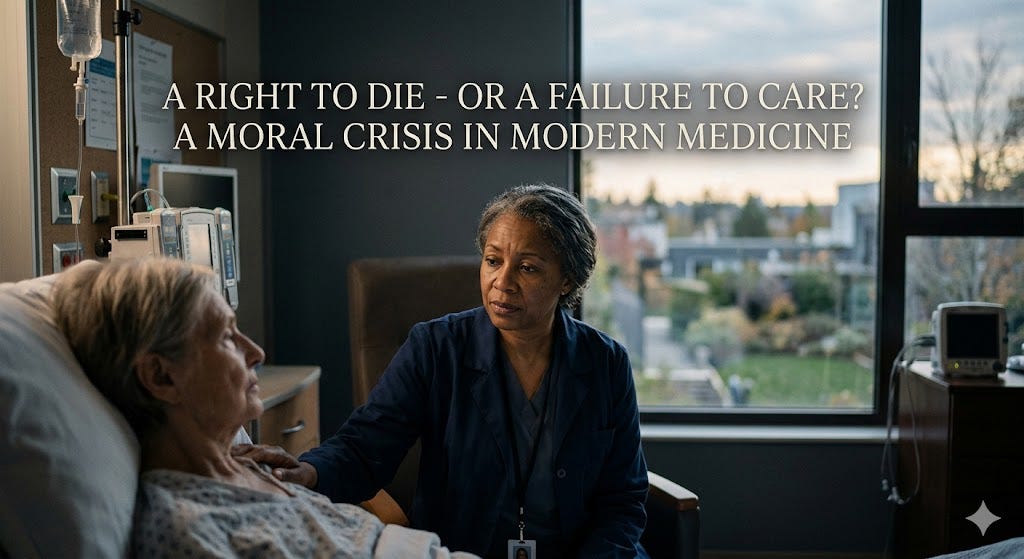
Despite family concerns and repeated appeals, the assisted suicide and euthanasia law in Spain has raised serious ethical questions—particularly in cases involving individuals with complex mental health conditions alongside physical suffering. These concerns are being raised across Europe and England, where assisted suicide has been introduced.
More broadly, a society that becomes detached from faith and belief in God risks losing a sense of compassion and responsibility toward its most vulnerable members.
In a recent and widely reported case, a young Spanish woman, Noelia Castillo, was administered euthanasia on 26 March at Sant Camil Hospital. She had been diagnosed from a young age with obsessive-compulsive disorder and borderline personality disorder. In 2022, she survived a suicide attempt that left her paraplegic and living with chronic, irreversible pain.
Her case became the subject of an 18-month legal battle, as her father sought to prevent the procedure. He argued that her mental health condition impaired her capacity to make such a decision and emphasised the state’s duty to protect vulnerable individuals, particularly those experiencing severe psychological distress. However, Spain’s courts ultimately upheld her request, and the European Court of Human Rights declined to intervene.
Under Spanish law, euthanasia is permitted for individuals who are deemed mentally competent and who suffer from a serious and incurable condition or chronic illness causing enduring and intolerable suffering. In this case, the request was approved on the basis of her physical condition and ongoing pain, although the presence of mental health difficulties has contributed to wider public debate. Some campaigners have called for broader eligibility criteria, including in cases involving mental suffering, but this remains highly controversial.
A deeper concern arises when the role of the state shifts from protecting life to facilitating its end. The fundamental duty of any just society is to safeguard human dignity, especially for those who are most vulnerable, dependent, or in distress. When legal frameworks make it possible for individuals in states of suffering—whether physical, psychological, or both—to choose death, it raises difficult questions about whether sufficient support, care, and alternatives are truly being offered. Rather than addressing suffering through compassion, investment in care, and long-term support, such policies risk normalising the idea that some lives are no longer worth living.
This concern also extends to the medical profession. For centuries, physicians were guided by the principles of the Hippocratic Oath, traditionally understood to prohibit the taking of life and to affirm the duty to heal and preserve wherever possible. While modern interpretations of medical ethics have evolved, the foundational commitment to “do no harm” remains central. The involvement of healthcare professionals in ending life—however regulated—marks a profound shift from this long-standing ethical framework and raises important moral and philosophical questions about the true role of medicine.
“For indeed, with hardship comes ease”
Surah Ash-Sharh, Chapter 94, The Expansion, Verse 5).
In Islam, life is a sacred trust from Allah (SWT), not a possession to be disposed of at will. While life can bring profound hardship and pain, faith teaches that hope in Allah must always overcome the pull toward despair. The Qur’an explicitly forbids taking one’s own life while emphasising divine mercy:
“And do not kill yourselves [or one another]. Indeed, Allah is to you ever Merciful” (Surah an-Nisa, Chapter 4, The Women, Verse 29).
This prohibition is not merely restrictive; it is a protection of the sanctity and value of human life.
Patience in Islam is not passive resignation; rather, it is an active resistance against despair, rooted in trust in Allah’s wisdom and plan. Trials and hardships can serve as a means of purification and a path to greater spiritual closeness when met with perseverance. The Holy Prophet (PBUH) and the Imams (AS) endured immense emotional and physical suffering, yet they consistently turned to Allah and never lost hope.
At the same time, faith does not negate the need for medical care. Islam strongly encourages seeking treatment for both physical and mental illnesses. The Prophet (PBUH) said:
“Seek treatment, for Allah has created a cure for every disease.”
Reaching out to family, friends, or trusted counsellors is essential, and communities bear a responsibility to respond with compassion, understanding, and support.
While intentional suicide is considered a grave sin, Islamic scholars recognise that individuals who lack full control over their actions due to severe mental illness or temporary incapacity may not be held accountable by Allah.
Bibliography: Fernando Valero Lopez / Wirestock