

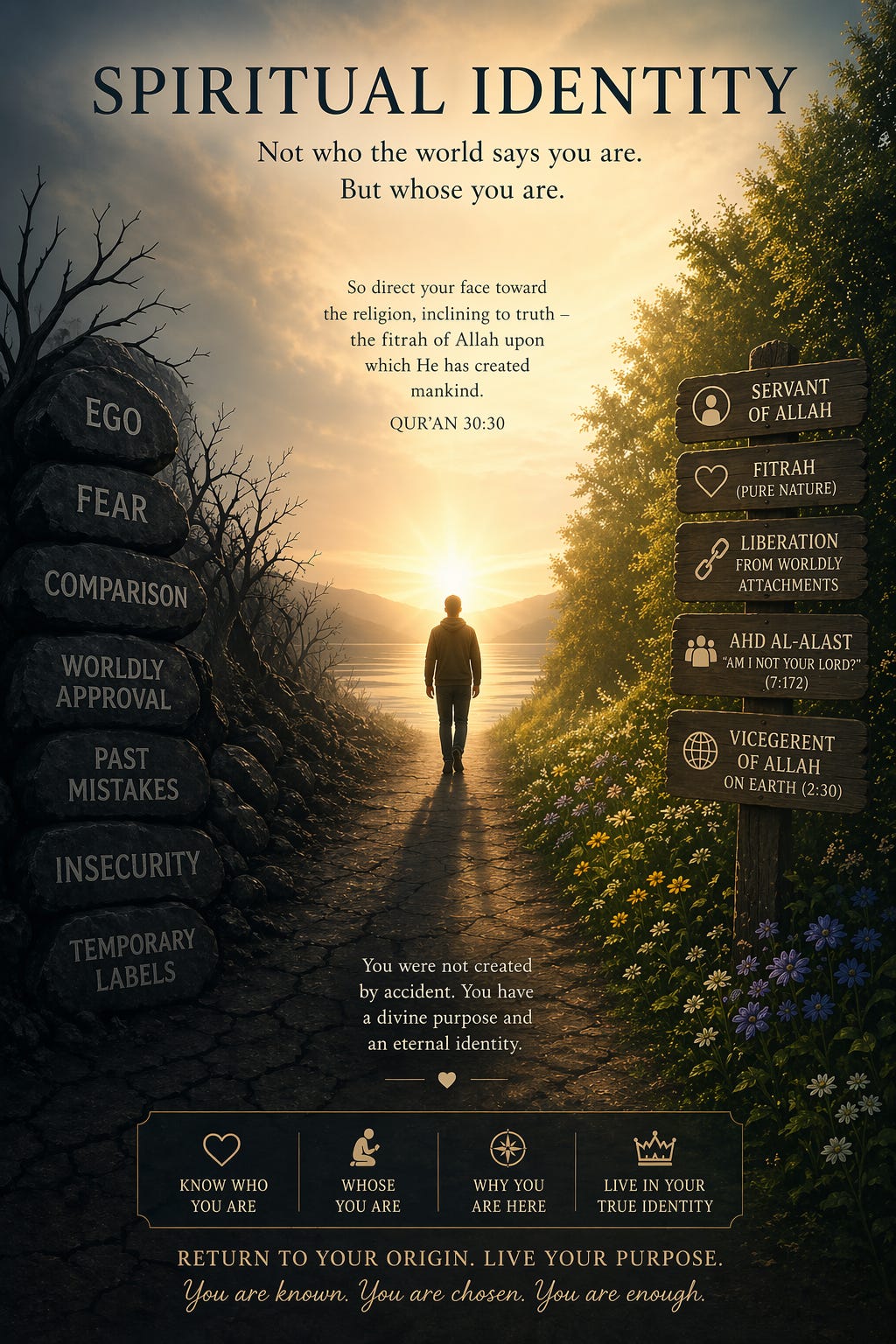
There is much discussion about identity these days. Many people define themselves in terms of mental health, others in terms of gender, and still others in terms of sexuality. Yet not many seem to affirm their identity in relation to the one true God; not many choose to align themselves with their origin and Creator. Sadly, it is all too easy to become egotistical in this matter, viewing ourselves as the be-all and end-all of our existence. But did we place ourselves on this earth? Do we even control the movement of the earth or the forces of nature that sustain it?
Some have awakened and realised that there is a higher power that underlies our very existence. There is a purpose and a lofty aim to aspire to beyond the so-called “self” of this world. These individuals have embraced a different identity—one not rooted in the shifting labels of the world or the ego in its many forms.
For Christians, identity is found “in Christ,” and their citizenship is in heaven. This is a God-given identity as a beloved child of God, not based on performance but on grace. As a new creation (2 Cor. 5:17), one is chosen, redeemed, forgiven, and seated in the heavenly realms. This understanding shifts identity from temporary, worldly standards to an eternal and unshakable foundation as God’s masterpiece.
The core aspects of identity in Christ include being a child of God—loved unconditionally and adopted into His family (John 1:12). Another aspect is becoming a new creation: the past is gone, and one is made new in Christ (2 Cor. 5:17). Believers are described as chosen, holy, and dearly loved (Colossians 3:12), redeemed and forgiven of their sins, and justified (Ephesians 1:7; Romans 5:1). They are also God’s workmanship, created for good works (Ephesians 2:10).
In Islam, a similar concept to “identity in Christ” can be found in the idea of fitrah (the primordial nature) and the status of being an ‘abd Allah (servant of God). While Christianity emphasises a familial “Father–child” relationship, Islam highlights a “Creator–servant” relationship, which is regarded as the highest honour for a human being.
Fitrah refers to the pure, innate nature with which every person is born. It is the original state of purity and recognition of God’s oneness (tawhid), existing prior to external worldly influences. The Qur’an points to this innate disposition:
“So direct your face toward the religion, inclining to truth—the fitrah of Allah upon which He has created mankind. No change should there be in the creation of Allah”
(Quran, Surah ar-Rum, Chapter 30, The Romans, Verse 30).
Unlike the concept of original sin, Islam teaches that each person is born with a “clean slate” and a natural inclination toward goodness and justice.
In addition, identifying as a servant of God is not seen as degrading but as a form of ultimate liberation. It signifies belonging solely to the Most High, freeing a person from enslavement to worldly desires, social pressures, or the ego. As the Quran states:
“I did not create jinn and mankind except to worship Me”
(Quran, Surah Adh-Dhariyat, Chapter 51, The Scatterers, Verse 56).
Here, worship is understood not merely as ritual, but as a comprehensive way of life oriented toward God.
This identity is also rooted in a pre-earthly event (Ahd al-Alast), in which God gathered all human souls and asked:
“Am I not your Lord? They said, Yes, we testify”
(Quran, Surah al-A’raf, Chapter 7, The Elevated Places, Verse 172).
Life, then, becomes a journey of living out that testimony and remembering this original covenant.
Furthermore, human beings are described as God’s representatives on earth, entrusted with responsibility:
“Indeed, I will place upon the earth a خليفة (successor/vicegerent)”
(Quran, Surah al-Baqarah, Chapter 2, The Cow, Verse 30).
This role carries the duty to act with justice, stewardship, and care for creation. The Quran also emphasises human dignity:
“We have certainly honoured the children of Adam”
(Quran, Surah al-Isra, Chapter 17, The Children of Israel, Verse 70).
In both faiths, true identity is found by looking away from the self and toward the Divine. In Islam, “finding oneself” means returning to the fitrah—reconnecting with the pure nature God has already given at birth. As the Quran reminds:
“And whoever turns away from My remembrance—indeed, he will have a constrained life”
(Quran, Surah Ta-Ha, Chapter 20, Verse 124)
pointing to the idea that a life disconnected from the Divine leads to inner unrest, while true alignment brings clarity and purpose.