

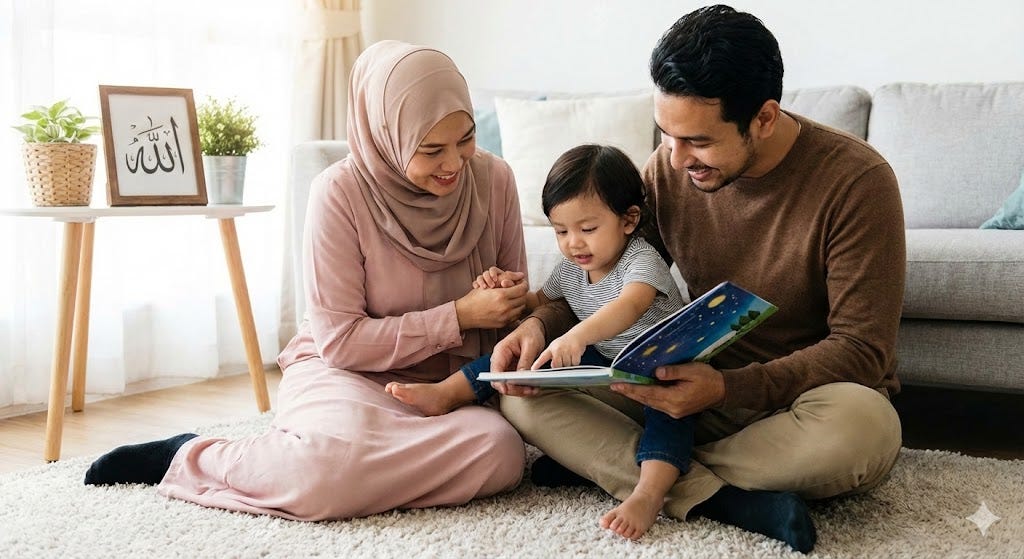
In the chaotic rush of modern parenting, it is easy to focus on the forms of religion—the rules, the rituals, and the memorisation—while neglecting the essence of faith. However, the heart of a child is like a blank canvas, receptive and pure. As Amir al-Mu’minin, Imam Ali ibn Abi Talib (AS), advised in his famous letter to Imam al-Hasan (AS):
“The heart of a youth is like uncultivated land; it accepts whatever you plant in it.” (Nahj al-Balaghah, Letter 31)
To raise children who do not just “practice” Islam but truly love Allah, we must plant seeds of mercy before seeds of fear. Here is a guide to cultivating that loving connection.
Begin with the Right Concept: The God of Mercy
Children interpret the world through emotion. If their first introduction to Allah is one of fire, punishment, and strict surveillance, their relationship with the Divine will be rooted in anxiety. Instead, they must know Allah first and foremost through His primary attributes: Al-Rahman (The All-Beneficent) and Al-Rahim (The All-Merciful).
Do not encourage children to imagine a physical picture of Allah, for
“There is nothing like unto Him”
(Quran, Surah Ash-Shura, The Council, Chapter 42, Verse 11).
Instead, help them build a heart-image based on His care:
“Allah loves you more than I do.”
“Allah is the One who makes sure you are safe while you sleep.”
“Allah wants the very best for you.”
This approach aligns with the supplications of the Ahlul Bayt. In Dua Abu Hamza al-Thumali, Imam Zayn al-Abidin (AS) teaches us to address Allah by saying: “I have known You by You, and You directed me to Yourself.” We want our children to “know” Allah through His kindness, laying a foundation of trust that will survive the challenges of adulthood.
Daily Conversations: Awakening the Sense of Awe
Make the remembrance of Allah a natural part of daily life, not just a classroom subject. This method of Tafakkur (reflection) is highly praised in the Quran.
Ask open, gentle questions that let the child lead:
“What made you smile today?”
“Who do you think gave us this delicious fruit?”
Guide them to see Allah’s hand in their own bodies. When a child marvels at their hands or eyes, remind them of the verse:
“It is He Who has created for you (the faculties of) hearing, seeing, feeling and understanding: little thanks it is ye give!”
(Quran, Surah Al-Mu’minun, The Believers, Chapter 23, Verse 78)
Point out the specific gifts mentioned by Imam Sajjad (AS) in Risalat al-Huquq (The Treatise of Rights), such as the eyes that see beauty and the hands that help. Say to them: “Did you notice how your eyes blink by themselves to keep them clean? That is Allah taking care of you without you even asking.”
Gratitude (Shukr) Before Rules
Before burdening a young child with the complex laws of halal (permissible) and haram (forbidden), teach them the language of Shukr (gratitude). The Quran promises:
“If you are grateful, I will surely increase you [in favor].”
(Quran, Surah Ibrahim, Chapter 14, Verse 7)
Establish simple habits:
Before eating: “Let’s thank Allah for this food.”
Before sleeping: “What are three things Allah gave you today that made you happy?”
Allow them to speak freely to Allah. The Ahlul Bayt (AS) taught that the intention of the heart is weightier than the eloquence of the tongue. By prioritising gratitude, the child learns that obeying Allah is a way of saying “thank you,” rather than just avoiding punishment.
Link Love Naturally to Salah
If Salah (prayer) is presented as a chore or a debt, the child will perform it with a heavy heart. We must reframe Salah as a meeting with the Beloved.
The Holy Prophet (PBUH) famously said:
“The coolness of my eyes was placed in Salah.”
We want our children to feel that same “coolness” and peace. Explain it simply:
“Salah is how we talk to Allah because we missed Him.”
“Allah loves it when we stand in front of Him.”
For young children, let them mimic your movements without correcting their posture or recitation. Avoid saying, “If you don’t pray, Allah will burn you.” Instead, adopt the positive reinforcement found in the traditions of the Imams:
“Allah loves that you tried to pray with me.”
“Every Sajdah (prostration) brings you closer to Allah’s hug.”
Arabic: A Gift, Not a Barrier
While Arabic is the language of the Quran, do not let the difficulty of the language become a barrier between the child and their Creator.
Frame Arabic as a special code or a key to treasures. When they say Allahu Akbar, explain the meaning: “Allah is greater than anything we can imagine.” When they say Alhamdulillah, tell them it means “Everything good belongs to Allah.”
The goal is to foster curiosity. As Imam Jafar al-Sadiq (AS) has advised regarding the stages of childhood, the first seven years are for play and freedom (al-Kafi). Academic pressure during this stage can backfire; let the learning be light and celebratory.
Modeling: The Silent Preaching
Children are keen observers. They will learn about Allah not by what you tell them, but by how you relate to Him. Imam Jafar al-Sadiq (AS) gave a powerful command to all parents and believers:
“Call people to us with other than your tongues (i.e., with your actions), so that they see piety, diligence, and prayerfulness in you.” (Al-Kafi)
Ask yourself:
Do my children see me turn to Allah in gratitude when I am happy?
Do they see me seek patience from Allah when I am stressed?
Do I speak of Allah with a smile, or only when I am angry at their behavior?
Even your mistakes are teaching moments. If you lose your temper, apologize and say, “I was upset, and I forgot to ask Allah for patience. I will try better next time.” This teaches the child that faith is a journey of returning to Allah, not a state of perfection.
The Long-Term Goal: The Worship of the Free
Our ultimate goal is to raise children who do not worship out of fear (which Imam Ali describes as the worship of slaves) nor out of greed for rewards (the worship of traders), but out of gratitude and love. This is the Worship of the Free (‘ibadat al-ahrar).
By focusing on connection, mercy, and gratitude in these early years, we ensure that when our children grow up and the supervision of parents fades, they remain connected to the One who never sleeps, the One who is closer to them than their own jugular vein.