

There are days in the calendar of faith when a single grief would be enough to fill the heart. The 28th of Safar gives us two.
On this day, believers around the world — and the Shia of the Ahl al-Bayt (AS) in particular — offer their condolences to the Imam of our Time, Imam al-Mahdi (AJ), as they commemorate the passing of the Messenger of Allah (S) and the martyrdom of his beloved grandson, the second Imam, Hasan al-Mujtaba (AS). This year, as the 28th of Safar 1448 AH arrives in mid-August 2026, it is worth pausing not only to grieve — but to reflect. Because the story of these two great figures is not merely a story of sorrow. It is a story of revolution, patience, betrayal and hope.
Two Lights, One Mission
Grandfather and grandson, the Prophet (S) and Imam Hasan (AS) are bound together not only by blood but by a single sacred mission: to build, protect and preserve the message of Islam. The Prophet (S) laid its foundations; Imam Hasan (AS) gave his life to guard its soul in one of the darkest hours of its history.
That guardianship cost the Imam everything. In the year 50 AH, at the age of 47, Imam Hasan al-Mujtaba (AS) was martyred in Madinah — poisoned by a member of his own household at the instigation of Mu’awiyah. He had faced armies, betrayal and open war; yet the blow that finally took him did not come from the battlefield. It came from within, from a hand that ate at his table and lived under his roof.
This is covert oppression — the most insidious form of injustice, because it wears the mask of intimacy and trust. It is the betrayal of the companion, the treason of the supposed friend, the dagger that arrives smiling. The martyrdom of Imam Hasan (AS), joined on this day with the commemoration of his grandfather’s passing, teaches every generation that the most dangerous enemy is not always at the gate; sometimes, he is inside it.
The Greatest Revolution in History
To measure what Imam Hasan (AS) was protecting, we must first remember what the Prophet (S) built. He inherited a backward, fragmented society, buried in idolatry and the oppression of the weak — and within a single human lifetime, he raised a unified community founded on tawhid (monotheism), justice, equality and moral excellence.
This was not merely political change. It was a revolution of the spirit, of the intellect and of the social order. Old hierarchies were shattered; the buried daughter became the honoured daughter; the oath became more sacred than blood loyalty. The Prophet (S) laid the foundation of a new civilisation — and proved that a society can be transformed not only by the sword, but by the Word.
The Drift: When a Revolution Loses Its Soul
But after the Prophet (S) was taken from this world, something began to shift. Political ambitions, old grudges and newly awakened appetites for power gradually pulled the community away from the essence of his revolution. The ideals of the Prophet (S) were threatened with distortion, and authority drifted away from the guidance he had left behind.
The revolution that had broken idols began, in places, to bow to power. And it was into this drifting, weary society that Imam Hasan (AS) was called to lead.
Imam Hasan (AS): The Strategist of a Stagnant Age
The era of Imam Hasan (AS) was an era of stagnation. The energy of the first generation was waning; betrayal was widespread — even within his own army; political chaos was normalised; and true Islam itself stood in danger of being swallowed by a regime that had learned to speak the language of religion while acting with the logic of empire.
His task, therefore, was not to repeat his grandfather’s revolution — but to prepare the ground for a new one.
His peace treaty with Mu’awiyah, which to a superficial eye looked like retreat, was in reality a strategic masterstroke. It prevented immediate bloodshed, preserved the lives of the believers, and — most decisively — exposed the true nature of the regime that had seized power. Once Mu’awiyah himself tore the treaty apart, no veil remained over the truth.
The Teacher of Karbala
Nor did Imam Hasan (AS) stop at the treaty. Through quiet, systematic work — nurturing sincere believers, building networks of loyal followers, keeping the flame of truth alive in an age of propaganda — he prepared the moral and spiritual ground for the uprising that would come under the leadership of his brother, Imam Husayn (AS).
This is why the scholars who said that Imam Husayn (AS) and the companions of Karbala were, in a real sense, the students of Imam Hasan (AS) were correct. Ashura was not a spontaneous explosion of grief; it was the harvest of years of quiet cultivation by the second Imam. The teacher was martyred before he saw the lesson completed — but the lesson was completed, and it has been teaching humanity ever since.
Graves Without Domes: The Silent Occupation
And here we arrive at the bitterest similarity of all — one that every pilgrim to Madinah can see with their own eyes.
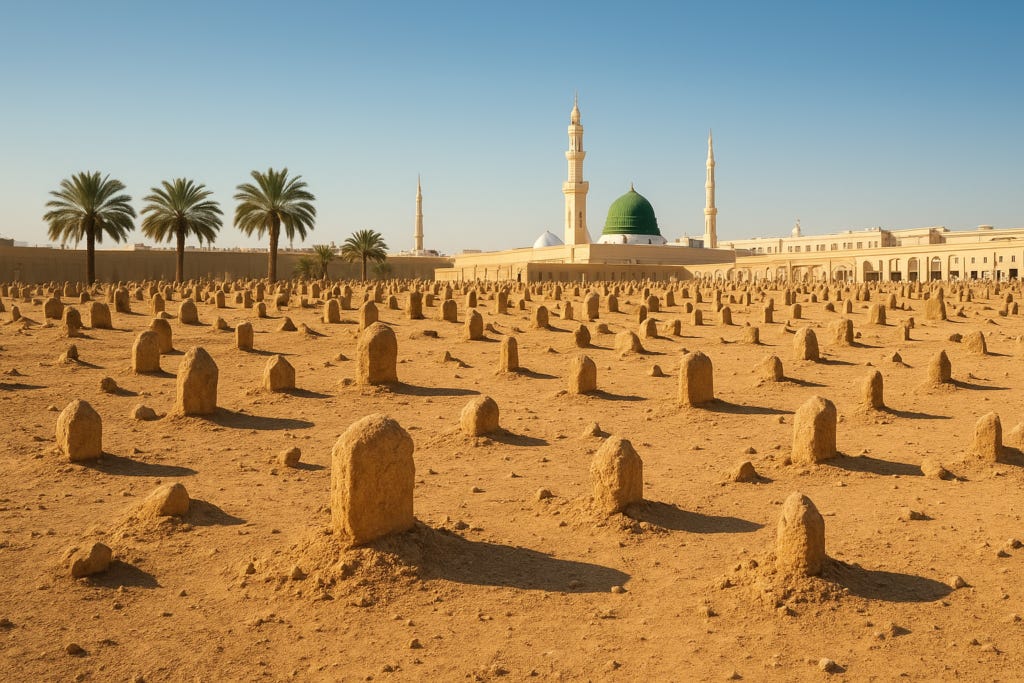
In Karbala, the shrine of the student — Imam Husayn (AS) — is adorned with a shining golden dome that draws millions of lovers each year. But in Madinah, the teacher rests in the flattened earth of Jannat al-Baqi, together with Imams Sajjad, al-Baqir and al-Sadiq (AS), whose domed shrines were demolished on 8 Shawwal 1344 AH (21 April 1925), leaving the graves bare and largely unmarked to this day. And the Prophet (S) himself rests in the humble chamber beside his mosque — a resting place denied the open, magnificent commemoration that the love of believers longs to build.
This, too, is a likeness between the two lights of the 28th of Safar: their holy graves remain under what can only be described as a silent occupation — the neglect of a society that has strayed from the revolutionary foundations of Islam. The flattened graves of Baqi, lying just steps from the Green Dome, are not merely an absence of stone; they are a witness to what happens when a community forgets its own roots.
Hope Has Not Left the Heart
Yet mourning is never the believer’s final word.
The same faith that carried the message of the Prophet (S) through fourteen centuries of trial also carries the hope — anchored in the promise of Imam al-Mahdi (AJ), who will fill the earth with justice as it was filled with oppression — that the day is not far when golden domes, worthy of their true greatness, will shine over the tombs of the Messenger (S) and his grandson (AS). And until that day, every believer carries a shrine in his own heart — and in that shrine, the revolution of the Prophet (S) and the patience of Imam Hasan (AS) remain alive.
What the 28th of Safar Teaches Us
Beware the covert enemy. Not every foe stands at the gate; some sit at the table. The martyrdom of Imam Hasan (AS) reminds every generation that vigilance within the inner circle is as vital as courage on the battlefield.
Revolutions need both uprising and cultivation. The sword of Karbala was sharpened by the patience of Madinah. Open resistance and quiet nurturing are two halves of one struggle.
Patience is also strategy. The treaty of Imam Hasan (AS) was not surrender; it was warfare by other means, timed for another battlefield.
Hope is an act of faith. Graves may be flattened and domes demolished, but the truth they guard cannot be buried.
Allahumma salli ala Muhammad wa Aali Muhammad, wa ajjil farajahum. Peace be upon the Messenger of Allah, and peace be upon his grandson al-Mujtaba — on the day they were taken from us, and on the day their promise is fulfilled. 🕊