

Oracy: An Age-Old Skill for an AI-Driven World
Oracy is increasingly at the heart of recent debates about how students learn and how they should be assessed. As artificial intelligence (AI) presents growing challenges to traditional teaching, coursework and examinations, oracy has been suggested as a possible and viable defence against some of these challenges. The ability of students to explain, defend and critically discuss their own work provides teachers with an opportunity to assess not only what students have produced, but also whether they genuinely understand it.
Denmark has already proposed such an approach. The country’s Education Minister, Mattias Tesfaye, has suggested introducing oral defences for assignments completed at home. As reported in The Guardian, approximately 9,000 upper-secondary students each year complete a major written assignment, known as the større skriftlige opgave (SSO), which they will now be required to defend orally. This reflects a growing recognition that written work alone may not always provide a sufficient measure of a student’s knowledge, understanding and independent thinking.
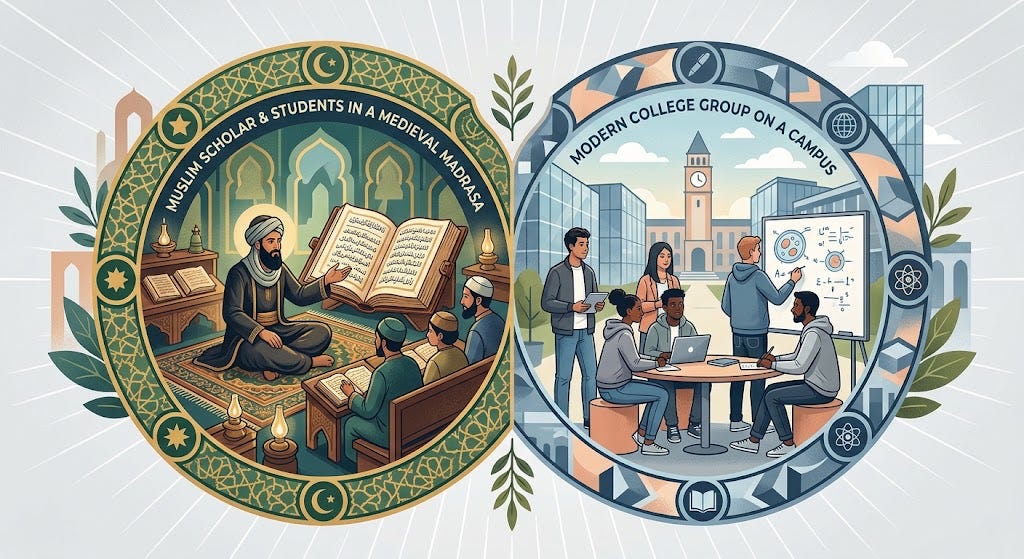
Interestingly, however, the importance of oracy is far from a new discovery. It has been recognised for centuries as an essential component of learning, intellectual development and professional training. Within Islamic educational traditions, particularly in centres of learning such as Qom in Iran, oral discussion and debate have long formed an important part of the training of scholars and jurists. Rather than simply receiving information from a teacher, students are expected to engage critically with ideas, question arguments and demonstrate their understanding through sustained dialogue.
Several established practices illustrate this approach. Mubahatha, or peer dialogue, involves students dissecting, critiquing and reconstructing complex legal or philosophical arguments presented in lectures. Munazara, or formal debate, provides an opportunity to test theological premises, compare jurisprudential evidence and defend competing interpretations. At the advanced level, Dars al-Kharij involves senior scholars presenting developed and often unscripted theories beyond the confines of a standard textbook curriculum. Students are expected to interject, question and challenge the professor’s reasoning in real time. There is also an emphasis on Tableegh, or public communication and oratory, which develops the ability to articulate ideas clearly, draw upon memorised scriptural material and engage persuasively with an audience.
These traditions raise an important question about the extent to which oracy has been underplayed within mainstream education systems, particularly in countries such as the UK. While speaking, debating and presenting are often recognised as useful skills, they have not always occupied the same central position in assessment as written examinations and coursework. This is particularly striking when we consider that effective communication is highly valued in the workplace, where the ability to articulate ideas confidently, persuade others, respond to questions and think on one’s feet can be crucial to securing and succeeding in senior positions.
There has, of course, been greater recognition of these skills within many private schools, where debating, public speaking, presentations and other forms of communication are often given considerable attention. The disparity raises a wider question: if these skills are considered valuable for students who are being prepared for leadership and professional life, why should they not be given greater prominence across the education system as a whole?
The rise of AI makes this question even more urgent. As technology becomes increasingly capable of generating essays, completing assignments and producing polished written responses, education needs assessment methods that can reveal genuine understanding, independent thought and intellectual engagement. Oracy cannot provide a complete solution on its own, but it offers an important part of the answer. A student who is required to explain, defend and critically reflect upon their work is placed in a position where genuine understanding becomes much harder to outsource.
Ultimately, oracy should not be viewed as a fashionable response to the arrival of AI. It is an age-old educational skill that has been used for centuries to cultivate scholars, thinkers, leaders and professionals. The challenge for modern education is therefore not to invent a new approach, but to recognise and harness an established one more effectively. Just as institutions with long traditions of scholarly training have understood the value of dialogue, debate, questioning and public speaking, modern schools and universities should consider how these practices can be placed at the heart of learning and assessment. In an age where AI can increasingly produce the written answer, the ability to think, speak, defend and engage may become more important than ever.
Reference: The Guardian (2026), ‘Danish pupils will have to orally defend essays in attempt to combat AI cheating’, 6 August 2026. The Guardian article