

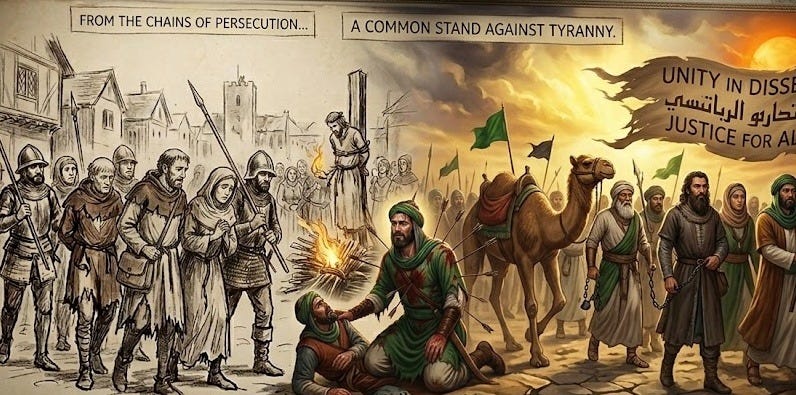
Throughout history, dominant religious institutions have often faced internal movements that challenge their authority, reinterpret doctrine, or call for reform. These movements—emerging from within rather than outside—are frequently perceived not merely as theological disagreements, but as existential threats to political and social order. Two such cases, separated by geography and culture, reveal strikingly similar patterns: the Lollards of late medieval England and a persecuted minority tradition within the early Islamic world.
Seeds Beneath the Surface: The Lollards
In fourteenth-century England, a movement inspired by the theologian John Wycliffe began to question the authority and practices of the established Church. These followers, later labelled “Lollards,” emphasised the primacy of scripture over ecclesiastical hierarchy, arguing that spiritual truth should be accessible to all rather than controlled by clergy.
Their insistence on translating the Bible into vernacular English challenged the Church’s monopoly on religious knowledge. Alongside this, they rejected practices such as indulgences, questioned core doctrines, and condemned the wealth and political entanglement of the Church.
The response was severe. Backed by the Crown, the Church treated dissent as both heresy and treason. Laws permitted execution, and public punishment was intended to deter others. Yet the movement endured underground—through secret readings, quiet networks, and outward conformity masking inner conviction.
When reformist ideas re-emerged in the sixteenth century, these hidden communities helped them take root.
Karbala: A Defining Moment of Conscience
Within the early Islamic world, a profound moral and spiritual crisis unfolded that would shape a minority tradition for centuries to come. At its heart stood Imam Husayn, the grandson of the Prophet, who refused to legitimise the rule of the Umayyad ruler Yazid.
His refusal was not driven by a quest for power, but by a conviction that the leadership of the community had deviated from the ethical and spiritual teachings of the Prophet. As later accounts emphasise, he sought to “reform” the community and stand against corruption and injustice.
In 680 CE, on the plains of Karbala, Husayn and a small group of family members and companions were surrounded by a vastly larger force. Denied water and escape, they were ultimately killed in what became one of the most defining tragedies in Islamic history.
This event was not merely a battle—it became a moral narrative. Husayn’s stand came to symbolise the principle that truth must be upheld even in the face of certain death. His choice not to submit exposed what many saw as the moral decay of the ruling sultan, transforming his death into a lasting call for justice.
The aftermath deepened the trauma. Survivors, including women and children, were taken captive and paraded publicly, while the message of the event was suppressed or distorted through state power and propaganda.
Survival Under Pressure
In the centuries that followed, adherents of this tradition often lived under suspicion and periodic persecution. Ruling authorities frequently viewed them as a threat to political and religious legitimacy, leading to cycles of repression, imprisonment, and violence.
To survive, communities developed strategies similar to those of the Lollards: discretion, coded expression of belief, and at times the concealment of one’s true convictions when faced with danger. Their collective memory of suffering—rooted in Karbala—became central to identity, reinforcing a moral framework built on resistance to tyranny.
Shared Patterns of Dissent and Suppression
Despite vast differences in theology and context, the parallels are striking. Both movements questioned who held legitimate religious and moral authority, and in doing so, challenged the structures that underpinned political order. Each advanced a moral critique of power, arguing that leadership had deviated from foundational teachings and become entangled with corruption.
In response, authorities did not treat these ideas as abstract theological debates but as direct threats. Suppression followed, often justified in the language of preserving unity and stability. This pressure forced both groups into forms of underground existence, where survival depended on adaptability, secrecy, and strong communal bonds.
Over time, memory itself became a form of resistance. The stories of those who suffered—whether executed reformers in England or those killed in the aftermath of Karbala—were preserved, retold, and given moral significance. These narratives did more than commemorate the past; they shaped identity and sustained conviction in the face of continued adversity.
From Karbala to the Present
The legacy of Karbala did not remain confined to history. Its message—standing against injustice regardless of consequence—has echoed across generations.
In more recent centuries, particularly in places such as Iran, religious scholars and movements have invoked the example of Husayn to challenge rulers they viewed as unjust or corrupt. During the twentieth century, for instance, opposition figures drew explicit parallels between contemporary leadership and the tyranny associated with Yazid, framing resistance as a continuation of that original moral struggle.
Even today, this narrative continues to shape political and religious discourse. For many, it represents an enduring call to hold authority accountable and to align governance with the ethical principles associated with the Prophet’s teachings—justice, humility, and moral integrity.
Diverging Outcomes, Shared Legacy
The Lollards ultimately dissolved into the broader Protestant Reformation, their ideas absorbed into a movement that reshaped Europe but erased them as a distinct group.
By contrast, this Islamic minority tradition endured as a living community, its identity continually shaped by remembrance of persecution and resistance. Rather than disappearing, it preserved its distinct voice—rooted in the belief that faith must stand in opposition to injustice.
Conclusion
These histories reveal a recurring pattern: when reform arises from within a religious tradition, it is often met with resistance from those who hold power. Yet they also demonstrate something more enduring.
From secret Bible readings in medieval England to the stand at Karbala and its echoes in the modern world, the struggle is not merely theological—it is moral. It is the question of whether authority serves truth, or whether truth must sometimes rise in defiance of authority.
Across centuries and cultures, the answer has often come at a cost—but it has never been silenced.