

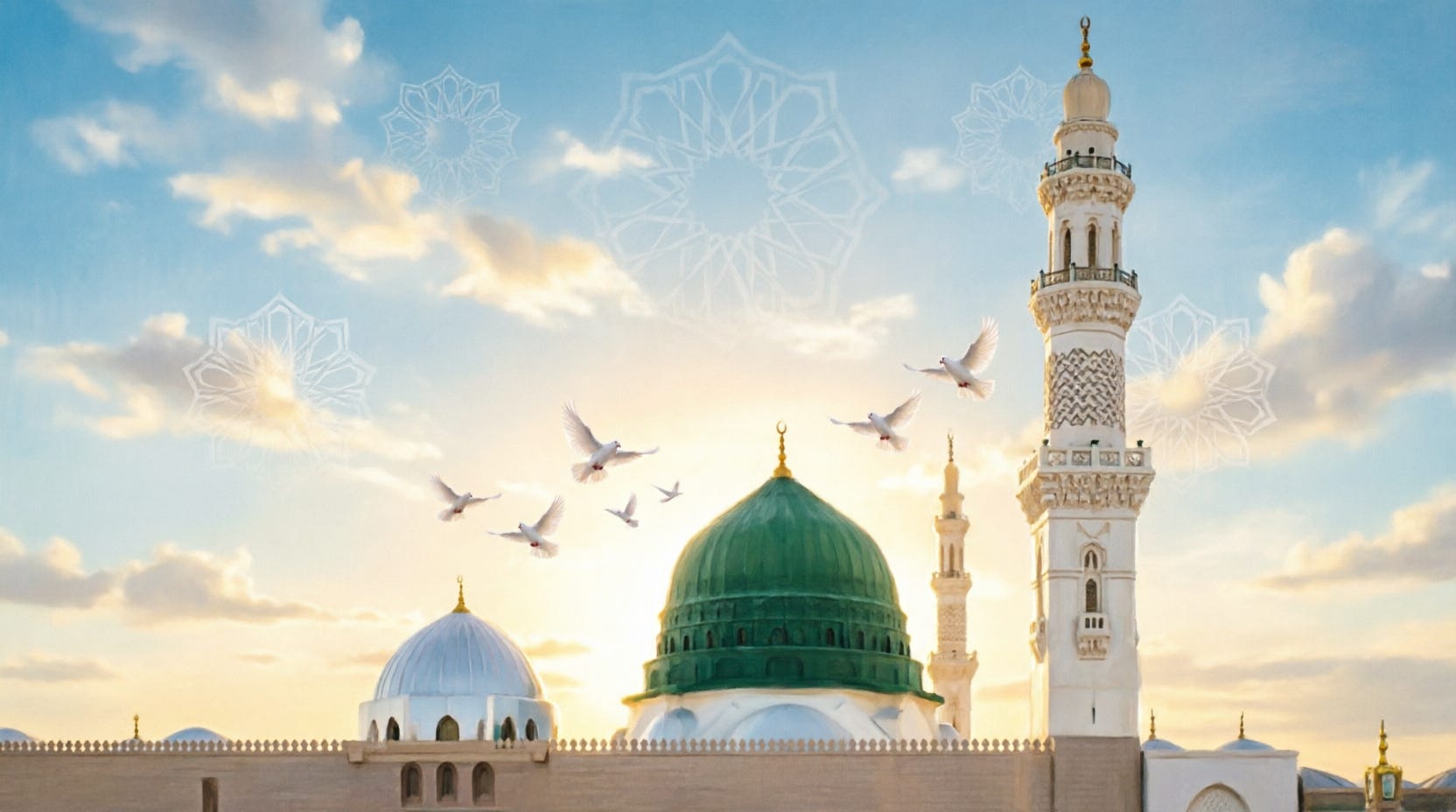
In the blessed month of Rabi’ al-Awwal, the hearts of the Muslim Ummah turn toward the life and legacy of the best of creation, Prophet Muhammad (S). While his titles are many, one stands out in the Holy Quran as the definitive summary of his cosmic mission: Rahmatan Lil Aalamin (Mercy to the Worlds).
In Surah Al-Anbiya, Allah (SWT) declares:
“And We have not sent you except as a mercy to the worlds.”
— (Quran, Chapter 21, The Prophets, Verse 107)
We often repeat this phrase, but what does it truly mean? Is it merely a poetic title, or does it hold a profound theological and linguistic blueprint for how we understand the Prophet (S), his message, and his relationship with all of creation?
To grasp the magnitude of this verse, we must break down its core components: Rahmah (Mercy) and Al-Aalamin (The Worlds).
1. What is “Rahmah” in the Quranic Worldview?
In modern parlance, “mercy” is often reduced to a fleeting emotion or a feeling of pity. But in the Quran, Rahmah is an active, encompassing force. The classical Quranic linguist Al-Raghib Al-Isfahani defined Rahmah as a tenderness that necessitates benevolence and action.
Scholars like Allamah Tabatabai (in Tafsir al-Mizan) note a crucial distinction: when humans show mercy, it is often triggered by emotional tenderness or empathy. But when Allah (SWT) and His Messenger (S) are described with Rahmah, it implies pure benevolence, grace, and the delivery of ultimate good, devoid of human emotional fragility.
Divine and Prophetic mercy manifests in several ways:
Material & Spiritual Blessings: From the creation of the night and day for our rest, to the sending of rain, to the ultimate spiritual blessing of divine guidance and salvation from misguidance.
Divine Forbearance: One of the greatest manifestations of mercy is patience. Allah (SWT) does not immediately punish disobedience; He grants time, space, and endless opportunities for repentance.
The Gift of Revelation: The Quran explicitly states that the Book was sent down to clarify our differences and act as a “guidance and mercy for a people who believe” (Quran, Surah an-Nahl, Chapter 16, The Bee, Verse 64).
2. The Boundaries of “Al-Aalamin” (The Worlds)
Who exactly are the recipients of this mercy? The word Al-Aalamin appears 73 times in the Quran. While it is sometimes used to refer to humanity, its primary Quranic usage is vastly broader.
When Fir’awn (Pharaoh) asked Musa (Moses) what the “Lord of the Worlds” was, Musa replied:
“The Lord of the heavens and the earth and whatever is between them”
— (Quran, Surah ash-Shu’ara, Chapter 26, The Poets, Verse 23-24).
Therefore, Al-Aalamin encompasses all of existence: humans, jinn, animals, the angelic realm, and the unseen. Among humans, it makes no distinction between the righteous and the wicked, the believer and the non-believer, the living and the dead. The Prophet’s (S) mercy is not a sectarian blessing; it is a universal atmospheric reality that covers all of creation.
3. The Linguistic Miracle of Infinity
Arabic is a language of profound precision, and the structure of Surah Al-Anbiya, Chapter 21, The Prophets, Verse 107 contains three distinct linguistic features that highlight the boundless nature of the Prophet’s (S) mercy:
The Scope (Al-Aalamin): As established, the plural form ensures no realm of existence is excluded.
The Absolute Restriction (Ma... illa...): The verse uses a negation followed by an exception (“We did not send you EXCEPT...”). In Arabic rhetoric, this restricts the entirety of his prophetic mission to this single, monumental purpose. Every battle fought, every treaty signed, and every sermon delivered was fundamentally an act of mercy.
The Indefinite Noun (Rahmatan): In Arabic eloquence, leaving a noun indefinite (without the prefix “Al-”) in this grammatical context signifies vastness, magnitude, and a quality that cannot be contained or quantified. It is not just “the” mercy; it is a mercy of unimaginable proportions.
This mercy was so vast that it even brought comfort to the heavens. When this verse was revealed, the Prophet (S) asked the Angel Jibreel (Gabriel),
“Did you receive any of this mercy?” Jibreel replied, “Yes. I used to fear the consequences of my affairs [the weight of my duties], but because of you, who are a mercy to the worlds, I am now reassured about my own situation.”
4. A Mercy to Believers and Non-Believers Alike
A common theological question arises: How can the Prophet ﷺ be a mercy to those who rejected him, fought him, or to societies that implement strict Islamic laws like Hudood (punishments) and Jihad?
To understand this, consider the Hospital Analogy.
Imagine a state-of-the-art hospital equipped with the world’s best doctors and life-saving medications, its doors thrown open to the entire public without discrimination. The existence of this hospital is a profound mercy to the city. If a sick person stubbornly refuses to enter and seek treatment, their refusal does not negate the universal mercy the hospital represents.
Similarly, the Prophet (S) and the message of Islam are a universal cure. The door is open; the mercy is absolute, regardless of who chooses to step inside. The spread of Islam brings salvation to all, and the rejection of it by some does not diminish its universal nature.
Furthermore, true mercy sometimes requires discipline. Just as a loving father disciplines his child, or a surgeon cuts a patient to remove a tumour, Islamic laws regarding justice, retribution, and societal boundaries are designed to protect the social fabric. They are manifestations of mercy for society at large, preventing the spread of spiritual and societal diseases.
The Ultimate Standard for Humanity
Just as Allah’s mercy encompasses friend and foe, the Prophet (S) was a mercy to both. This was evident in his historical conduct: forgiving the citizens of Mecca who had tortured and exiled him, praying for the guidance of tribes who stoned him, and emphasising compassion even in the midst of conflict.
Prophet Muhammad (S) stands as the ultimate example of human conduct, kindness, and generosity. He was not just sent to be a mercy to the Muslims, but as a masterclass in compassion for all of humanity. As we reflect on his life, we are left with a profound mandate: to be a reflection of that Rahmah in our own worlds—our families, our communities, and the earth we walk upon.
References & Further Reading:
Al-Raghib Al-Isfahani, al-Mufradat.
Allamah Tabatabai, Tafsir al-Mizan.
Majma Al-Bayan, Commentary on Surah al-Anbiya.