

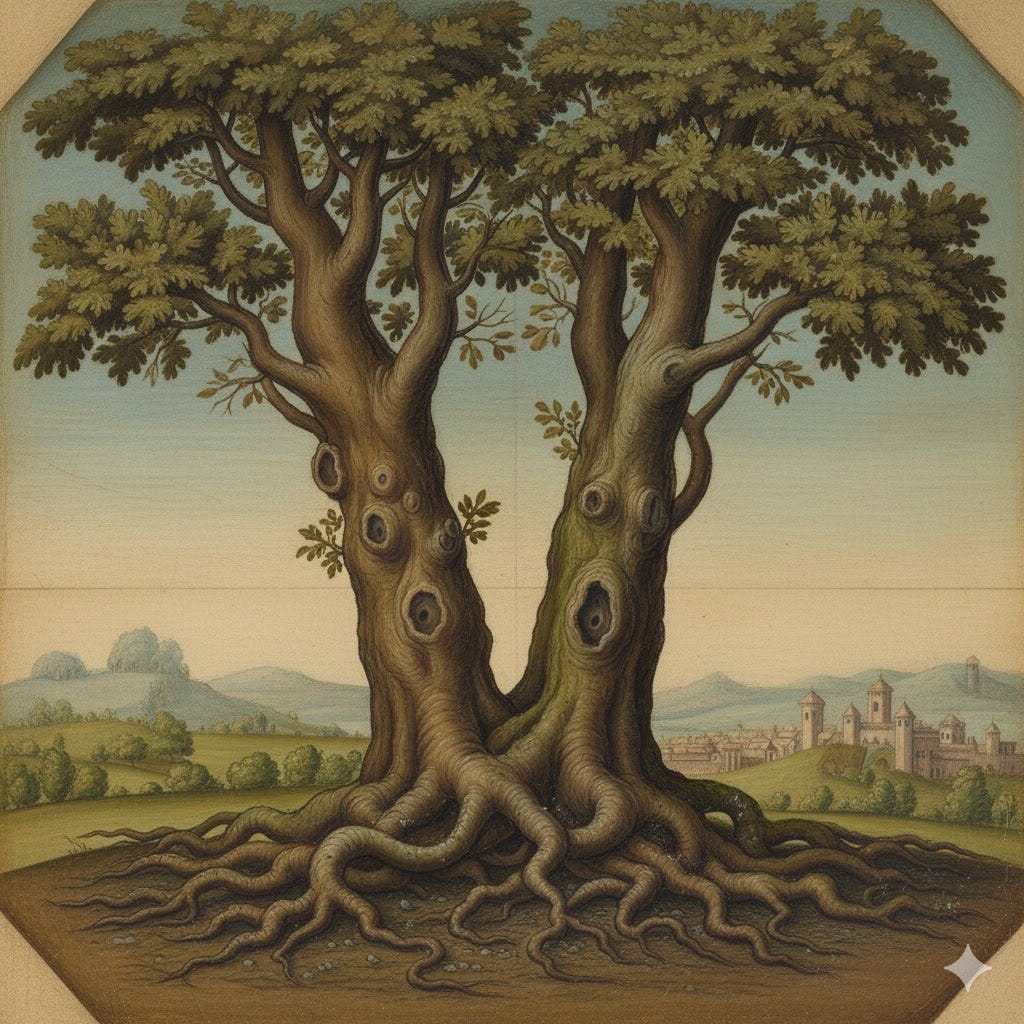
Not even a leaf falls without His knowledge, nor a grain in the darkness of the earth, nor anything—green or dry—but it is written in a perfect Record.”
(Quran, Surah al-An‘am, Chapter 6, The Cattle, Verse 59)
The Quran frequently draws our attention to trees and plants as powerful signs (ayat), encouraging us to reflect on Allah’s (SWT) creative power, wisdom, and mercy, and to derive lessons through parables of faith. Allah has placed within every human being an innate disposition toward truth (fitrah), which can be reawakened through sincere reflection upon His creation.
One aspect of His creation which benefits us all are the trees that surround us. When we walk through a forest, little do we realise that we are treading just above a vast and hidden world: an intricate root system interwoven with a mycorrhizal fungal network. This underground web—often referred to as the “wood wide web”—resembles a marketplace where nutrients, water, and information are exchanged. Through this symbiotic relationship, trees provide sugars to fungi, while fungi supply trees with essential minerals and water. This unseen network also allows communication between trees and serves as a vital support system for the health and balance of the forest.
Contrary to common assumptions, trees do not compete ruthlessly simply because they grow close to one another. They do not steal from one another or drain each other in a struggle for survival. Rather, they support one another—often unconditionally. Stronger trees help sustain weaker ones, and the wellbeing of the forest as a whole takes precedence over the success of any single tree.
In the world of trees, the individual is not valued above the community. Forests thrive most when they contain a diversity of species, each complementing and supporting the others. What a profound lesson this offers humanity—one drawn from the harmonious and indiscriminate cooperation of plant and fungal life beneath our feet.
How different this is from the human model of “survival of the fittest,” which has become the prevailing mantra of a global capitalist system driven by profit, power, and accumulation.
Trees demonstrate another way of being: a way in which the strong uphold the weak and the abundant resources Allah has placed upon this bountiful earth are shared rather than hoarded.
Much about the intelligence, cooperation, and interconnectedness of trees has only recently been revealed. One notable example comes from the long-term observations of a forest ranger, Peter Wohlleben, documented in his bestselling book The Hidden Life of Trees. He criticizes modern forestry practices that rely on monoculture plantations—often consisting of a single species such as pine or fir—grown rapidly for commercial gain. Over time, these forests become weak and disease-prone, deprived of the benefits that come from species diversity and the complex underground networks that allow for mutual nourishment and resilience.
Sadly, much of the forest industry prioritizes speed and yield over balance and longevity. As with many profit-driven practices, this approach often leads to the collapse and degradation of a far more sophisticated and harmonious order—one that Allah has already perfected. Trees, in their natural state, do not need to be isolated from so-called competitors. Instead, they flourish through cooperation, diversity, and interdependence. Modern attempts to override this divine balance often result in harm rather than benefit, rooted in human ignorance and greed.
Once again, Allah teaches us through His creation that just as plants cooperate and mutually benefit from one another despite their differences, so too can humanity.
“All living beings roaming the earth and winged birds soaring in the sky are communities like yourselves. We have left nothing out of the Record. Then to their Lord they will all be gathered.”
(Quran, Surah al-An‘am, Chapter 6, The Cattle, Verse 38)
This verse points to a complex and balanced ecosystem (mīzān), in which every component has inherent value and a divinely assigned role—far beyond mere utility to human beings.
Let us therefore thank and praise our Glorious Lord, who creates with such beauty, wisdom, and complexity—signs for us to observe, reflect upon, and learn from. Let us be humbled by the creation of the tree where the strong support the weak and where Allah (SWT) has revealed the harmonious and symbiotic relationship that these organisms share.
This was such a beautiful read/ reminder. Thank you for sharing this wonderful message, May Allah bring you immense blessings 💗
Salaam Alaikum everyone,
This book offers a vivid and powerful description of the Day of Judgment (يوم القيامة) — from the moment the Trumpet is blown, through the reckoning, and finally to each soul’s ultimate destination.
For the sinner, it is a sobering and terrifying reminder to repent.
For the obedient, it is comforting, heart-warming, and reassuring.
📘 Free PDF available here:
https://drive.google.com/file/d/1vxPP6jbg1fD70qpOnNACjnX6d2yPg43d/view?usp=drivesdk
🤍 Support the effort:
https://gogetfunding.com/my-dashboard/
📱 Purchase the ePub (only $0.99):
https://books2read.com/u/bolGw9
✍️ Leaving a short book review is also a great form of support and deeply appreciated.
Jazakum Allahu khayran, and thank you in advance.