

A famous quote often attributed to Socrates says:
“Strong minds discuss ideas, average minds discuss events, weak minds discuss people.”
Perhaps today we might add another observation:
“Even weaker minds discuss themselves constantly.”
Sit on a train, in a café, or in any public space and listen carefully to the conversations around you. What do we hear people discussing most often? Increasingly, it is not even other people or meaningful ideas, but themselves — their identity, their sexuality, their salaries, their diets, their appearance, their desires, and how they wish to be perceived.
The pattern becomes difficult to ignore: modern conversation is often centred almost entirely around the self.
How we define ourselves inevitably shapes what we speak about and what occupies our thoughts. In societies increasingly detached from God and spirituality, public discourse has descended to a more superficial and worldly level. Identity is now frequently rooted in materialism, appearance, desire, and personal gratification rather than in any relationship with a higher power or transcendent purpose.
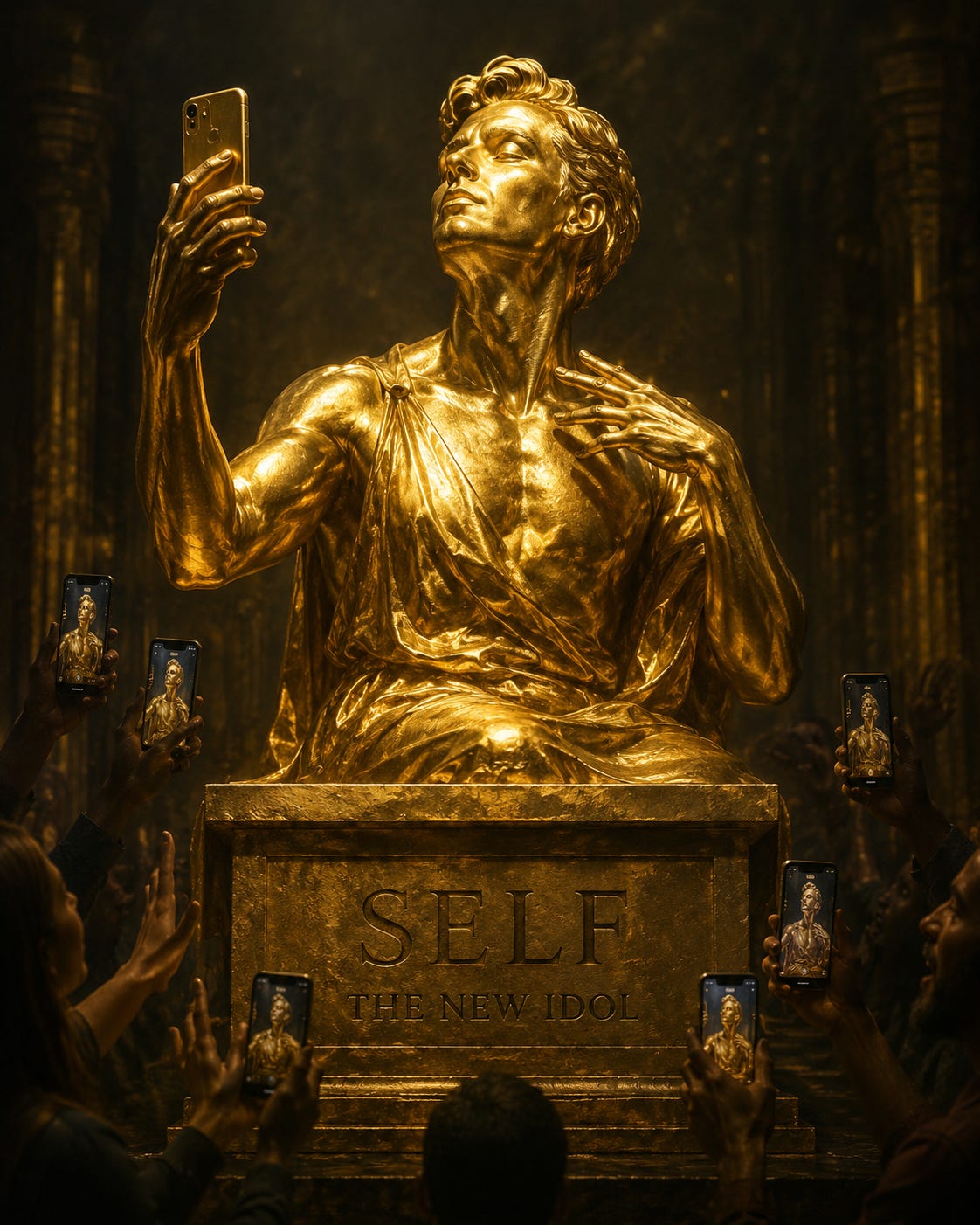
Many in the modern West no longer orient their understanding of the self around God. Instead, the self becomes the centre of meaning and devotion. In this sense, self-worship becomes the new idolatry. It can manifest in many forms: obsession with physical beauty, fixation on sexual identity, the pursuit of status, or the creation of fantasy identities shaped by ego and desire.
Yet this phenomenon is not new.
Ancient peoples also fashioned idols from their own imaginations and desires, creating physical representations of what they chose to worship. The human tendency toward idolatry has always existed — only the forms have changed.
The Quran, along with earlier sacred texts such as the Bible, warns repeatedly about this inclination within human nature. One of the clearest examples is found in the story of the Prophet Moses and the golden calf.
When Moses ascended the mountain for forty days, the Children of Israel — not to be confused with the modern political state of Israel — were tested. Despite having witnessed the miraculous parting of the sea and their deliverance from oppression, many still retained an inner attraction to the idolatrous practices they had observed in Egypt.
In many ways, this mirrors the condition of believers today. Surrounded by materialism, hedonism, and a culture of excess, people are constantly tempted away from faith and toward worldly worship.
During Moses’ absence, the people became impatient and demanded something visible and tangible to worship. They turned to the golden calf.
The Quran identifies the Samiri as the instigator who exploited the people’s weak faith and impatience. Using their own gold wealth that had accompanied them after their liberation from Egypt, he fashioned the idol. Symbolically, the very possessions associated with their freedom became the instruments of their spiritual bondage.
The forty-day absence of Moses was therefore not merely a delay, but a test meant to expose the true condition of their hearts.
The Quranic command for them to “kill yourselves” (Surah al-Baqarah, Chapter 2, The Cow, Verse 54) has been understood by some scholars both literally — as punishment for the ringleaders — and spiritually, as a call to destroy the ego and purge the soul of idolatry and rebellion.
At the heart of the story lies a profound contrast:
The unseen God versus the visible idol.
Human beings often crave a deity they can see, touch, shape, and ultimately control. The golden calf represented a god created by human hands — a god submissive to human desire. True faith, however, requires surrender to the unseen Creator: not a deity controlled by humanity, but the Lord who guides, commands, and transcends humanity.
Perhaps the modern idol is no longer carved from gold or stone.
Perhaps the modern idol is the self.