

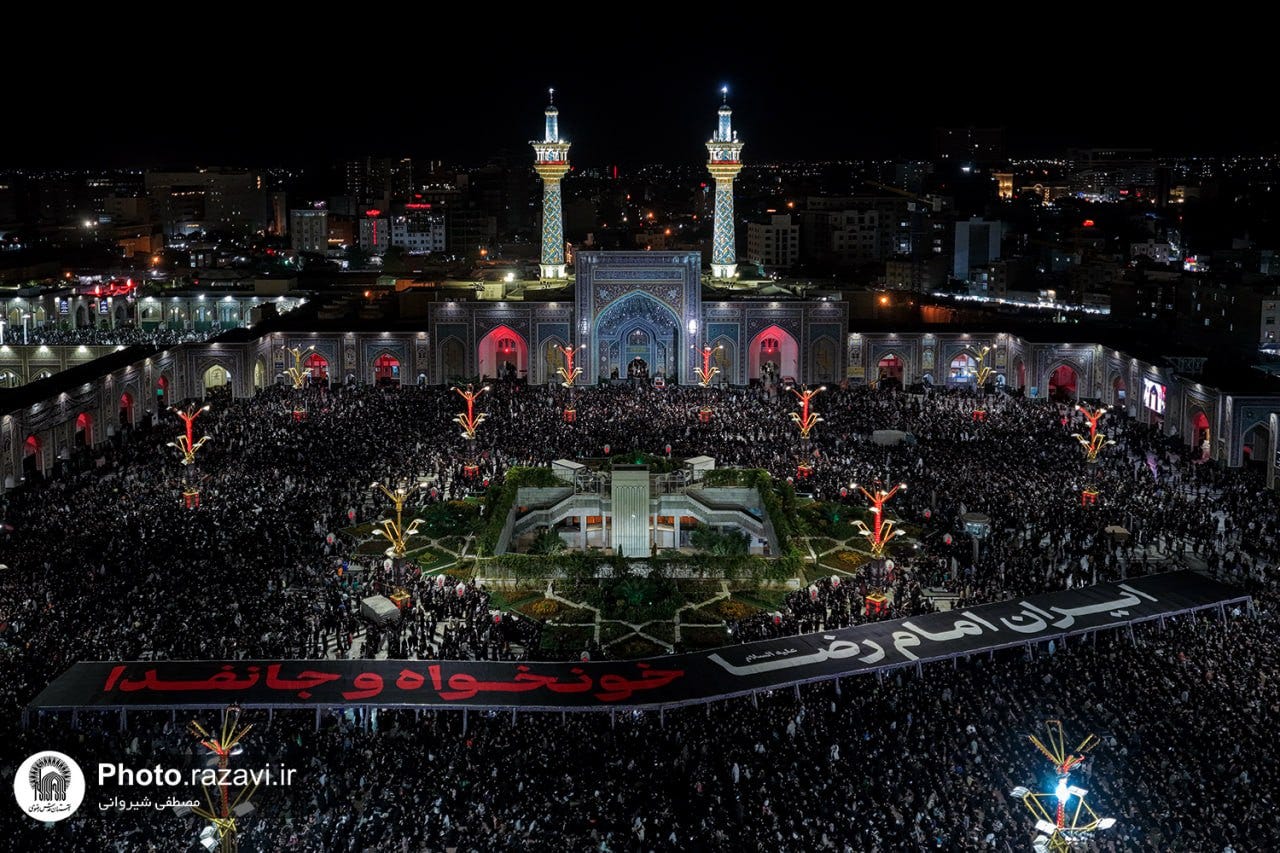
Safar is a month that does not let the heart rest. On the 28th we carried two sorrows — the passing of the Messenger of Allah (SWT) and the martyrdom of Imam Hasan al-Mujtaba (AS). And as the month closes, a third grief arrives: the martyrdom of the eighth Imam, Ali ibn Musa al-Reza (a), taken by poison in Tus in the year 203 AH, far from his grandfather’s grave in Madinah.
As the final days of Safar 1448 AH arrive in mid-August 2026, and the roads to Mashhad fill with pilgrims on foot, it is worth pausing not only to grieve — but to understand who it is that lies beneath the golden dome. Because, as one of the greatest scholars of our age has reminded us, most people — even those who live beside the shrine or visit it every week — have not yet realised the true greatness of Imam Reza (AS).


“Imam Reza (AS) Is the Light of Allah”
In one of his most celebrated speeches, delivered on the anniversary of the Imam’s martyrdom, Ayatollah Wahid Khorasani centred his reflection on one of the eighth Imam’s titles: Siraj Allah — the Light (Lamp) of Allah.
The word siraj is not an ordinary word. In the Quran, it is used for the sun, the lamp that illuminates the world, and it is used for the Prophet Muhammad (S) himself, whom the Almighty sent as “a caller to Allah, by His permission, and a shining lamp” — sirajan munira. To call Imam Reza (AS) Siraj Allah is therefore to say something enormous: that he is a source of divine knowledge illuminating the hearts of people, and of spiritual warmth that nourishes faith — a lamp lit from the same niche as the Prophet (S).
The Imam Whom Imam Sadiq (AS) Longed to Meet
How high is the station of this Imam? Ayatollah Khorasani answered with a narration that stops the heart. Imam Ja’far al-Sadiq (AS) once said to his son, Imam Musa al-Kazim (AS): “Among your descendants will be a scholar of the lineage of Muhammad.” And then the sixth Imam (AS) added words that Ayatollah Wahid Khorasani himself called astonishing:
“How I wish I could live to meet him.”
If Imam Sadiq (AS) — the teacher of an entire age, the wellspring of the school of the Ahl al-Bayt (AS) — dreamed of merely meeting Imam Reza (AS), then how great must the eighth Imam be before Allah? History bears the title out: in the courts of Khurasan, scholars of every creed and science came to test the Imam of Tus, and found in him the inheritor of the Prophet’s (S) knowledge — the ‘Alim Al Muhammad, the scholar of the lineage of Muhammad.
The Ziyarat Closest to the Throne
It is no wonder, then, that the narrations on visiting his grave reach heights the scholars have pondered for centuries. Ayatollah Khorasani recalled a tradition transmitted by the greatest masters of Shia hadith — Shaykh al-Kulayni, Shaykh al-Tusi and Shaykh al-Saduq: on the Day of Judgment, those who visited the tombs of the Infallible Imams (AS) will be near them — but those who visited the tomb of Imam Reza (AS) will be closest to the Divine Throne (Arsh).
And he emphasised the famous hadith of Imam Musa al-Kazim (AS): “Whoever visits the tomb of my son in Tus, it is as if he has visited Allah at His Throne.” Such a statement, the Ayatollah stressed, cannot be taken literally — Allah is not contained in any place or direction. It is a pointer to the exceptional spiritual status of Imam Reza (AS) and his unique nearness to the Almighty: to stand at his grave, with recognition and love, is to stand at one of the nearest doors to Allah.
A Thousand Hajj
Equally staggering is the tradition the Ayatollah cited on the reward of this ziyarat: if a person were to live a thousand years and perform Hajj every year, the reward of one sincere visit to the tomb of Imam Reza (AS) may equal a thousand pilgrimages.
Let there be no misunderstanding: such a tradition does not replace Hajj, which remains an obligatory pillar of the faith, while ziyarat remains a beloved recommendation. Its purpose is to reveal the incredible spiritual value Allah has placed at the grave of His eighth proof — and to awaken hearts that treat the journey to Tus as ordinary.
A Ziyarat That Transforms
Yet the speech’s most important moment came at the end, with the words of Imam Reza (AS) himself on what true faith requires — three qualities:
From Allah: the ability to conceal people’s shortcomings and never reveal their secrets;
From the Messenger of Allah (S): patience and gentleness in dealing with people, even in the face of injustice;
From the Wali of Allah: steadfastness and patience both in trials and in prosperity.
Here is the key to spiritual perfection. The ziyarat of Imam Reza (AS) should not merely bring a person blessings — it should change him. The pilgrim who returns from Mashhad must return with a tongue that conceals faults, a heart that answers injury with gentleness, and a soul that stands firm whether tested by hardship or by ease. Only then has the pilgrim truly visited the Light of Allah — because only then has the Light been lit in him.
What the Close of Safar Teaches Us
Safar’s sorrows are one story. The Prophet (S), Imam Hasan (AS), Imam Reza (AS) — three lights of the same lamp, each paying the price of preserving the message.
Light exists to be given. The Imam’s knowledge was never hoarded; it illuminated. The believer’s knowledge must do the same.
Greatness can be hidden in plain sight. Millions visit the dome; few know the one beneath it. Seek the Imam, not only the shrine.
Ziyarat is a covenant of character. To visit the Imams (AS) is to sign a contract to become like them — in concealment of faults, in gentleness, in steadfastness.
Allahumma salli ala Muhammad wa Aali Muhammad, wa ajjil farajahum. Peace be upon the Light of Allah, the scholar of the lineage of Muhammad — on the day he was martyred, and on the day his promise is fulfilled.