

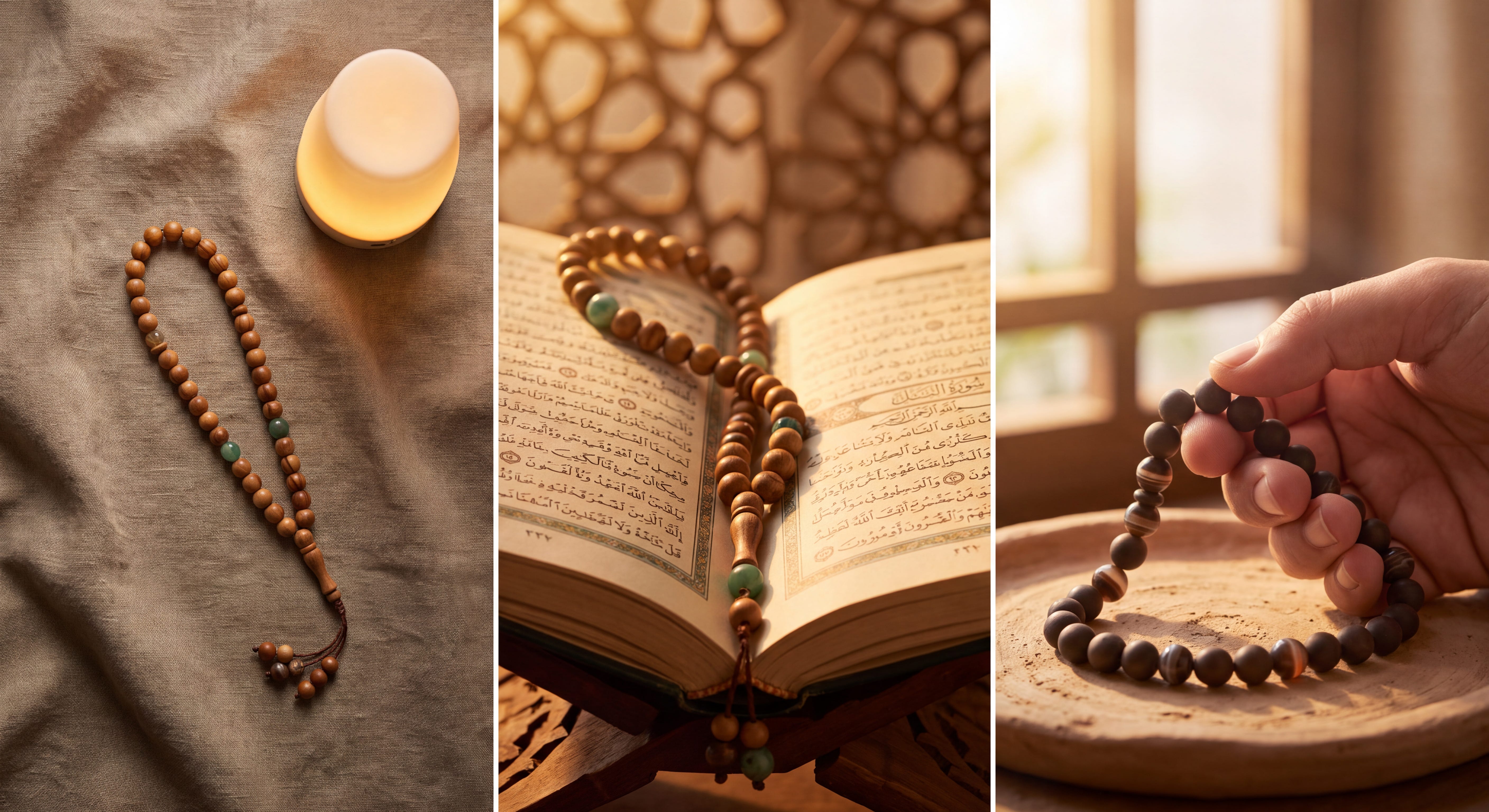
Every day, millions of Muslims around the world utter the phrase SubhanAllah (Glory be to Allah). It flows from our lips in moments of awe, in times of distress, and during our daily prayers. But what does tasbih truly mean? Is it merely a repetitive phrase, or does it hold a deeper transformative power?
The Quran itself gives us perhaps the clearest explanation of tasbih. In Surah As-Saffat, Allah says:
سُبْحَانَ اللَّهِ عَمَّا يَصِفُونَ
“Glory be to Allah above what they attribute to Him.”
— Quran, Surah as-Saffat, Chapter 37, The Rangers, Verse 159
And in Surah Al-Isra:
سُبْحَانَهُ وَتَعَالَىٰ عَمَّا يَقُولُونَ عُلُوًّا كَبِيرًا
“Glory be to Him, and exalted is He, immensely above what they say.”
— Quran, Surah al-Isra, Chapter 17, The Children of Israel, Verse 43
These verses function almost like Quranic definitions of tasbih. At its core, tasbih is tanzih: the active recognition that Allah is above every deficiency, limitation, comparison, and false description. In simple words, Allah is not like His creation and is not limited as created things are.
Beyond “Glory Be to Allah”
When we say SubhanAllah, we are saying much more than a simple translation of “Glory be to Allah.” We are declaring that Allah is far above anything unworthy of Him and above every limited idea we may form of Him.
We know that Allah sees, hears, knows, and has power—but He does so in a manner that befits His Majesty, not in the limited, physical, or temporal way that His creation does. Reciting tasbih protects our theology. It shields us from the subtle trap of anthropomorphism—imagining the Creator like the created.
The Connection Between Tasbih and Salah
Allah beautifully connects tasbih with our daily prayers (salah). In Surah al-Hijr, He commands:
فَسَبِّحْ بِحَمْدِ رَبِّكَ وَكُنْ مِنَ السَّاجِدِينَ
“So glorify your Lord with His praise and be among those who prostrate.”
— Quran, Surah al-Hijr, Chapter 15, The Rocky Tract, Verse 98
In salah, tasbih should be deeply conscious. When we lower our foreheads to the ground in sujūd and say, Subhana Rabbiyal A’la wa bihamdih (Glory be to my Lord, the Most High, and praise be to Him), we are physically embodying a profound spiritual truth. We recognise that while Allah is entirely free from limitation, we are in absolute, humble dependence upon Him. Sujud gives our bodies the language to express the tanzih of our hearts.
Tasbih and Sabr: Restoring Perspective
Life is filled with trials, and Allah intimately connects tasbih with sabr (patience). In Surah Ta-Ha, He advises the Prophet (S):
فَاصْبِرْ عَلَىٰ مَا يَقُولُونَ وَسَبِّحْ بِحَمْدِ رَبِّكَ
“So be patient with what they say, and glorify your Lord with His praise.”
— Quran, Surah Ta-Ha, Chapter 20, Ta-Ha, Verse 130
Why does tasbih breed patience? Because it restores our perspective. The person troubling us is not absolute. The difficulty standing before us is not absolute. Even our own human understanding is painfully limited. SubhanAllah reminds us that Allah is above all of that. When we remember His absolute perfection and control, our worldly anxieties shrink, and our trust in Him expands.
The Living Tasbih: Lessons from the Ahl al-Bayt (AS)
The Ahl al-Bayt (AS) did not just teach tasbih as a theological concept; they lived it. The legacy of tasbih in the Shia tradition is most famously encapsulated in the Tasbih of Sayyida Fatimah al-Zahra (SA).
Following the birth of Imam Husayn (AS), the Prophet Muhammad (S) taught his beloved daughter a specific formula of remembrance: 34 times Allahu Akbar, 33 times Alhamdulillah, and 33 times SubhanAllah. This was not just a set of words, but a spiritual anchor meant to be recited after every obligatory prayer and before sleep.
The Imams of the Ahl al-Bayt (AS) placed immense emphasis on this practice, elevating it to the highest ranks of worship. Imam Ja’far al-Sadiq (AS) stated regarding its value:
“The tasbih of Fatimah al-Zahra (SA) after every obligatory Salah is more loved to me than praying a thousand rak’ahs every day.”
He also highlighted that this specific form of frequent remembrance is the perfect embodiment of what Allah commands in the Quran.
Furthermore, in the profound supplications inherited from the Ahl al-Bayt, such as Dua Kumayl by Imam Ali (AS) or Dua al-Sabah, the Imams constantly begin with phrases of tanzih and tasbih (e.g., Subhanaka ya Allah). They teach us that before we ask Allah for anything, we must first clear our minds of any limited or flawed conceptions of Who we are asking.
Conclusion: A Way of Life
Ultimately, tasbih is not merely something we recite with our tongues; it is something we learn to live. It is a continuous process of correcting how we think about Allah, humbling ourselves in prostration before Him, and facing the trials of life with greater patience, trust, and divine perspective.
The next time the words SubhanAllah leave your lips, pause for a moment. Remember His absolute perfection, your humble dependence, and the profound reality that your Lord is exalted, immensely above all limitations.