

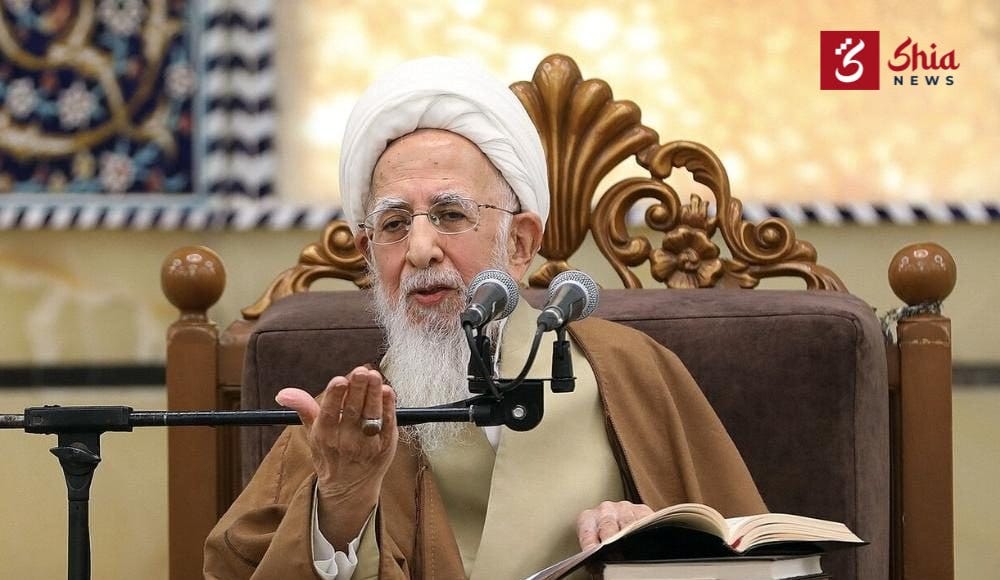
Qom, Azam Mosque – Weekly Lecture on Morality
In his weekly lecture on morality at the Azam Mosque in Qom, Grand Ayatollah Abdullah Javad Amoli drew on the sayings of Imam Ali (AS) from Nahj al-Balagha (The Path of Eloquence) to explore how tawhid must manifest not only in a person’s beliefs but in every dimension of daily life.
Tawhid: The Price of Paradise
Ayatollah Javad Amoli opened by reframing what it means to be a true monotheist:
“Tawhid is the price of Paradise. A monotheist is not simply someone who believes that God is one. It is someone in whom tawhid is reflected in their actions and behaviour, who does not see the world separately from its Creator, and who sees their entire life in the light of the words: ‘There is no power and might except in Allah.’
Monotheism, he stressed, is not a static creed but a living orientation – one that colours how a person works, relates, and responds to the world around them.
Knowledge Without Action Becomes Ignorance
Turning to the inseparable link between knowledge and practice, Ayatollah Javad Amoli quoted Imam Ali (AS):
“Do not turn your knowledge into ignorance, nor your certainty into doubt. When you know, act; when you are certain, decide.”
He elaborated:
“A knowledgeable person who does not act according to their knowledge turns it into ignorance. If knowledge has no consequences, it becomes like ignorance.”
The message was clear: learning in Islam is never an end in itself. It is a trust that demands embodiment.
The Needy as a Messenger of Allah
Ayatollah Javad Amoli then addressed how tawhid must shape social relations. If someone comes seeking help – whether material, scientific, or social – one must never treat them with contempt. If you are able to help, help. If not, politely decline and direct them to someone who can.
He cited the saying:
“The needy is a messenger of Allah.”
This perspective, he explained, can revitalise society and make it truly civilised: a person sees the one who comes to them for help not as a burden, but as someone through whom a divine responsibility is directed towards them.
Dignity and the Confrontation of Injustice
Speaking about confronting oppression, Ayatollah Javad Amoli quoted Imam Ali (AS):
“He who is humiliated will not reject humiliation.”
He urged the congregation to maintain their dignity and never passively accept oppression. He then recalled another saying:
“Return the stone to where it came from.”
He explained its meaning:
“Do not throw the first stone, because initiating oppression is unacceptable. But if someone throws a stone at you, immediately return it. Live courageously – that is, with dignity, skill, and bravery.”
Lady Maryam (SA): An Example for the Entire Believing Community
In his closing remarks, Ayatollah Javad Amoli addressed the position of women in the Quran, citing Lady Maryam (SA) as the supreme example:
“The Quran distinguishes between the concepts of ‘women,’ ‘men,’ and ‘people.’ When it comes to Lady Maryam (SA), she is presented not simply as a role model for women. The Quran says that Allah brought Lady Maryam (SA) as an example to those who believed. It does not say that Maryam (SA) is an example only for women. Therefore, Maryam (SA) is an example for righteous and believing people – a role model for the entire believing community.”
Thus, spiritual perfection in the Quran is not limited by gender. Lady Maryam (SA) stands as an example of faith, steadfastness, and devotion for every believing person – male and female alike.
This article is based on the weekly morality lecture of Grand Ayatollah Abdullah Javad Amoli at the Azam Mosque, Qom.
Reference: Shia News