

To fully understand why Abdullah al-Mahd made the monumental claim that his son was the prophesied Mahdi, we have to look at the complex political and theological landscape of the 8th century. His decision was not made in a vacuum; it was driven by a blend of shifting theology, prophetic interpretation, and intense political survival.
Here is a breakdown of why he made this fateful claim, and how it culminated in one of the most tragic encounters in early Islamic history.
1. The Fluid Definition of “Mahdi” in Early Islam
Today, in Twelver Shia Islam, the title of “The Mahdi” specifically refers to the 12th hidden Imam who will return at the end of times. However, during the chaotic final years of the Umayyad dynasty, the term Mahdi (which literally means “the rightly guided one”) was often used more broadly. Many Muslims were desperate for a saviour to overthrow the tyrannical rulers and “fill the earth with justice.” Abdullah likely used the term as a powerful political and spiritual rallying cry for a righteous revolution, believing his son was the saviour meant for their specific time.
2. Differing Views on Leadership (Hasanid vs. Husaynid)
While the Husaynid line (represented by Imam Muhammad al-Baqir and Imam Ja’far al-Sadiq) taught that the Imamate was a matter of strict divine appointment passed down a specific lineage, the Hasanid branch (Abdullah’s family) had developed a different perspective.
Many Hasanids believed that rightful leadership belonged to any pious, learned descendant of Lady Fatima who publicly rose up with a sword against injustice. Because Imam al-Sadiq took a quietist approach (focusing on teaching and refusing to launch an armed rebellion), Abdullah and his followers felt the responsibility fell to them to take militant action.
3. Fulfilling the “Checklist” of Prophecy
Abdullah looked at his son, Muhammad, and genuinely believed he fit the prophetic descriptions of the saviour:
The Name: The Prophet had prophesied that the Mahdi’s name would be his name, and his father’s name would be his father’s name. Abdullah’s son was named Muhammad ibn Abdullah.
The Character: His son was so famously devout and pious that he was nicknamed al-Nafs al-Zakiyya (The Pure Soul).
The Lineage: Their lineage was uniquely “pure,” descending from both Hasan and Husayn.
4. Desperation and Political Strategy
The Hashemites were being hunted, tortured, and killed. Abdullah was a desperate father and an elder trying to save his family and the Muslim Ummah from oppression. He saw an opportunity to unite both the Alids and the Abbasids under his son to finally overthrow the Umayyads. In his zeal to achieve this justice, he relied on his own human reasoning, tragically bypassing the divine knowledge of the actual Imam of his time.
The Secret Summit at Al-Abwa
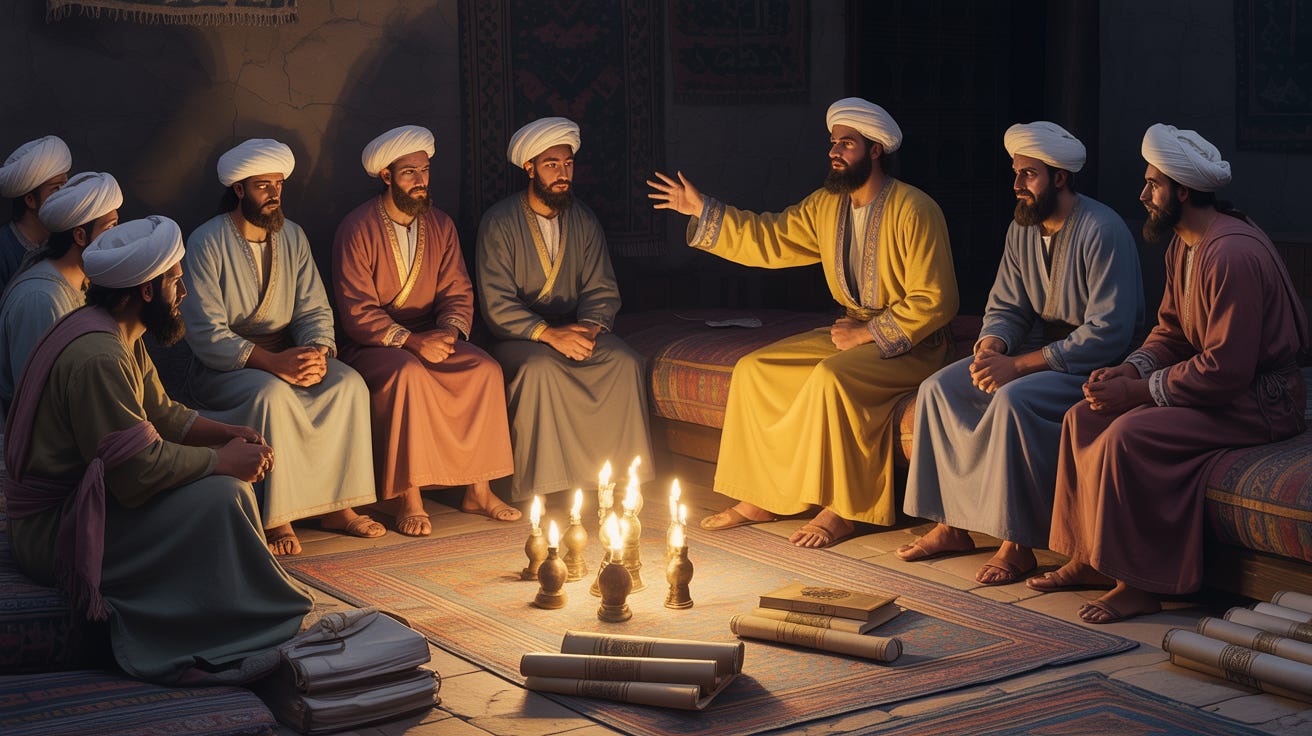
This clash between human political ambition and divine foresight came to a head in roughly 746 CE (around 129 AH). As the Umayyad Empire crumbled, the broader Hashemite clan organised a secret summit at Al-Abwa, a village between Mecca and Medina. The attendees included the heavyweights of both the Alid branch and the Abbasid branch, including future caliphs As-Saffah and Abu Ja’far al-Mansur.
At the gathering, Abdullah al-Mahd stood up and formally proposed that everyone pledge allegiance to his son, explicitly declaring him to be the prophesied Mahdi. Because of Abdullah’s age and his son’s “pure” lineage, the crowd—including the Abbasids—agreed and pledged their loyalty.
The Arrival of the Imam and the Bitter Accusation
Imam Ja’far al-Sadiq (AS) arrived after the pledges had begun. When invited to pledge allegiance, the Imam respectfully but firmly refused. He looked at his relatives and delivered a chillingly accurate prophecy:
“Do not do this! If you, O Abdullah, think that your son is the Mahdi, then he is not the Mahdi, and this is not his time. And if you are rebelling in the way of Allah to command good and forbid evil, we will not abandon you, our elder, to pledge allegiance to your son.”
Operating entirely from a political mindset, Abdullah was deeply offended and misread the Imam’s divine knowledge as mere family rivalry, angrily accusing the Imam of being envious of his son.
Imam al-Sadiq, maintaining his composure, replied with profound sorrow: “By Allah, I am not driven by envy...”
The Prophecy of the Yellow Cloak
It was then that Imam Ja’far al-Sadiq made his most famous and terrifying prediction. He turned his attention toward the Abbasids, specifically pointing to Abu Ja’far al-Mansur, who was sitting nearby wearing a yellow cloak (qaba’).
The Imam warned Abdullah: “This matter [the Caliphate] will not be for you, nor for your sons! It will be for them. And this man in the yellow cloak will play with it, and he will eventually kill your children.”
Having delivered his warning, the Imam left the gathering, refusing to participate in an uprising built on a false theological premise.
The Tragic Aftermath
Everything the Imam predicted at Al-Abwa came true with devastating precision.
The Abbasid Betrayal: The Abbasids used the Alids to gain public support, but once the Umayyads were defeated in 750 CE, they seized the Caliphate for themselves.
The Slaughter of the Hasanids: Al-Mansur—the man in the yellow cloak—became consumed by paranoia regarding Abdullah’s sons. It was he who ordered the arrest, torture, and starvation of Abdullah al-Mahd in the dungeons of Hashimiyya.
The Failed Uprising: After Abdullah died in prison, his son Muhammad finally launched his rebellion, but he was militarily crushed and beheaded by Al-Mansur’s army. His brother Ibrahim suffered the same fate shortly after.
The debate at Al-Abwa remains a cornerstone of historical memory. It highlights the tragedy of Abdullah al-Mahd—a pious man who sought justice but allowed desperation to blind him to the guidance of the true Imam of his time, ultimately walking himself and his sons straight into the trap the Imam had warned him about.