

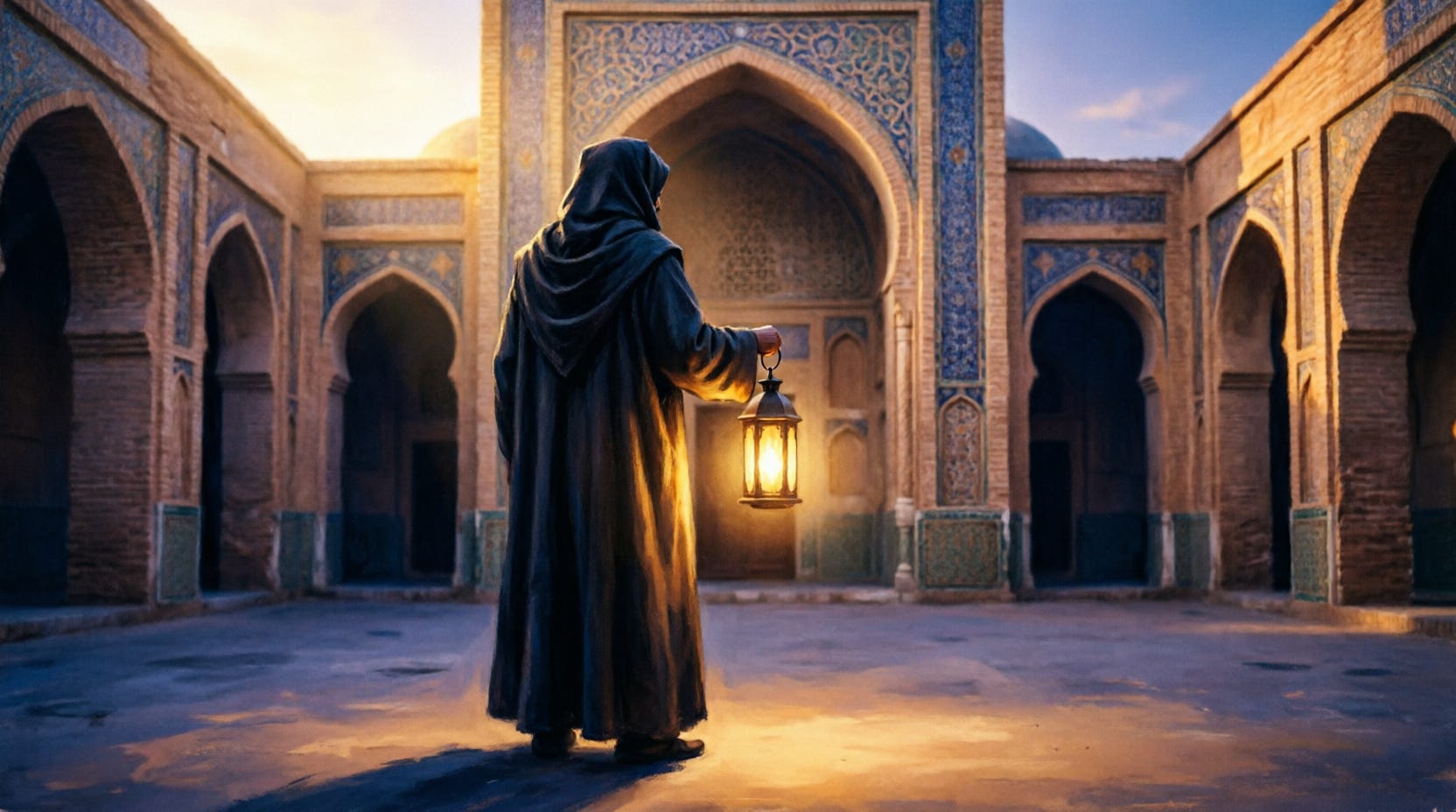
When studied in isolation, the imamate of Imam Hasan al-Askari (peace be upon him) can appear brief, confined, and heavily restricted. Lasting only six years, much of it was spent under the intense, suffocating surveillance of the Abbasid regime in Samarra.
Yet, when viewed through the profound lens of the “250-Year Human Being,” this short period emerges as one of the most sensitive and decisive chapters in Islamic history.
The 250-Year Human Being: One Continuous Reality
The “250-Year Human Being” is a framework that invites us to see the Imams not as separate personalities pursuing disconnected programs, but as a single, continuous reality manifesting across different historical circumstances. Their central mission remained unchanged: to preserve authentic Islam, clarify the authority of the Ahl al-Bayt (peace be upon them), cultivate a faithful community, and prepare the ground for divine governance.
While the core mission remained the same, the methods evolved to meet the demands of each age. For Imam Hasan al-Askari (AS), the demand of the age was nothing short of engineering the survival of the faith.
Engineering the Passage to the Occultation
Imam al-Askari (AS) was tasked with a uniquely critical responsibility: to transform the doctrinal, scholarly, ethical, and organisational capital built by the previous Imams into a resilient structure capable of guiding the community after the end of the era of visible presence.
He was, in essence, completing the project of transitioning the Ummah from the era of presence to the era of Occultation.
The Delicate Balance: Concealment and Confirmation
One of the most monumental missions of Imam al-Askari (AS) was protecting the life of his son, Imam al-Mahdi (may Allah hasten his reappearance), while simultaneously establishing the reality of his birth and Imamate for the faithful.
This required executing two seemingly contradictory tasks with divine precision:
Concealment: Shielding the birth of the Promised Saviour from the paranoid eyes of the Abbasid regime, which sought to extinguish the light of the Imamate.
Confirmation: Proving the existence and rightful authority of the 12th Imam to a select circle of trusted companions and the broader community, ensuring the chain of divine guidance would not be broken.
Building the Network of Trust
The Wikala (network of representatives) was not created overnight. Its foundations were laid during the era of Imam Ja’far al-Sadiq (AS) and expanded by the subsequent Imams. Imam al-Askari’s role was to refine, complete, and prepare this network for a time when direct access to the Imam would become nearly impossible.
But organisational structure alone was not enough. A community destined to endure the long, testing era of the Occultation could not rely solely on emotional devotion. It required inner ethical strength, social trust, and a profound sense of individual responsibility.
Thus, alongside the organisational network, Imam al-Askari (a.s.) was meticulously building a “network of trust.” While the representatives preserved the community’s outer organisation, his ethical teachings preserved its inner cohesion.
The First Architect of the Occultation
It is a profound mistake to view Imam Hasan al-Askari (AS) merely as “the last Imam of the era of presence.” He was, in truth, the first architect of the community of the age of Occultation.
He preserved the chain of Imamate at a moment when it faced the threat of annihilation. He accustomed the community to indirect access to the Imam, strengthened their ethical and social identity, and redefined intizar (waiting) not as passive inaction, but as an active state of patience, responsibility, and perseverance.
Today, as we navigate the complexities of the modern world, the legacy of Imam al-Askari (AS) reminds us that true resilience is built on a foundation of faith, ethical integrity, and unwavering trust in the divine plan.