

To many, death is the ultimate “tunnel of terror”—a pitch-black void that threatens to swallow every ounce of joy, every lingering dream, and every human smile. We often look at the end of life as a tragic obliteration. But what if our anxiety stems not from the reality of death itself, but from a profound misunderstanding of its true purpose?
During the life of the tenth Shia Imam, Ali al-Hadi (AS), one of his close companions fell critically ill. While physical pain racked his fragile body, it was his emotional and spiritual torment that weighed heaviest; as the final hour drew near, the man began to weep uncontrollably out of sheer terror.
Learning of his companion’s intense agony, Imam al-Hadi (AS) went to visit him. Sitting gently by his bedside, the Imam offered a compassionate diagnosis:
“O servant of God, you fear death because you do not understand it correctly.”
To anchor this profound truth into the mind of his weeping companion, the Imam presented a beautifully tangible analogy:
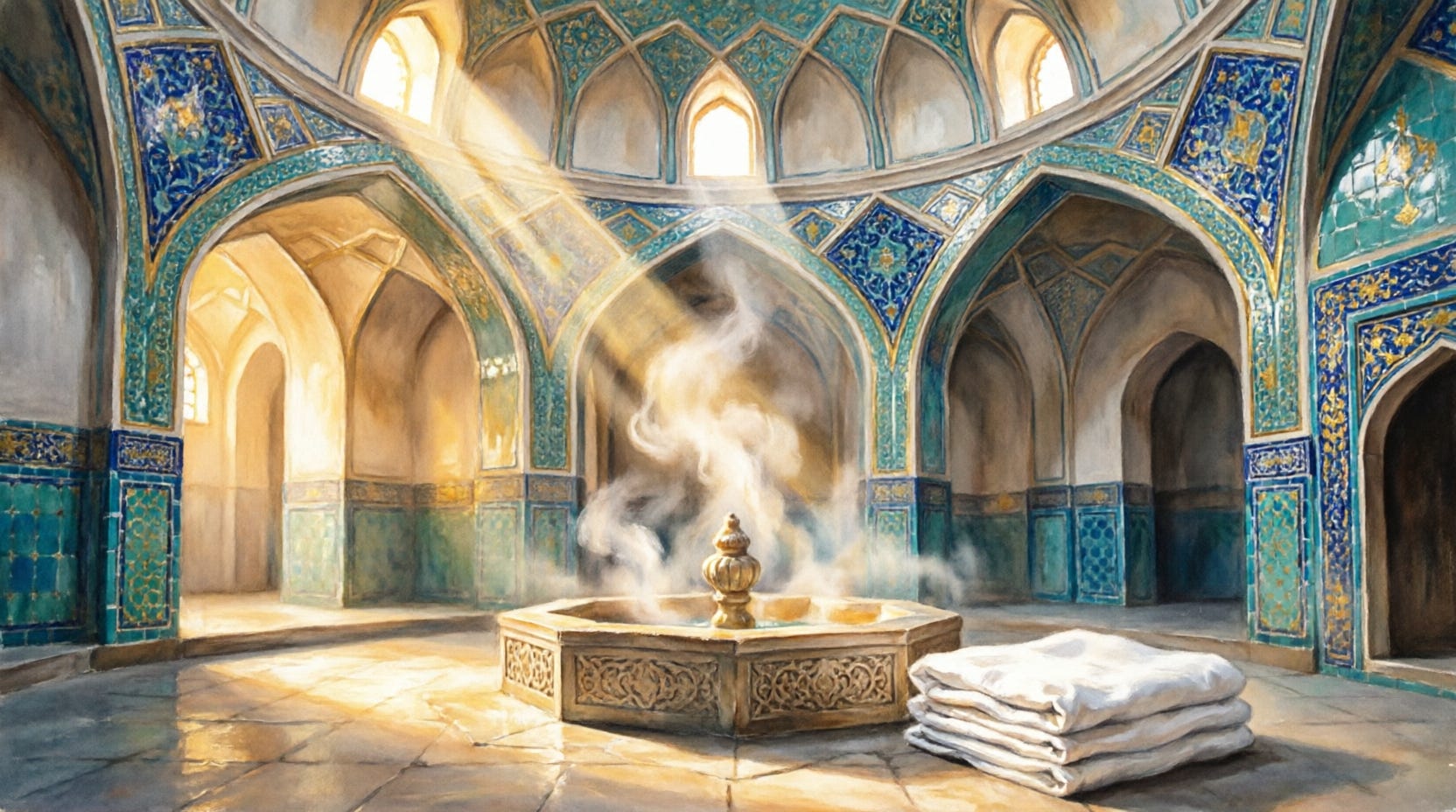
“Tell me, if your body were soiled with dirt so that you were pained and discomforted and afflicted with running sores, and you knew that a washing in the bathhouse (hammam) would rid you of all that filth and pain, would you not wish to avail yourself of the bathhouse to cleanse yourself of the dirt? Or would you be reluctant to do so and prefer to remain in your polluted state?”
The sick man lifted his eyes and replied, “O descendant of the Messenger of God! I would definitely prefer to wash myself and become clean.”
Imam al-Hadi (AS) smiled warmly and provided the ultimate prescription for peace:
“Know, then, that death is exactly like the bathhouse. It represents your last chance to rid yourself of your sins and to purify yourself of evil. If death embraces you now, there can be no doubt that you will be freed of all sorrow and pain and attain everlasting happiness and joy.”
Historical accounts note that upon hearing these few words, the man’s gnawing terror instantly dissolved into an overwhelming sense of calm. He peacefully closed his eyes and surrendered his soul, full of hope.
Divine Echoes: The Quranic Perspective
The comforting analogy of Imam al-Hadi (AS) perfectly aligns with how the Holy Quran frames the transition from this world. In the Islamic worldview, life and death are not cosmic accidents, but intentional phases of spiritual development.
A Transition, Not an End: The Quran notes that the transition of a righteous believer is handled with profound gentleness by the angels:
“Those whose lives the angels take while they are in a pious state, saying [to them]: ‘Peace be upon you! Enter Paradise because of what you used to do.’” (Quran, Surah an-Nahl, Chapter 16, The Bee, Verse 32)
The Ultimate Return: Rather than a descent into a cold void, death is a return to a merciful Creator:
“[To the righteous it will be said], ‘O reassured soul, return to your Lord, well-pleased and pleasing [to Him], and enter among My [righteous] servants, and enter My Paradise.’”
(Quran, Surah al-Fajr, Chapter 89, The Daybreak, Verse 27-30)
Wisdom of the Ahl al-Bayt (AS)
Imam al-Hadi’s (AS) beautiful perspective wasn’t an isolated teaching; it inherited the foundational framework established by his ancestors, the Ahl al-Bayt (AS), who consistently taught that death is merely a gateway for the believer.
Imam Ali ibn Abi Talib (AS): The Commander of the Faithful famously illustrated the absolute fearlessness of a believer when he was struck with the fatal blow in worship, crying out: “By the Lord of the Kaaba, I have succeeded!” He also taught: “To the believer, death is like stripping off dirty, tight clothes and replacing them with the finest, most comfortable garments.”
Imam al-Husayn (AS): On the day of Ashura, amid the ultimate worldly trial, Imam al-Husayn comforted his companion by saying: “Patience, O sons of noble heritages! Death is nothing but a bridge that carries you from distress and hardship to the vast paradises and everlasting blessings.”
Shifting Our Paradigm
When we look through the lens offered by Imam al-Hadi (AS), the terrifying shadow of death vanishes. For the believer who has strived, stumbled, and sought forgiveness, death loses its cruelty. It ceases to be an executioner and becomes a spiritual bathhouse—a final, merciful cleansing that washes away the mud, scars, and exhausting trials of this earthly existence, welcoming the soul into the ultimate embrace of absolute joy.
Ask yourself once again: with this gentle, beautiful perspective in mind, does death still seem as frightening as it once did?