

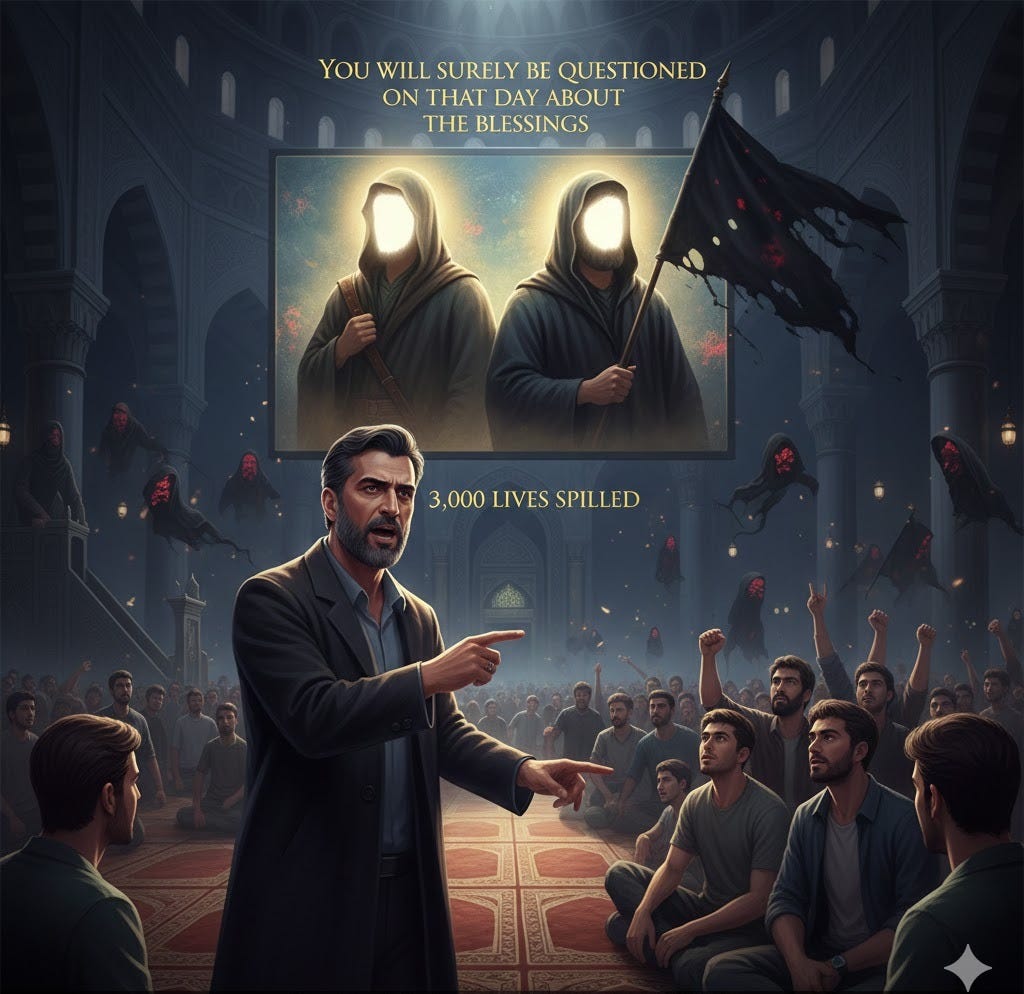
In a powerful address, the speaker challenges the Muslim community’s passive approach to faith and social responsibility, questioning why believers wait for tragedy before taking action. The discourse centers on the events of 22 Dey (January 12th in the Iranian calendar), which the speaker considers the most significant historical event of the revolution, when people with insight rose up to counter the greatest terrorist threat against the nation.
The Unprecedented Nature of Contemporary Muslim Action
The speaker emphasizes the exceptional nature of the current Muslim community, declaring that throughout Islamic history, there has never been a people quite like those who stood up during this critical moment. However, this praise is immediately followed by a sharp critique that forms the core of the address.
Why did you give the enemy courage? Where were you? Must three thousand people’s blood be spilled before you come to the streets?
— Sheikh Ali Reza Panahian
The Crisis of Empty Mosques
A central concern raised is the state of mosques in the community. The speaker questions why mosques remain empty and lacking vitality, arguing that this emptiness emboldens enemies. The critique extends to those who sit in religious gatherings (hey’at) without understanding their true purpose, living as if the awaited Imam Mahdi (may our souls be sacrificed for him) has already arrived and everything has been resolved.
The speaker challenges the community’s complacency, asking why believers are not living in active anticipation and preparation. The goal, as stated, should be to act in such a way that enemies lose their ambition to harm the community.
Islam: A Religion of Active Responsibility
The discourse firmly rejects any notion of passive or irresponsible religiosity. According to the speaker, Islam does not accommodate inactive faith or believers who shirk their responsibilities. The Quran’s approach is described as one that holds even good people accountable, demanding more from those who have received divine blessings.
The Quranic Evidence
To support this argument, the speaker cites a crucial Quranic verse:
لَتُسْأَلُنَّ يَوْمَئِذٍ عَنِ النَّعِيمِ
- You will surely be questioned on that Day about the blessings
— The Holy Quran, Surah, at-Takathur, Chapter 102, The Multiplication of Wealth, Verse 8
The speaker emphasises the certainty of this questioning through the grammatical construction of the verse, noting the double emphasis (the letter ‘lam’ and the intensified ‘nun’) that makes this promise absolute. This questioning specifically targets those who follow the path of Wilayah (divine guardianship) regarding the blessing of this spiritual connection.
The Weight of Husayn’s Sacrifice
The most emotionally charged part of the address focuses on the responsibility believers bear toward Imam Husayn (peace be upon him). The speaker poses a haunting question about divine accountability:
God will say: ‘Certainly I will ask about the blessing I gave you. I gave you Husayn - what did you do? What did you do for Husayn? Husayn did everything for you. He gave his existence and his family for you.’
— Sheikh Ali Reza Panahian
This rhetorical device powerfully illustrates the asymmetry between what Imam Husayn sacrificed and what contemporary Muslims offer in return.
No Excuses on the Day of Judgment
The speaker, acknowledging their own shortcomings and describing themselves as potentially the most guilty when questioned by God, categorically rejects any possibility of exemption from divine accountability. The address dismisses several potential excuses:
Being a regular prayer attendee at the mosque will not grant exemption
Serving as a mosque trustee or imam will not provide immunity
Being a faithful, religious youth will not excuse inaction
The failure of leaders to fulfill their duties will not justify personal negligence
The intensity of global imperialism’s actions will not serve as an excuse
The presence of modern-day ‘Cains’ (Qabil) will not justify hiding at home
The speaker emphatically states that the Quran’s framework simply does not accommodate such excuses. There is no divine pardon for those who fail to act simply because circumstances were difficult or leadership was lacking.
Conclusion: The Imperative of Active Faith
This address serves as a wake-up call to the Muslim community, challenging comfortable religiosity and demanding active engagement. The speaker’s message is clear: faith without social responsibility is incomplete, and divine blessings come with divine accountability. The empty mosques, the passive waiting, and the excuses for inaction all stand condemned in light of the sacrifices made by Imam Husayn and the responsibilities that come with claiming to follow his path. The call is for a faith that fills mosques, deters enemies through its vitality, and lives up to the monumental sacrifices made for its preservation.
Reference: Sheikh Ali Reza Panahian - Speech on the night of the birth of Qamar Bani Hashim (Peace be upon him) at the holy shrine of Lady Masoumeh (peace be upon her) - 23rd of Bahman, 1404 (Persian Calendar)