

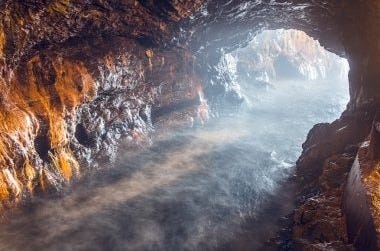
A shelter sculpted from rock and earth — a place of protection from predators and from the elements: wind, rain, and hardship.
A cave.
Not a man-made structure, but a refuge formed by nature itself, untouched by human hands and shaped by the mercy of God.
In the Quran, the cave is a place of divine protection for a group of believing youths — followers of the Prophet Jesus, who at that time would have been known as Christians. Fleeing persecution, they were told in Surah al-Kahf, Chapter 18, The Cave, Verse 16.
“Since you have distanced yourselves from them and what they worship besides Allah, take refuge in the cave. Your Lord will extend His mercy to you and accommodate you in your ordeal.”
But this was not the only time God granted safety to His believers through a cave.
Centuries later, the Prophet Muhammad sought refuge in the Cave of Thawr while being pursued by his enemies, as mentioned in Surah at-Tawbah, Chapter 9, The Repentance, Verse 40:
“Then Allah sent down His tranquillity (sakinah) upon him and supported him with angels you did not see…”
The verse reminds believers that God’s support is sufficient, even when the Prophet was hidden in a cave with only one fearful companion beside him.
Then there is the Cave of Hira — the place where the Prophet Muhammad would retreat for solitude, meditation, and contemplation. Most significantly, it was there that he received the first revelation of the Quran through the Angel Gabriel:
“Read in the name of your Lord who created.”
— Surah al-Alaq, Chapter 96, The Clot, Verse 1
The cave, therefore, becomes more than a physical shelter. It represents withdrawal from corruption, distance from the noise of society, and the search for divine mercy and guidance. It is the birthplace of revelation, contemplation, and spiritual transformation.
Caves in these sacred narratives are almost always found far from urban life and worldly distraction — remote sanctuaries removed from the clamour of society. They symbolise a turning away from a corrupt world in order to draw nearer to God.
Perhaps this is why the symbolism of the cave still resonates so deeply today. Not all of us will retreat to a mountain or a desert, but every soul needs its own cave — a place of stillness where the noise of the world fades, and the heart can return to God.
In a world overwhelmed by distraction, constant stimulation, and spiritual exhaustion, we too must learn to withdraw at times: to step away from the endless demands of society, to reflect, to pray, and to reconnect with what is eternal. Our “cave” may be a quiet room, a moment before dawn, a solitary walk, or simply a space in which we remember God sincerely and without interruption.
The cave teaches us that guidance often begins in retreat and that closeness to God is often found away from the crowds. Sometimes we must distance ourselves from the noise of the world in order to hear the truth more clearly.