

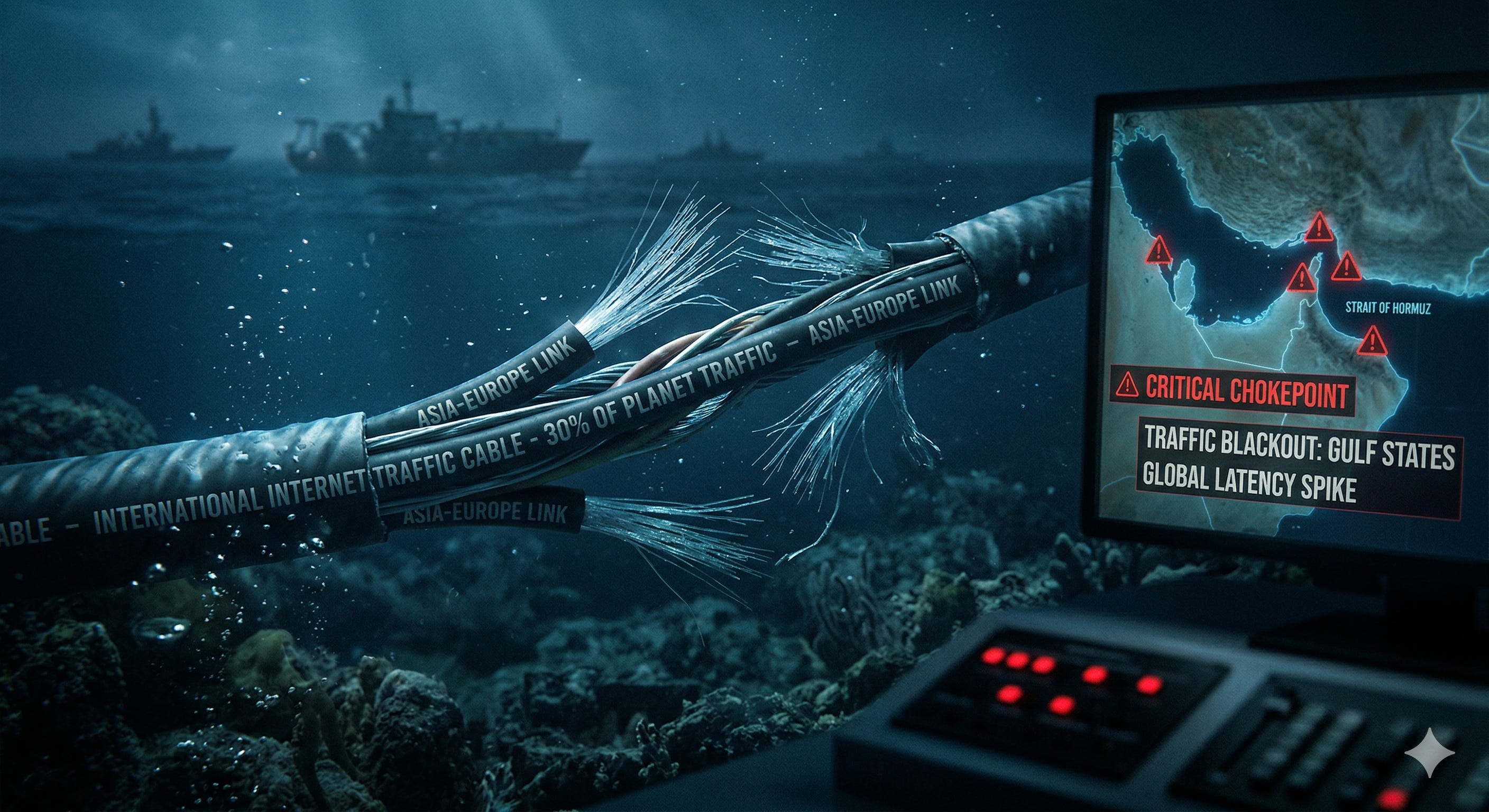
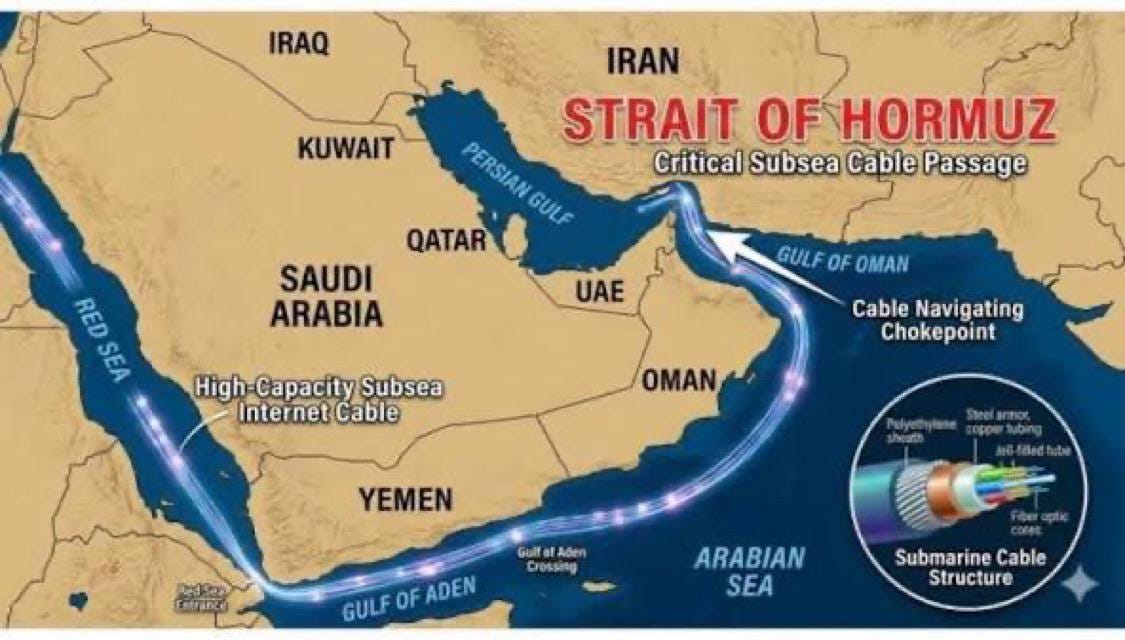
In the modern era, “cutting off a country” no longer requires a naval blockade of ships; it can be achieved by severing the hair-thin glass fibres resting on the ocean floor. The Strait of Hormuz and the Red Sea are not just corridors for oil tankers—they are the central nervous system of the global digital economy. If these cables were deliberately targeted as a retaliatory measure against Gulf States hosting foreign military forces, the world would face a connectivity crisis without precedent.
1. A Near-Total Blackout for the Gulf States
For nations like Kuwait, Qatar, Bahrain, the UAE, and Saudi Arabia, the severance of these cables would be a digital “lights out” event. While these countries have invested heavily in domestic infrastructure, they remain tethered to the global web through these specific chokepoints.
The Intranet vs. The World: While local intranets might “limp along,” it is a common misconception that domestic apps are fully independent. Most modern “local” apps rely on global Content Delivery Networks (CDNs). Even if a banking app is domestic, if its security certificate needs to be verified by a server in California or London, the app will fail to open.
The Cloud Evaporates: The Gulf has recently become a hub for massive AI and hyperscale data centres (AWS, Azure, Google Cloud). Without international fibre links, these multi-billion dollar facilities would become “isolated islands,” unable to process data for global clients or receive essential security updates.
2. The “Starlink” Fallacy
In a crisis, many assume that satellite internet providers like Starlink would save the day. In reality, satellites currently handle less than 1% of global internet traffic. While they are a lifeline for basic communication and a few emails, they lack the massive bandwidth required to support the data needs of a modern economy. They simply cannot replace the terabits of data carried by a single undersea fibre-optic strand.
3. The Global Domino Effect
The impact would not be confined to the Middle East. Because these cables represent a primary bridge between Europe and Asia/Africa, the ripple effects would be felt globally.
Latency Spikes: Internet traffic would be forced to reroute via much longer paths—likely through the Pacific or around the southern tip of Africa—causing massive slowdowns.
Cripple of Services: Real-time global trading and cloud-based collaborative tools would become painfully slow. For regions like India, Pakistan, and East Africa, the internet could become virtually unusable for professional purposes.
4. Economic Paralysis and Logistics
The global economy is built on “just-in-time” data. If the cables are cut, the flow of goods and money slows to a crawl.
Financial Markets: Stock exchanges and oil futures markets rely on millisecond-level precision. International systems like SWIFT, credit card processing, and crypto exchanges would face massive delays, making international trade nearly impossible.
Supply Chain Freeze: Modern ports and airlines operate on global coordination systems. Without stable connectivity, logistics chains for everything from medicine to microchips would be frozen at the borders.
5. Repair Times and Electronic Warfare
Fixing a deep-sea cable is not a simple task; it requires specialised cable-laying vessels and calm geopolitical waters.
The GPS/GNSS Interference: If a state is targeting undersea cables, they are likely also engaging in Electronic Warfare (GPS jamming). This makes the job of repairing ships significantly harder, as they would struggle to precisely locate and retrieve the severed cable ends on the dark sea floor without accurate satellite positioning.
The Conflict Barrier: In a scenario where the Strait of Hormuz is a “hot” zone, insurance companies would refuse to cover repair vessels. Under these conditions, the world could be looking at 6 to 12+ months of degraded, high-latency internet before the first fibre is fused back together.
Conclusion
The vulnerability of our undersea infrastructure highlights a paradox of the 21st century: our most advanced technologies—AI, global finance, and instant communication—rely on a few vulnerable strands of glass at the bottom of the sea. In the Strait of Hormuz, the “digital chokepoint” is just as critical, and perhaps more fragile, than the oil chokepoint the world has feared for decades.