

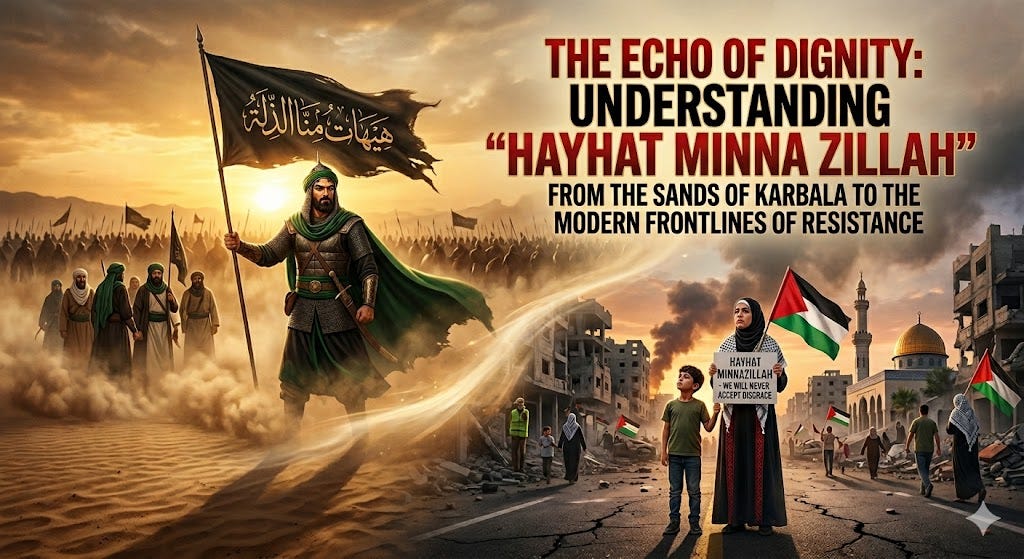
The phrase “Hayhat Minna Zillah” (هيهات منا الذلة) is much more than a historical quote; it is a timeless doctrine of human dignity. Translated as “Far from us is disgrace” or “We will never accept humiliation,” it represents a fundamental refusal to bow to tyranny, regardless of the cost.
To understand the political and spiritual movements of the modern Middle East, one must first understand the profound weight of these three words. They form a bridge connecting a 7th-century battlefield to the geopolitical struggles of today.
The Origins: Imam Husayn and the Ultimate Choice
The origins of this powerful declaration lie in the scorching desert of Karbala in 680 AD (61 AH). Imam Husayn ibn Ali, the grandson of the Prophet Muhammad, found himself surrounded by the massive, heavily armed forces of the Umayyad caliph, Yazid.
Yazid was known for his corruption, tyranny, and severe departure from the principles of justice. He demanded that Imam Husayn pledge allegiance to him, essentially asking the Imam to legitimise an unjust and oppressive rule. The ultimatum given to Imam Husayn was absolute: submit and pledge allegiance, or face certain death.
It was in this desperate, defining moment that Imam Husayn uttered the words that would echo through eternity:
“The bastard, son of a bastard, has left me with only two choices: drawing the sword or accepting humiliation. And Hayhat Minna Zillah (far from us is disgrace)! God, His Prophet, the believers, and the pure and chaste wombs that bore us reject that we should prefer obedience to the vile over the honourable death of the martyrs.”
Imam Husayn chose to be massacred alongside his family and a small band of 72 companions rather than legitimise a tyrant. By choosing death over submission, he established a permanent moral paradigm: that true defeat is not losing your life, but losing your dignity and compromising your principles.
The Modern Echo: The Maximum Pressure Ultimatum
Fast forward to the modern era, and “Hayhat Minna Zillah” has become the ideological bedrock of Iran and the broader “Axis of Resistance.” Iran’s Supreme Leader, Martyr Ayatollah Ali Khamenei, frequently invoked this exact phrase to articulate the geopolitical stance of Iran against modern global imperialism, most notably during severe confrontations with the United States.
A defining moment of this dynamic occurred during Donald Trump’s presidency. Following the US withdrawal from the nuclear deal (JCPOA), the Trump administration launched a “Maximum Pressure” campaign and issued a sweeping, 12-point ultimatum to Iran. This ultimatum essentially demanded total geopolitical capitulation:
Nuclear and Military Surrender: Iran was ordered to indefinitely halt all nuclear enrichment and completely dismantle its ballistic missile program.
Regional Withdrawal: Iran was told to cut all ties with and funding for its regional allies (including Hezbollah, Hamas, and the Houthis) and withdraw its forces from Syria.
The implicit threat was clear: submit entirely to American demands, or face crushing economic sanctions and the looming threat of military destruction.
For Martyr Imam Khamenei, this sweeping ultimatum was the modern equivalent of Yazid’s demand at Karbala. He explicitly rejected the demands, labelling negotiations under such coercive threats as “poison.” By invoking “Hayhat Minna Zillah,” Imam Khamenei drew a direct parallel, framing the US as the modern oppressor demanding submission, and Iran as the camp of Husayn. He argued that yielding to such an arrogant ultimatum to avoid economic hardship or military strikes would be an acceptance of disgrace. Instead, he declared that the nation would resist, proving that sacrificing wealth and comfort is preferable to sacrificing national sovereignty and dignity.
This stance set the tone for Iran’s ongoing resistance against subsequent pressures and military threats, reinforcing the idea that yielding to foreign hegemony is the ultimate humiliation.
“Hayhat Minna Zillah” in Today’s World: The Current Wars
When we look at the world today, particularly the devastating conflicts currently reshaping the Middle East, the philosophy of “Hayhat Minna Zillah” is playing out in real-time beneath the rubble of modern warfare.
The War in Gaza: In the face of overwhelming military bombardment, blockade, and starvation, the people of Gaza have exhibited a resilience that leaves the world stunned. When civilians refuse to leave their ancestral lands despite massive ordnance, or when a mother holds her martyred child and praises God instead of begging for the mercy of her oppressors, the world is witnessing “Hayhat Minna Zillah” in action. It is the collective refusal of an indigenous population to quietly accept erasure and subjugation.
The Broader Regional Conflict: As the conflict continues to engulf Lebanon, Yemen, and beyond—with unprecedented strikes and military escalation directly involving global powers like the US and Israel—resistance factions invoke this exact slogan when firing back or blockading shipping lanes. They frame their fight not just as a territorial dispute, but as an existential battle against foreign domination. The staggering disparity in military might mirrors the imbalance at Karbala, yet the resolve to fight remains the same.
The Global Anti-Imperialist Sentiment: Beyond the Middle East, the spirit of this phrase resonates with any population facing neo-colonialism or systemic oppression. Whether it is students protesting on university campuses worldwide against the funding of war machines, or nations in the Global South refusing to be dictated to by Western powers, the core ethos is identical: a rejection of subservience.
Conclusion
“Hayhat Minna Zillah” teaches that true power does not lie in the size of an army, the sophistication of weaponry, or the wealth of an empire. True power lies in the unbreakable will of the human spirit.
Imam Husayn proved in 680 AD that by sacrificing his blood, he could defeat the sword of his oppressors in the court of history. Today, as that same rallying cry echoes from the geopolitical decisions of Iranian leadership in the face of presidential ultimatums, to the besieged streets of Gaza and a wider regional war, the lesson remains clear: those who are willing to lose everything for the sake of their dignity can never truly be defeated.