

The Sin That Takes Lying to Another Level
In the last article, we talked about lying — and we established that it is the key to every evil, that it plants hypocrisy in the heart, and that it slowly but surely fragments the interior life of the person who habitually practices it.
Now we move to something that takes the sin of lying and multiplies its gravity in a way that should genuinely make every Muslim pause.
False oath — swearing by Allah that something is true when you know it is not — or swearing in the name of Allah to do something you have no intention of doing.
Think about what that is for a moment. Lying is presenting a falsehood to another person. But a false oath is doing something far more audacious — it is invoking the name of the Creator of the universe as a witness to a lie. It is using Allah’s name as a tool of deception. It is taking the most sacred thing in existence — the name of Allah — and making it serve dishonesty.
False swearing is a greater sin as mentioned in the authentic tradition recorded by Abdul Azim and also in the tradition of Imam al-Ridha (AS) as quoted by Fazl Ibn Shazan. There is a report from Imam Ja’far al-Sadiq (AS) in the book Tuhaf ul Uqul: “False swearing causes destruction of the faith.”
Destruction of the faith. Not weakening. Not damage. Destruction.
What Exactly Is a False Oath?
An oath in Islamic law is the solemn invocation of Allah’s name as witness to the truth of a statement or the sincerity of a commitment. It is the verbal equivalent of saying — I am so certain of this, so committed to this, that I am placing Allah Himself between me and any deception.
That is an enormous thing to do. And Islam treats it as such.
A false oath — Yamin al-Ghamus, as the scholars call it — is an oath sworn on something the person knows to be untrue. The name comes from the Arabic root meaning to plunge or to drown — because this oath drowns the person in sin and then in the Fire.
Ayatollah Dastaghaib Shirazi explains that there are two main categories of false oaths to understand:
The first is swearing by Allah that a past event is true when you know it is not. “Wallahi, I never took that money.” “I swear by Allah, I was at home that night.” Invoking Allah’s name to confirm a lie you know you are telling.
The second is swearing by Allah to do something in the future with no genuine intention of fulfilling it. “Wallahi, I will pay you back next week.” “I swear by Allah, I will never do it again.” Using Allah’s name to make a promise you have no real commitment to keeping.
Both are false oaths. Both are greater sins. And both share the same devastating quality — they weaponise the name of Allah in service of deception.
What the Quran Says
The Quran addresses oaths extensively — and the picture it paints makes clear how seriously Allah regards the careless or dishonest use of His name.
In Surah al-Baqarah, Chapter 2, The Cow, Verse 224, Allah says:
“And do not make Allah a reason — through your oaths — for refraining from doing good, acting rightly, and making peace between people. And Allah is Hearing and Knowing.”
This verse addresses a specific misuse of oaths — using them as an excuse not to do good. “I swore I would never speak to him again, so I cannot make peace between them.” Allah is saying: do not use My name as an excuse for sin or for abandoning what is right.
In Surah al-Maidah (Chapter 5, The Table Spread, Verse 89), Allah addresses the breaking of oaths — and prescribes a specific kaffarah (expiation): feeding ten poor people, or clothing them, or freeing a slave. If unable — then fasting for three days. The existence of this detailed expiation tells us how seriously Islam takes even an accidentally broken oath — let alone a deliberately false one.
And in Surah an-Nahl, Chapter 16, The Bee, Verse 91-92), Allah gives one of the most comprehensive commands about oaths:
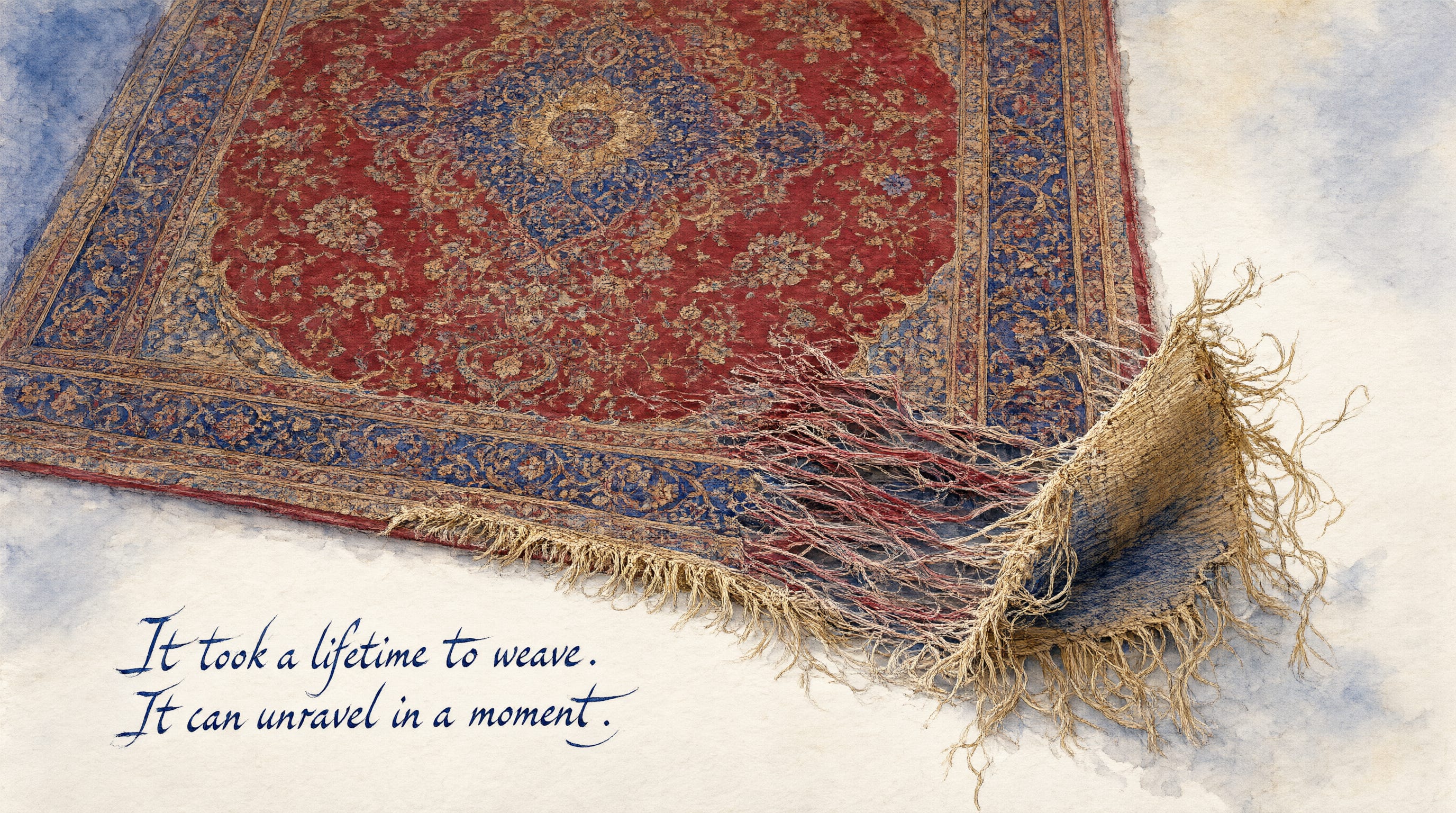
“And fulfil the covenant of Allah when you have taken it, and do not break oaths after their confirmation while you have made Allah your guarantor. Indeed, Allah knows what you do. And do not be like she who unravelled her spun thread after it was strong — taking your oaths as means of deception between you.”
The image of the woman who spins a strong thread and then unravels it is one of the most vivid in the entire Quran — a picture of pointless self-destruction, of wasted effort, of creating something solid and then deliberately dismantling it. That is what a false oath does to the fabric of trust, of faith, and of the soul itself.
What the Ahlul Bayt (AS) Taught
The Imams (AS) spoke about false oaths with extraordinary gravity — connecting it directly to the destruction of the most fundamental spiritual assets a believer possesses.
Imam Ja’far al-Sadiq (AS) said: “False swearing causes destruction of the faith.” Not damage. Not weakening. Destruction. The Arabic word used — hadm — means to demolish, to tear down completely. The false oath does not simply chip away at faith. It brings it down.
Why such severity? Because faith — iman — is built on a relationship of truth between the servant and Allah. Every act of worship, every dua, every salah is a communication between the believer and their Lord. When a person takes Allah’s name as a witness to a lie — deliberately, knowingly — they are not just committing an act of dishonesty. They are corrupting the very channel through which their entire spiritual life flows.
The Prophet (S) placed false oath in a category all its own. He said: “The major sins are: associating partners with Allah, disobeying parents, murder — and false oath.” In this particular narration, he listed false oath alongside the very sins that head this entire series. Its company in that list is telling.
And Imam Ali (AS) said something that captures both the gravity and the practical consequence: “Beware of false oaths — for they destroy the home.” Not just the soul. The home. The family. The household built on false promises collapses — not eventually, not theoretically, but practically, predictably, and often with devastating speed.
The Three Types of Oath in Islamic Law
Ayatollah Dastaghaib Shirazi helpfully distinguishes between different types of oaths, so we understand precisely what is and is not sinful:
Yamin al-Ghamus — The Drowning Oath:
This is the false oath we are discussing today — deliberately swearing by Allah on something known to be untrue. It is called the drowning oath because it plunges the person into sin and into the Fire. This is the greater sin.
Yamin al-Mun’aqida — The Binding Oath:
This is a genuine oath about something in the future — a sincere commitment made in Allah’s name. This oath is binding. Breaking it without genuine necessity requires kaffarah — expiation. But it is not a greater sin in itself — only in the deliberate breaking of it.
Yamin al-Laghw — The Idle Oath:
This is the casual, habitual use of Allah’s name in conversation — “Wallahi, you won’t believe this story” or “Wallahi, it was the best biryani I’ve ever had.” These oaths — where there is no real intention to invoke Allah as a formal witness — are considered by most scholars as not sinful in themselves, though they are discouraged because they habituate a carelessness with Allah’s name that can slide toward something more serious.
The distinction matters practically. Someone who casually says “Wallahi” in conversation is not committing a greater sin. But someone who says “Wallahi, I did not take that money” knowing full well they did — that is Yamin al-Ghamus. That is the drowning oath. And the difference between them is everything.

The Commerce of False Oaths — A Warning for Business
One of the most practically relevant discussions in Ayatollah Dastaghaib Shirazi’s chapter on this sin is the specific warning about false oaths in business and trade.
The Prophet (S) said: “A false oath makes goods sell but removes the barakah from the transaction.”
This is one of the most precise descriptions of how sin operates in economic life. The false oath works — in the short term. The customer believes the seller. The goods sell. The money changes hands. But the barakah — the divine blessing that makes wealth grow, sustain, and bring genuine happiness — has been removed. The money arrives, but it does not flourish. The business succeeds on paper but does not bring peace.
In our community — in markets, in businesses, in transactions between family members, in car dealing, in property sales — the casual use of “Wallahi” to make a deal, to convince a reluctant buyer, to assure someone of a quality that may not be fully true — this is among the most common forms of false oath in daily Muslim life.
The Imam (AS) warned about this specifically because the temptation in business to use Allah’s name as a sales tool is enormous — and the damage it does, spiritually and eventually materially, is equally enormous.
The Prophet (S) also said: “Three people will not be spoken to by Allah on the Day of Judgement, nor will He look at them, nor purify them — and for them is a painful punishment: the old man who commits adultery, the king who lies, and the poor man who is arrogant.” Some narrations add a fourth: the merchant who swears false oaths.
The merchant. Specifically. By name. Because the marketplace was and remains one of the places where Allah’s name is most casually and most frequently abused.
The Oath of Dissociation — A Warning Story
Ayatollah Dastaghaib Shirazi includes a striking account in this chapter that illustrates the gravity of false oaths in a uniquely Shia context.
There was a man who came to Imam Musa al-Kadhim (AS) and was accused of something he denied. The Imam, in a complex political situation involving the Abbasid caliph Mansur, suggested that the man take an oath of dissociation — swearing that if he was lying, he would be dissociated from the Prophet (S) and the Ahlul Bayt (AS).
The man took the oath — and died shortly afterwards.
The scholars who discuss this account are careful to explain that the Imam knew something about this man that others did not — and that the oath of dissociation from the Prophet and the Ahlul Bayt, taken falsely, carries consequences of a uniquely severe nature. Because in Shia theology, the Wilayah of the Ahlul Bayt is itself the most fundamental spiritual covenant — and to invoke dissociation from them falsely is to strike at the root of the believer’s connection to Allah.
This account is not presented to frighten but to illustrate — there are some things so sacred that using them carelessly or falsely carries consequences that arrive in this world, not just the next.
The Habitual Wallahi — A Gentle Warning
Let us speak directly about something that is extremely common in Muslim communities — including our own.
The word Wallahi — by Allah — has, in many of our cultures, become a conversational filler. It is used to add emphasis, to express surprise, to make a point more vivid, to win an argument. “Wallahi, he’s the best cook.” “Wallahi, I’m telling you, it happened.” “Wallahi, I don’t know what you’re talking about.”
In most of these uses, there is no deliberate false oath — the speaker is not consciously invoking Allah as a formal witness to a deliberate lie. And as we noted earlier, scholars generally classify habitual idle oaths as discouraged but not sinful in the same category as Yamin al-Ghamus.
But there is a danger in the habit. The more casually we use Allah’s name, the less weight it carries in our own hearts. The person who says Wallahi twenty times in a conversation has — without realising it — trained themselves to treat Allah’s name as an ordinary word. And the person who has trained themselves to treat Allah’s name as ordinary is the person who, when the serious moment comes — when they actually need to make a genuine oath, when the temptation to use that name in service of a lie is real — has already eroded the internal barrier that should make that impossible.
The Quran’s command in Surah al-Baqarah, Chapter 2, The Cow, Verse 224 — not to make Allah a reason through your oaths — applies not only to deliberate misuse but to the gradual casualisation of something that should always feel weighty, always feel significant, always feel like what it actually is: the invocation of the Lord of all creation as your witness.
Guard His name. Every time you say it — mean it.
What About Oaths That Are Broken Unintentionally?
The Quran and the Ahlul Bayt are compassionate toward the person who makes a genuine oath and then finds themselves unable to keep it — not through deception but through genuine circumstance.
For such cases, kaffarah — expiation — is prescribed: feeding ten poor people, or clothing them, or freeing a slave. If none of these is possible, fasting for three days.
This expiation is not a punishment for weakness. It is a recognition that life is complex, that circumstances change, and that a sincere believer who made a genuine commitment and found themselves unable to keep it has not committed the same sin as the person who invoked Allah’s name knowing from the start that they were lying.
The tawbah from a false oath — from Yamin al-Ghamus — requires genuine remorse, the kaffarah of expiation, and, where the false oath caused harm to another person, making amends for that harm wherever possible. Because a false oath does not only offend Allah — it frequently defrauds, deceives, or harms the person to whom it was made. That person’s right must also be addressed.
The Connection to the Previous Sin
Notice the beautiful and sobering progression across the last two articles. Sin 17 — lying — established that the tongue is a weapon. That words, when untrue, destroy the internal life of the speaker and the trust of the community around them.
Sin 18 — false oath — takes that weapon and coats it in the sacred. It takes the most dangerous thing a tongue can do — speak falsehood — and wraps it in the name of Allah. If lying is a knife, false oath is that same knife held against the name of the One who created truth itself.
That is why the Imam said it causes the destruction of faith. Not because Allah is offended in the way a human ego might be. But because faith — iman — is fundamentally a relationship of truth. It is built on La ilaha illallah — a statement of ultimate reality. A person who uses that same reality as a vehicle for falsehood has not just broken a rule. They have struck at the very foundation of the structure they are supposed to be building their entire life on.
A Closing Thought
False oath sits eighteenth on this list — and it sits there as a warning about one of the subtlest and most serious ways we can dishonour the name of Allah in our daily lives.
Most of us will never bow to an idol. Most of us will never deny Allah outright. But many of us — in moments of fear, of financial pressure, of wanting to be believed, of needing a deal to go through — have reached for His name and placed it in service of something less than truth.
The Ahlul Bayt are asking us to make His name too precious for that. To feel the weight of Wallahi every single time it leaves our lips. To reserve it for moments of genuine, truthful, committed invocation — and to let it rest in dignified silence at every other time.
Because a name that is never cheapened is a name that retains its power. In our hearts, in our du’a, in our salah — when we say Allahu Akbar, we want it to mean something. And it will only mean something if we have spent our lives treating His name as what it is — the most sacred utterance a human tongue can produce.
May Allah guard our tongues from false oaths, make His name the most beloved sound in our hearts, and grant us the integrity to mean what we say and say only what we mean. Ameen.