

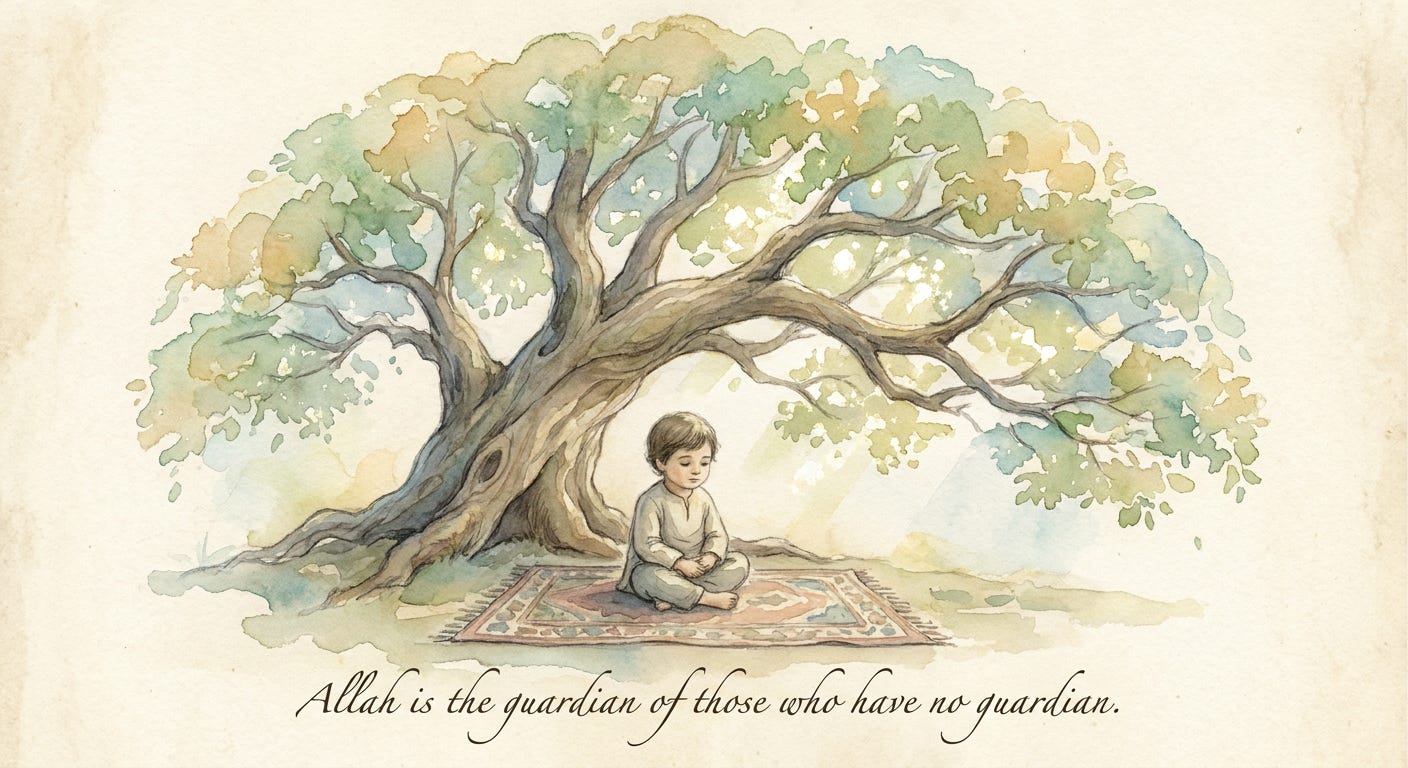
The Most Defenceless People in Any Society
Think for a moment about what it means to be an orphan.
You have lost the person — or the people — who were your entire world. Your provider. Your protector. Your safe place. You are small. You are grieving. You don’t fully understand what has happened, only that the person who used to hold your hand is no longer there.
And now imagine that the adults around you — the very people who were supposed to care for you in your parents’ absence — begin quietly taking what little was left behind for you.
That is the eighth greater sin. And the reason Allah responds to it with such severity is not hard to understand at all.
What Is This Sin Exactly?
The eighth greater sin is to usurp the property of an orphan who has not yet attained maturity. This is confirmed as a greater sin by the Holy Prophet (S), Imam Ali (AS), Imam al-Ridha (AS), and Imam al-Kadhim (AS).
An orphan in Islamic law is a child who has lost their father before reaching the age of maturity — the age at which they can manage their own affairs. Until that time, any wealth, property, or inheritance left behind by their father belongs entirely to them and must be protected, maintained, and handed over to them intact when they come of age.
The guardian — whether an uncle, a relative, a family friend, or a court-appointed trustee — is not an owner. They are a custodian. They hold that wealth in trust. The moment they begin treating it as their own — spending it, investing it for personal gain, delaying its return, or simply absorbing it quietly into the family finances — they have crossed into one of the gravest sins in Islam.
And the Quran describes what awaits them in terms that are viscerally, uncomfortably vivid.
What Does the Quran Say?
In Surah an-Nisa, Chapter 4, The Women, Verse 10, Allah says:
“Indeed, those who devour the property of orphans unjustly — they are only consuming fire into their bellies. And they will be burned in a blazing fire.”
The word used here is swallow — they swallow fire into their bellies. Not a metaphor gently applied. A direct, graphic statement about what is actually happening in a spiritual sense when someone reaches into an orphan’s share and takes it for themselves. Every coin spent. Every piece of property absorbed. Every inheritance delayed or denied. It is fire being eaten — and it will one day become fire from which there is no escape.
Ayatollah Dastaghaib Shirazi points out the extraordinary precision of this verse. Allah does not say “they will be punished with fire” — He says they are already consuming it. The sin and its consequence are described as inseparable. You don’t eat the orphan’s property and then face a fire later. In a profound spiritual sense, you are eating the fire right now.
In Surah al-Baqarah, Chapter 2, The Cow, Verse 220, Allah addresses those entrusted with orphans directly and with remarkable nuance:
“They ask you about orphans. Say: Improvement for them is best. And if you mix your affairs with theirs, they are your brothers. Allah knows the one who causes corruption from the one who does good.”
Notice how Allah frames this. He acknowledges the reality that sometimes guardians live with orphans, share meals with them, manage finances together. He is not demanding an impossible, clinical separation. But He draws the line absolutely clearly: Allah knows the difference between the guardian who mixes affairs out of genuine care and the one who mixes them out of greed. You cannot hide that difference from Him, even if you can hide it from everyone else.
Why Is This Sin So Severe?
Ayatollah Dastaghaib Shirazi explains the depth of this sin beautifully. It is not merely about money. It is about the compounding of cruelty — adding injustice to grief, taking advantage of vulnerability at its most extreme.
The orphan cannot defend themselves. They cannot take you to court as an equal. They cannot fully understand what is being taken from them. They cannot even articulate the loss. And so the person who steals from them is exploiting not just their financial weakness but their emotional devastation, their youth, their total dependence on the goodness of the adults around them.
Islam looks at that and says: this is among the worst things a human being can do. Not because property is sacred above all else — but because the orphan is.
There is a hadith from Imam Ali (AS) that captures this with heartbreaking clarity. He said:
“Fear Allah regarding the orphans. Do not allow them to go hungry, and do not let them be lost while you are present.”
Do not let them be lost while you are present. The guardian who steals from an orphan has not just taken their money — they have abandoned them entirely, choosing themselves over the most vulnerable person in their care.
The Punishment Arrives in This World Too
One of the distinctive aspects of this sin, which Ayatollah Dastaghaib Shirazi emphasises, is how swiftly its consequences manifest in this life — not just the next.
There is a narration about a man who passed away leaving behind debts and young children. A guardian was appointed. That guardian, over time, began mismanaging and absorbing the children’s inheritance. Not long after, the guardian began to suffer — his own affairs became disordered, his health declined, his household fell into difficulty. Those who knew the situation recognised what was happening.
The Imam (AS) explained it this way:
“The one who eats the property of an orphan unjustly will find that Allah removes the barakah from his own sustenance. And if he has children, they will suffer for it too.”
This is one of the most sobering teachings in the entire chapter. The sin does not stay contained. It spreads. It seeps into the household of the one who committed it. The barakah — the divine blessing that makes wealth grow and last and bring happiness — is lifted. And the family that benefited from stolen wealth finds that the wealth brings them nothing of what they had hoped.
What the Ahlul Bayt (AS) Taught About Orphans
The teachings of the Imams on the care of orphans go far beyond simply not stealing from them. They paint a picture of what the Islamic community is supposed to look like around its most vulnerable members — a picture of extraordinary tenderness.
Imam Ali (AS) in Nahj al-Balagha writes in his famous letter to Malik al-Ashtar, his governor in Egypt:
“Let the orphan never go to bed hungry while you have eaten. Let the widow never feel abandoned while you have a home. These are the people whose prayers are answered immediately before Allah — and whose curses reach Him just as fast.”
That last line is crucial and worth pausing on. The dua of the oppressed — and especially the orphan — travels directly and unimpeded to Allah. There is no barrier. No delay. No bureaucracy of mercy between the crying of an orphan and the hearing of Allah.
The Prophet (S) himself demonstrated this practically and personally. He was an orphan. He lost his father before his birth and his mother at the age of six. He knew, from the inside, what it felt like to be the child with no one. And so every teaching he gave about orphans carried the weight of lived experience.
He said: “I and the one who cares for an orphan will be in paradise like this” — and he held up his index and middle fingers close together. Caring for an orphan — genuinely, lovingly, protectively — earns you the companionship of the Prophet (S) himself in Jannah.
The flip side of that promise is the gravity of the sin we are discussing today.
It Goes Beyond Money — The Rights of the Orphan’s Heart
Ayatollah Dastaghaib Shirazi makes a point here that elevates this discussion beyond the purely financial. The property of an orphan is the most obvious dimension of this sin, but the spirit behind it encompasses the entire well-being of the orphan in your care.
To make an orphan feel unwanted. To treat them as a burden. To favour your own children so obviously that the orphan grows up feeling less than. To withhold affection, education, or opportunity from them. All of these are forms of the same injustice — using your position of power over a vulnerable child for your own comfort rather than their flourishing.
The Quran in Surah ad-Dhuha, Chapter 93, The Brightness, Verse 9 gives a direct, one-line command:
“So as for the orphan — do not oppress them.”
Do not oppress them. Not: manage their finances correctly. Not: file the paperwork. Do not oppress them. The command is about the whole child — their heart, their dignity, their sense of belonging in the world.
What About Those of Us Who Are Not Guardians?
Most of us reading this article are not legal guardians of orphans. So does this sin have any relevance to our daily lives?
Yes — deeply so.
Because Islam’s concern for orphans is not only a legal matter. It is a community responsibility. The traditions are filled with encouragement to notice the orphans around us — the child of a neighbour who lost their father, the cousin whose parent passed away, the child in your extended family who is quietly struggling.
You don’t have to be their legal guardian to offer them something real. A kind word. An invitation to Eid lunch. An interest in their schooling. A check-in from time to time. The Prophet (S) taught that even running your hand over the head of an orphan out of compassion brings divine reward.
And on the other side, the warning extends equally broadly. Anyone who is in a position of financial trust over a child without full parents, and who exploits that position even in small ways, is touching the edges of this grave sin. Guardianship is a trust. The One who gave you that trust is watching every decision you make with it.
How Do We Make This Right?
If someone has taken from an orphan — whether through outright theft, negligence, or the slow absorption of property over time — the path of repentance is demanding but clear.
If the sin involves the rights of other people — like usurping someone’s property or money — it must be returned immediately to the rightful owner. If the owner has passed away, it must be returned to their heirs. If the heirs cannot be found, it must be given away in the path of Allah on behalf of the original owner.
There is no tawbah from this sin that does not include returning what was taken. Remorse alone is not enough. Prayers alone are not enough. The wealth must go back — or its equivalent — because the sin here is not just between you and Allah. It is between you and a child who was wronged.
And if you are currently in a position of guardianship over an orphan’s property, this article is a reminder and an encouragement. You are holding something precious. Not precious because of its monetary value. Precious because it belongs to someone Allah has specifically placed under His own protection. You are Allah’s instrument in keeping that trust safe.
Do it well. Do it honestly. Do it with the awareness that the One who appointed you to this trust sees everything you do with it.
A Closing Thought
There is something quietly profound about where this sin sits in the list. After Shirk, after despair, after heedlessness, after murder, after disobedience to parents and severing family ties — we arrive here. At the child sitting alone. At the small pair of hands with nothing left.
It is as though Ayatollah Dastaghaib Shirazi is building a picture for us across these eight sins — of what a heart looks like that has truly turned away from Allah. It has no Tawhid. No hope. No fear. No regard for life. No respect for those who gave it life. No care for its family. And no compassion for the most vulnerable among them.
And the antidote is the reverse — a heart with Tawhid at its centre, full of hope and healthy fear, awake to accountability, protective of life, honouring to parents, generous with family, and tender toward the orphan.
May Allah make us guardians — not just of the property of orphans, but of their dignity, their hearts, and their sense of belonging in this world. And may He protect every orphan from the cruelty of those entrusted with their care. Ameen.