

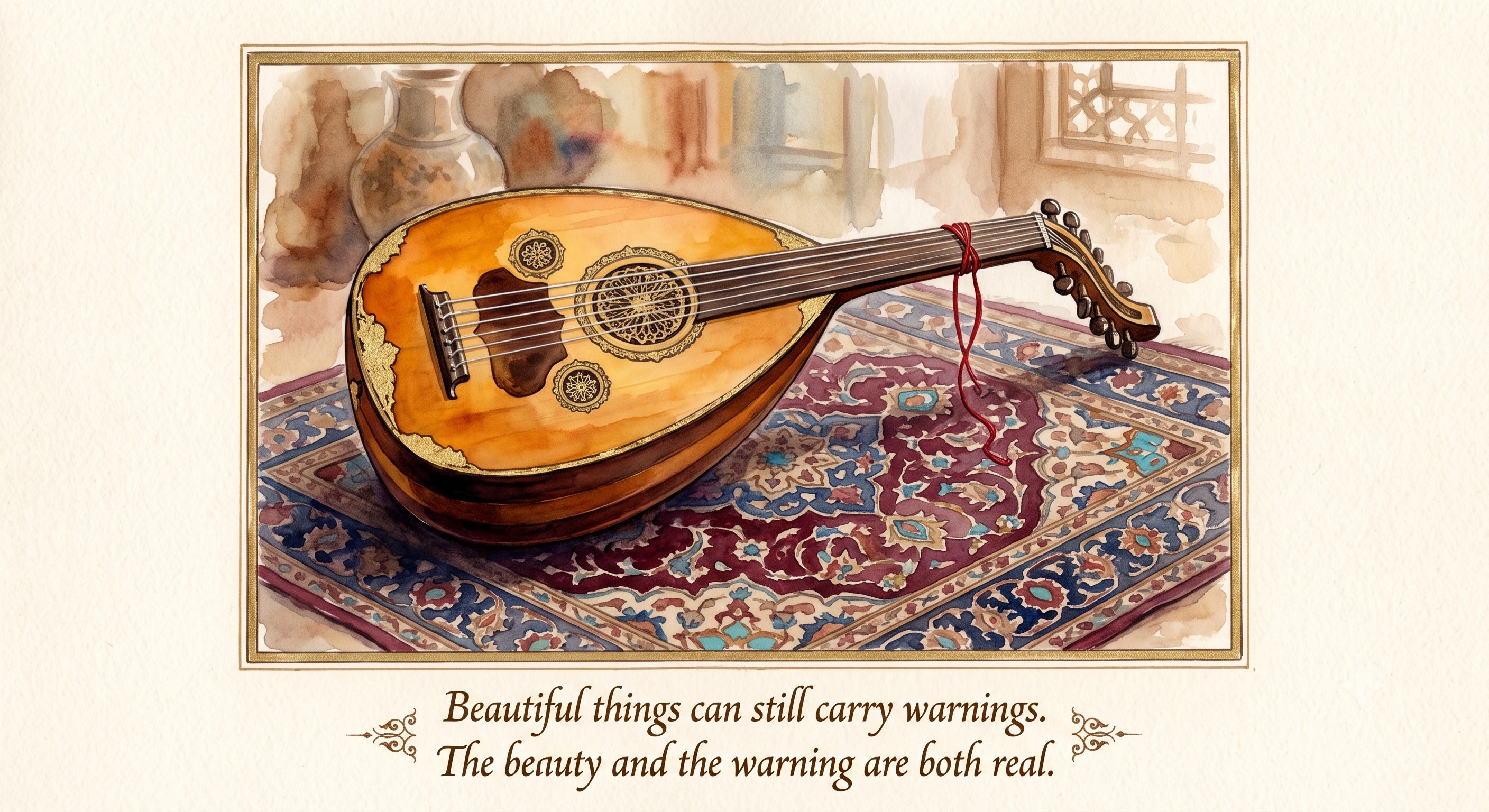
Let’s Be Honest From the Start
Of all fifteen greater sins we have covered so far — Shirk, despair, murder, gambling, alcohol, false accusation — this is the one most likely to make a reader stop and say: really? Music?
Because music is everywhere. It is in our cars, our kitchens, our earphones, our weddings, our children’s cartoons, our phone ringtones. It is the backdrop of modern life in a way that almost nothing else is. And for most Muslims living in the West, it has never felt like a serious religious question — just one of those things that some scholars mention but nobody really takes seriously.
So this article is going to do something slightly different. Rather than simply stating the ruling and moving on, we are going to sit with the question honestly — what exactly did Ayatollah Dastaghaib Shirazi mean? What did the Ahlul Bayt actually prohibit? And how do we navigate this in real life with both honesty and wisdom?
Because this topic deserves nuance. And it deserves honesty. And it deserves both at the same time.
The Key Word — Ghina
The fifteenth greater sin is described in the traditions not simply as music in the broad modern sense, but specifically as Ghina (غناء) — a particular kind of music and singing.
Ghina can be explained as a sound in which the tone comes from the throat which the common people refer to as singing — it causes excitement in the person and is suitable for gatherings of vain and futile entertainment. The scholars describe it more precisely as: prolonging the sound with changes in pitch in a manner suited to the gatherings of corruption, sin, and entertainment built around heedlessness of Allah.
This is critically important — because it immediately tells us that this prohibition is not about sound itself. It is not about melody. It is not about all music in every form and context. It is about a specific kind of music — music designed to excite the lower self, music that belongs to the atmosphere of sin and heedlessness, music that pulls the heart away from Allah and toward the world.
Playing instruments of music is a greater sin. It is haram to play instruments like guitar, piano, tambourine, drums etc. Listening to music is also a greater sin. Music as a greater sin is reported by Fazl ibn Shazan from Imam Ali al-Ridha (AS)
But here is where the honest conversation begins — because the scholars of fiqh and the scholars of akhlaq (spiritual ethics) have approached this question from different angles, and understanding both is essential.
What the Quran Says — Through Interpretation
The Quran does not use the word music directly. The Quranic foundations for this prohibition come through interpretation of several verses — the most prominent being in Surah Luqman (Surah 31, Verse 6):
“And of the people is he who buys the amusement of speech to mislead from the way of Allah without knowledge — and who takes it in ridicule. Those will have a humiliating punishment.”
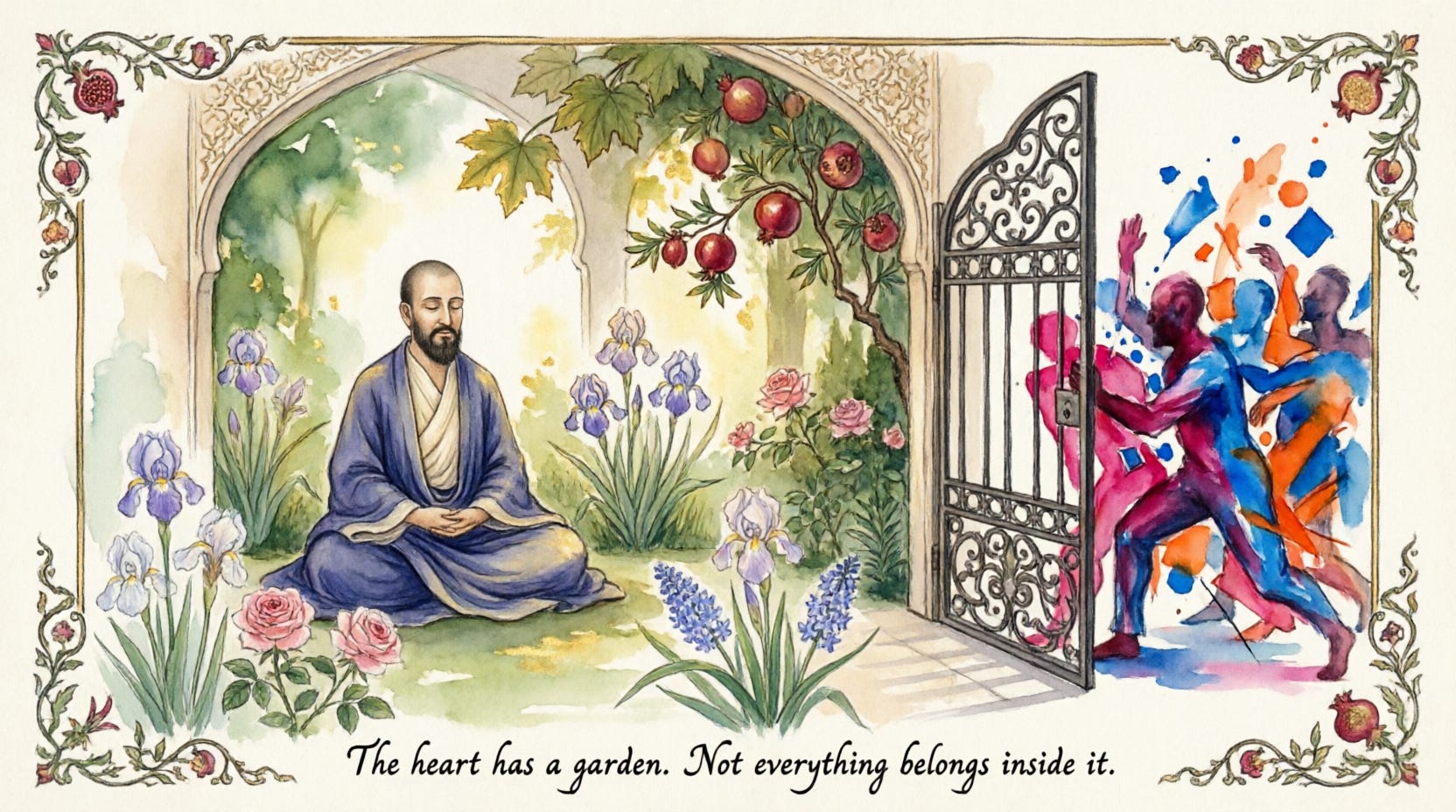
The phrase “amusement of speech” — lahw al-hadith — is interpreted by many Shia scholars, including Ayatollah Dastaghaib Shirazi, as referring to Ghina and music of the corrupting variety. Not every sound. Not every melody. But the kind of entertainment specifically designed to distract from Allah, to fill the heart with heedlessness, and to create an atmosphere where sin feels comfortable.
In Surah Al-Isra (Chapter 17, The Children of Israel, Verse 64), Shaytan is given permission to entice humanity using his voice — and classical scholars of tafsir understood this as including music used as a tool of spiritual distraction. The scholars noted that Shaytan himself considers music one of his most effective instruments for leading people away from Allah.
What the Ahlul Bayt (AS) Taught
The traditions of the Imams on this topic are extensive and consistent — and they are specifically directed at Ghina in its corrupting form.
Imam Ja’far as-Sadiq (AS) said: “The house in which music is played is not safe from sudden calamity, and du’as made in it are not answered, and angels do not enter it.”
Three consequences — vulnerability to calamity, unanswered du’a, and the absence of angels. That last point is particularly striking. The same angels whose presence brings barakah, whose descent brings peace, whose company elevates the spiritual atmosphere of a home — they do not enter a house where Ghina is a constant presence.
The Prophet (S) said: “Music causes hypocrisy to grow in the heart the way water causes plants to grow.”
Hypocrisy — nifaq — that gap between what is on the outside and what is on the inside. The scholars explain this beautifully: music of the Ghina variety trains the heart to feel without meaning it, to be moved without being changed, to experience emotion as a kind of entertainment rather than as a call to action or reflection. Over time it creates a person who is emotionally responsive but spiritually hollow. Their heart can be moved by a song but not by the Quran. Can feel the pull of a melody but not the weight of a du’a.
That is the hypocrisy the Prophet was describing. And many of us, if we are honest, recognise something of that description in ourselves.
Imam Ali (S) in Nahj al-Balagha said: “Music is the trap of Shaytan.”
Not a temptation. Not a test. A trap — something designed to catch and hold.
The Crucial Distinction — And Why It Matters
Here is where Ayatollah Dastaghaib Shirazi’s discussion becomes genuinely nuanced — and where honest engagement with this topic requires us to hold two things simultaneously.
The scholars of fiqh teach us the minimum requirements for a Muslim — what they must refrain from to be protected from the punishment of Allah. Although some forms of music may be permitted according to the fiqh of Islam, if one wants to reach that station of proximity to Allah in this world and closeness to the Prophet and his Ahlul Bayt in the hereafter, it is necessary to refrain from even those things which may be permitted — music being one of them.
This is a remarkable and honest statement. It acknowledges that different scholars have different rulings on different types of music — that the question of what exactly is prohibited and what may be permitted is one where the fuqaha (jurisprudential scholars) have genuine differences of opinion. But it also says: even if something is technically on the borderline of permissibility, the person seeking closeness to Allah would do well to step back from it entirely.
The practical implication of this is important. Not all music is identical in its spiritual effect. A nasheeds — melodious recitation of praise for Allah and the Ahlul Bayt — is a completely different spiritual experience from music designed for a nightclub. Quranic recitation in a beautiful, moving voice is not the same as a song saturated with sexual content. Traditional devotional music from Islamic cultures is not the same as music designed to create the atmosphere of intoxication and abandon.
The question the Ahlul Bayt were addressing was specifically the latter — music that creates an environment of heedlessness, that excites the lower passions, that belongs to the world of sin and abandonment of Allah. Not all sound. Not all melody. Not all beauty.
What About Latmiyya, Nasheed and Marthiya?
This is the question every Shia Muslim has — because our tradition is rich with devotional sound. The marthiya of Imam Husayn (AS). The latmiyya of Muharram. The nasheed in praise of the Prophet (S) and the Ahlul Bayt. The recitation of du’as in a melodious, moving voice.
The scholars are clear on this. Devotional recitation — even when melodious, even when emotionally moving, even when accompanied by certain instruments in some traditions — is fundamentally different in nature and purpose from Ghina. Its goal is to move the heart toward Allah, toward the Ahlul Bayt, toward grief for Karbala, toward love for the Prophet (S). It creates an atmosphere of spiritual elevation, not spiritual heedlessness.
To recite anything — whether poetry, prose, Quran, or poems in praise of the pure Imams — in a form that would be considered Ghina is haram. And to recite the Quran, supplications, or things such as this in the form of Ghina would actually incur more punishment.
The key is the form and the atmosphere. A beautiful, moving recitation of Ziyarat Ashura is not Ghina. A nasheed designed to sound indistinguishable from a pop song — with the same rhythms, the same production values, the same effect on the lower self — that sits in more ambiguous territory and deserves honest reflection.
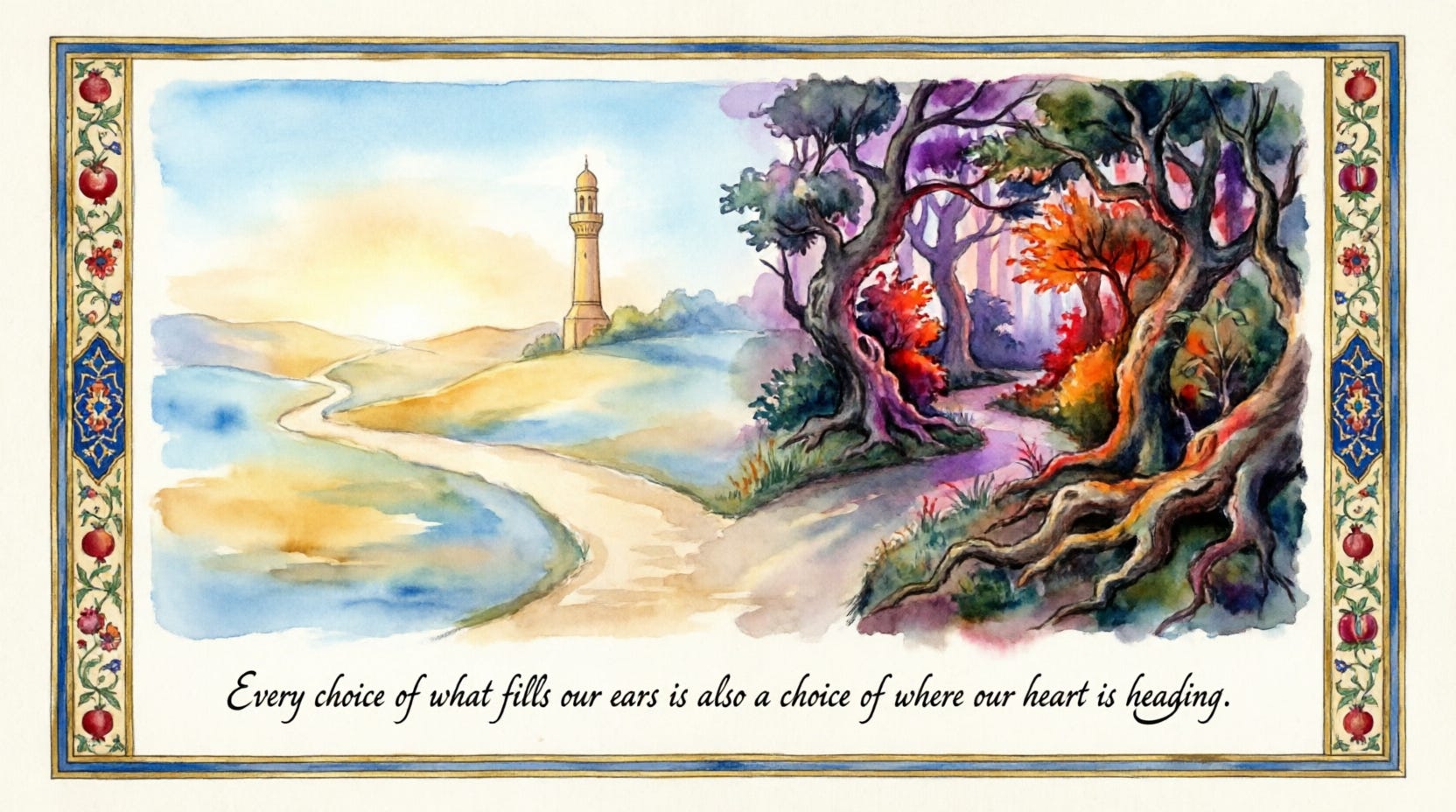
The question to ask of any sound we bring into our homes and hearts is: does this move me toward Allah or away from Him? Does this create an atmosphere of taqwa or of heedlessness? Does this make salah feel more natural or does it make it feel like an interruption?
The Heart Is the Measure
Imam Ja’far as-Sadiq (AS) gave one of the most practically useful guidelines on this question:
“Know the prohibited Ghina by the effect it has on the heart. Whatever music excites and intoxicates — that is Ghina and it is haram.”
The heart as the measure. Not just the content of the lyrics. Not just the presence or absence of certain instruments. The effect on the heart. Does it excite the lower passions? Does it create a state of intoxication — that heady, carried-away feeling where reason and taqwa recede and emotion takes over? That is the warning sign.
This is why the scholars connect music so closely to alcohol and gambling in their discussions. All three create altered states — conditions where the rational, spiritual mind is bypassed and the person becomes dominated by feeling, excitement, and the chase of more. All three are described by the Ahlul Bayt as tools of Shaytan for precisely this reason.
And all three, in the modern world, have been engineered to be more potent, more immersive, and more addictive than ever before in human history. The music industry spends billions understanding exactly which sounds, which rhythms, which frequencies create the most powerful emotional responses — and then producing music designed to maximise that effect. The Imam’s warning about music exciting and intoxicating the heart was never more accurate than it is today.

Living Honestly With This Teaching
Let us be genuinely honest here — because this article would be doing a disservice if it simply said all music is haram and left it there, or if it softened the teaching so much that it had no practical content at all.
The Ahlul Bayt were clear that Ghina — music designed for the atmosphere of sin, music that excites the lower passions, music that creates heedlessness of Allah — is prohibited. That is the ruling and it is not ambiguous.
What is more nuanced is the application of that ruling to the enormous spectrum of sound that exists in the modern world. And that nuance is precisely why the scholars of fiqh differ, why honest Muslims find themselves genuinely uncertain, and why this topic requires personal reflection rather than a simple list of allowed and forbidden songs.
Some honest questions worth sitting with:
What does the music I listen to do to my heart? Does it make me more or less likely to pray with focus? More or less inclined to remember Allah during the day? More or less peaceful in my soul?
What atmosphere does it create? If the Imam (AS) walked into the room while I was listening to this — would I feel the need to turn it off? That question alone is remarkably clarifying.
What is it associated with? Music that is designed for, marketed for, and primarily consumed in contexts of alcohol, sexual permissiveness, and heedlessness carries the spiritual atmosphere of those contexts even when listened to in isolation.
Am I using music to avoid something? Sometimes music becomes the constant background noise that prevents us from ever sitting with silence — with our own thoughts, our own du’a, our own relationship with Allah. The Ahlul Bayt valued silence. They valued the heart that could be still. If music has become the thing that fills every gap and prevents any stillness — that itself is worth reflecting on.
What Can Fill the Space?
One of the most important practical questions for a Muslim genuinely engaging with this teaching is: what do I fill the space with?
The Ahlul Bayt gave us an extraordinary treasury of sound that nourishes the soul rather than distracting it.
The recitation of the Quran — in a beautiful, moving voice — is the antidote to Ghina. It moves the heart. It produces emotion. It is aesthetically powerful. But it moves the heart toward Allah rather than away from Him. The Prophet (S) said: “Beautify the Quran with your voices.” Sound itself is not the problem. The direction it takes the heart is everything.
The du’as of Sahifa Sajjadiyya, recited with presence and attention. The latmiyya of Muharram that connects us to the grief of Karbala. The salawat that keeps the Prophet (S) alive in our hearts. The sound of a child reciting their first surahs. The adhan echoing through a still morning.
These are the sounds the Ahlul Bayt surrounded themselves with. And anyone who has spent time immersed in them knows they offer something that no playlist on Spotify can replicate — a movement of the heart that leaves you closer to Allah, not further from Him.
A Closing Thought
Music is the fifteenth greater sin — and it is placed here, near the end of volume one, following alcohol and gambling, because it shares their essential quality. Like alcohol, it alters the state of the heart. Like gambling, it captures attention and crowds out what matters. Like both, it has been specifically engineered in the modern world to be more powerful and more immersive than ever before.
Ayatollah Dastaghaib Shirazi’s discussion of this sin is not a call to live in joyless silence. Islam is not a tradition that fears beauty or rejects the power of sound. It is a tradition that understands sound’s power so deeply that it wants to direct that power toward Allah — toward Quran, toward du’a, toward the remembrance of the Ahlul Bayt — rather than allow it to be captured and used against the soul.
The question this article leaves with you is not am I technically allowed to listen to this? The question is deeper and more personal: what is this doing to my heart? And is my heart — the most precious thing I carry — being filled with what it truly deserves?
May Allah fill our hearts and our homes with sound that draws us closer to Him. May He give us ears that find their deepest pleasure in His words. And may He make the Quran, the du’as of the Ahlul Bayt, and the remembrance of His name the music that our souls keep returning to. Ameen.