

The Sin That Needs No Introduction — Or Does It?
Of all the greater sins we’ve covered so far, murder is the one that most people would instinctively place near the top of the list. It feels obvious. Of course killing someone is a major sin. Everyone knows that.
But here’s the thing — Ayatollah Dastaghaib Shirazi dedicates serious attention to this sin not just to confirm what we already know, but to expand our understanding of what murder actually means in Islam. Because the Islamic view of taking a life goes far, far deeper than the act itself.
By the time you finish this article, you may find that this sin touches your life in ways you never expected.
What Exactly Is the Sin?
The fifth greater sin is the murder of a person whose execution has not been ordered by Allah and His Prophet. That definition is precise and important. Islam is not a pacifist religion — it recognises that there are situations where life can lawfully be taken, such as in just war or through the legal system. But outside of those narrow, carefully defined circumstances, the taking of a human life is one of the gravest acts a person can commit.
And the punishment described in the Quran for such an act is staggering in its seriousness.
In Surah an-Nisa, Chapter 4, The Women, Verse 93, Allah says:
“And whoever kills a believer intentionally, his punishment is Hell; he shall abide in it, and Allah will send His wrath on him and curse him and prepare for him a painful chastisement.”
Five separate punishments are packed into that single verse — Hell, permanent residence in it, the wrath of Allah, being cursed by Allah, and a great chastisement. It is difficult to find another sin in the Quran that receives such a detailed, stacked list of consequences. The message is unmistakable — in Allah’s eyes, the sanctity of human life is not a small matter.
One Soul Is All of Humanity
Here is where Ayatollah Dastaghaib Shirazi introduces one of the most breathtaking concepts in all of Islamic ethics. It comes from Surah al-Ma’ida, Chapter 5, The Table Spread, Verse 32:
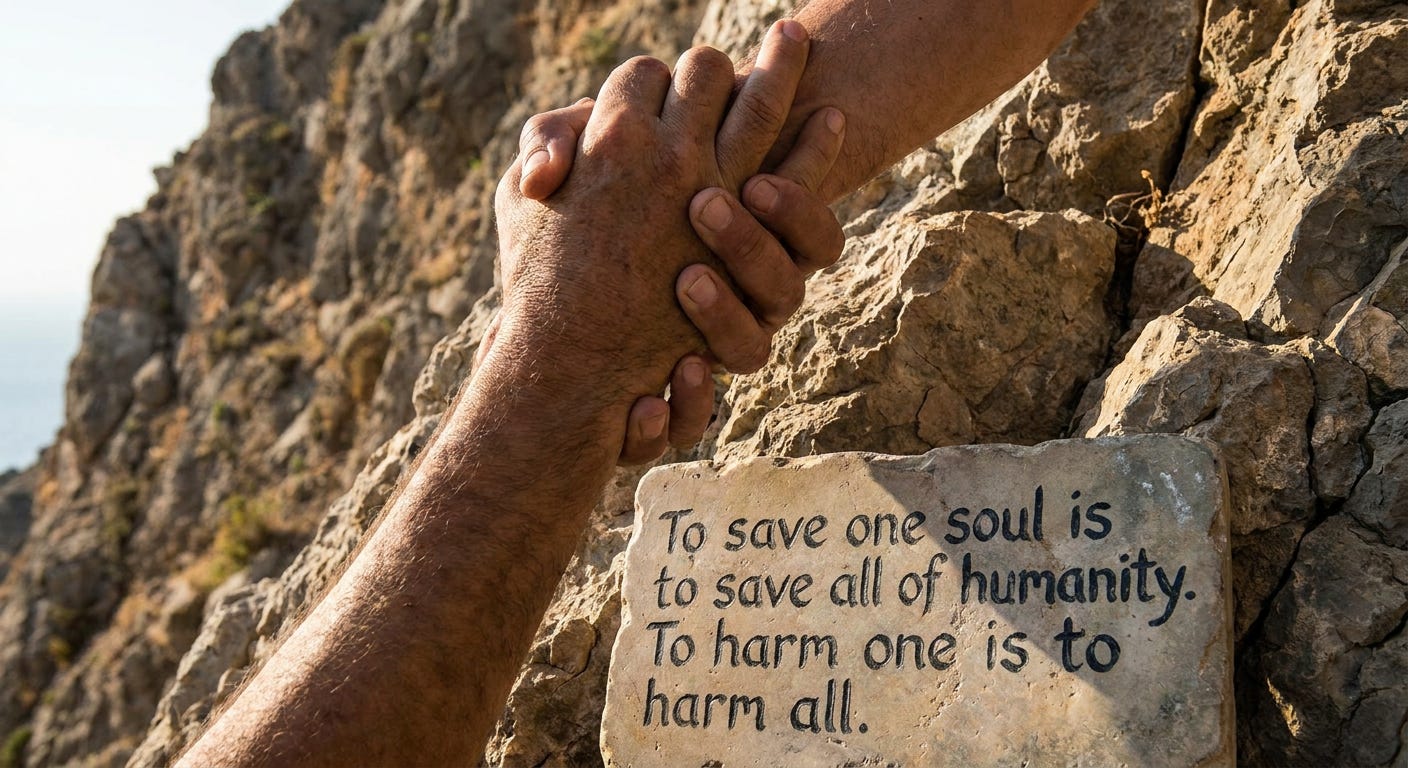
“Whoever slays a soul — unless it be for manslaughter or for corruption in the land — it is as though he slew all people. And whoever saves a life, it is as though he saved all people.”
Read that carefully. Not a lot of people. Not many people. All people.
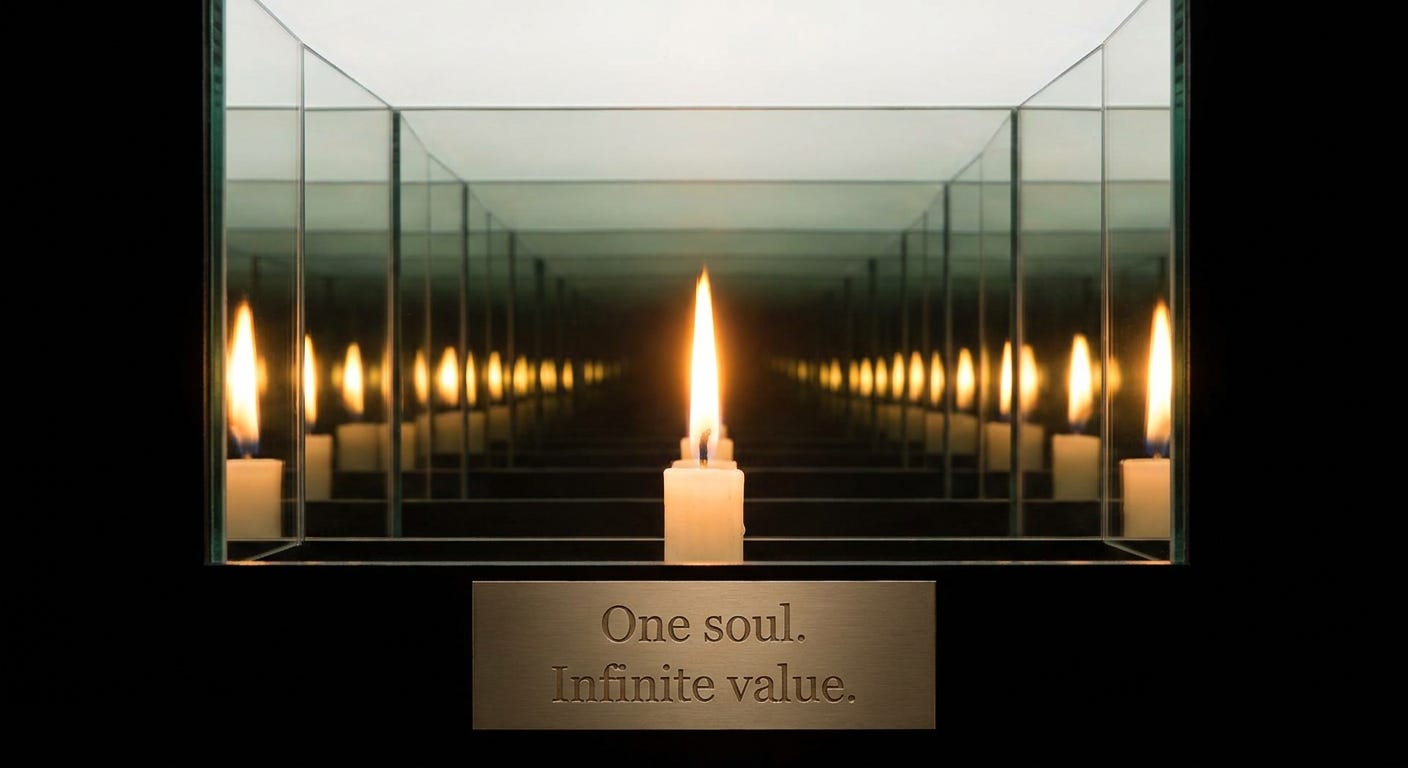
How can killing one person be equivalent to killing all of humanity? The scholars explain it beautifully. Every human being is a universe unto themselves — a world of experiences, relationships, potential, worship, love. When you extinguish that life, you extinguish an entire world. Every descendant they would have had. Every good deed they would have done. Every person they would have comforted, raised, and inspired. All of that — gone.
All believers are children of Adam (AS) and brothers to one another. One who kills another perpetrates a great evil and ignites feelings of malice, revenge, and hatred among people — wounds that spread far beyond the moment of the crime itself.
But notice the flip side of this equation — the one that often goes unmentioned. Saving a life is equally cosmic in its reward. Pulling someone back from danger. Feeding someone who is starving. Advocating for someone who is being oppressed. Standing between a person and harm. According to this verse, every single one of those acts is as though you gave life to all of humanity.
This is Islam’s way of showing us that life is not just biological. Every soul carries infinite weight.
What the Ahlul Bayt (AS) Taught About Murder
The Imams (AS) were deeply emphatic on this topic, and their teachings go well beyond the physical act of killing.
Imam Ja’far as-Sadiq (AS) said something that should send a chill down the spine of anyone who has ever taken another’s life carelessly:
“At the time of his death, the killer is told: die as you wish — die as a Jew, a Christian, or a Magian.”
This is one of the most severe descriptions of spiritual consequence in all of Shia hadith literature. The person who kills an innocent believer is, at the moment of death, stripped of the shelter of their faith. They do not die under the protection of La ilaha illallah. They die as one who has placed themselves outside it.
The same Imam added:
“A believer lives in the vast expanse of his faith — until he colours his hands with the blood of a believer.”
What a powerful image. Faith as a vast, open, free space — and murder as the act that collapses that space entirely.
And then this: “One who kills a believer intentionally is deprived of the tawfiq — the divine assistance — to repent.”
This is perhaps the most sobering statement of all. Not that repentance becomes impossible, but that the tawfiq, the inner guidance and motivation to genuinely repent, is taken away. The murderer is left alone with their crime, with no internal compass pulling them back toward Allah. It is one of the subtlest and most devastating consequences imaginable.
The Sin Is Bigger Than the Killer
Now here is where this article becomes relevant to people who will never commit murder in the physical sense, which is most of us. Because the Ahlul Bayt taught that the responsibility for a murder extends far beyond the person who pulls the trigger or holds the blade.
The Holy Prophet (S) said:
“By the Almighty Who appointed me with Prophethood — if all the creatures of the heavens and earth were to participate in the murder of a Muslim and be pleased by it, Allah would surely involve them all in punishment and send them to Hell.”
Pleased by it. Not even involved — just pleased. Just satisfied when you heard the news. Just silent when you could have spoken up. The circle of responsibility in Islam is wide.
Imam Muhammad al-Baqir (AS) narrated something even more striking. He described a scene on the Day of Judgement where a man is brought before Allah with a streak of blood on him — yet he insists he never killed anyone. Allah responds: “Yes, but one day you spoke about a believer, and your words caused him to be killed. Hence, you are responsible.”
Words. Just words. A rumour passed on. A reputation destroyed. A lie told to the wrong person. And the consequences — life-ending consequences for someone else.
Imam Ali al-Ridha (AS) extended this even further:
“If someone is killed in the east and a person living in the west is pleased upon this — then that person is a partner in the murder.”
Let that sit for a moment. In our world of social media, 24-hour news cycles, and comment sections — where we react to deaths, conflicts, and violence from thousands of miles away — this hadith feels like it was written for our exact time.

Suicide — The Murder of the Self
Ayatollah Dastaghaib Shirazi makes a point here that many people overlook entirely — suicide falls under the same category as murder in Islamic law.
Allah says in Surah an-Nisa, Chapter 4, The Women, Verse 29-30):
“Do not kill yourselves. Surely Allah is Merciful to you. And whoever does this aggressively and unjustly — We will cast him into Fire.”
Allah prohibits believers from suicide even in times of turmoil. The soul you carry is not entirely yours to dispose of. It is an amanah — a trust from Allah. You were given a body, a life, and a period of time in this world as a test and an opportunity. To end that by your own hand is to reject the test and refuse the opportunity.
This is not said to judge or condemn those who have struggled with suicidal thoughts — Islam is deeply compassionate toward suffering. But it is a reminder of the profound value Islam places on life — especially your own life. You are a nafs al-muhtaram — a protected soul —, and that protection covers you too.
If you or someone you love is struggling, reaching out to a trusted person, a scholar, or a mental health professional is not a weakness. It is honouring the gift of life that Allah gave you.
Even Abortion Is Addressed
One of the remarkable aspects of Ayatollah Dastaghaib Shirazi’s discussion of this sin is how early he places the beginning of protected life. It is forbidden to abort an unborn child — like in the case of murder, diyah (prescribed compensation) must be paid. There is no difference between a foetus and a full-grown person. Even if the killers are the parents themselves.
The gradations of diyah — the compensation paid depending on the stage of development of the foetus — reflect just how seriously Islamic jurisprudence takes the sanctity of life from its very earliest stages. Life is considered sacred not from birth, not from viability, but from conception.
Can a Murderer Ever Repent?
Given how severe the consequences described above are, the natural question is: Is there any way back?
The path of repentance for one who has committed intentional murder is a deeply serious one. The murderer must surrender himself to the heirs of the murdered person. Those heirs then have the right to choose — they can demand retribution, accept diyah (blood money as compensation), or forgive entirely. If they choose to forgive, three things become obligatory on the murderer: freeing a slave, feeding sixty poor people, and fasting for sixty days.
But beyond the legal requirements, the spiritual reality is that genuine tawbah from murder requires a complete shattering and rebuilding of the self. It requires facing the full weight of what was done, making every possible amends in this world, and throwing oneself entirely on the mercy of Allah and the family of the one wronged.
It is not impossible. Allah’s mercy is boundless. But the road is long, and it begins with honesty — with looking at what was done and refusing to minimise it.
A Closing Thought
Murder sits fifth on this list — after sins that might seem less tangible, like despair and heedlessness. But there is a wisdom in that ordering. The first four sins are all about the internal relationship between a person and Allah. By the time we reach murder, Ayatollah Dastaghaib Shirazi is showing us how that internal state spills outward into the world — how the heart that has lost its connection to Allah becomes capable of the worst crimes against His creation.
A heart rooted in Tawhid. A heart that has not despaired. A heart that is awake and conscious of Allah’s plan. A heart that takes His warnings seriously. That heart does not reach for violence. That heart recognises in every human face a universe created and loved by Allah.
Protecting life — all life, including your own — is not just a legal obligation. It is an act of worship. Every day you choose not to harm, to speak words that build rather than destroy, to stand against injustice rather than celebrate it — you are, in the truest sense, giving life to all of humanity.
May Allah make us among those who protect life, honour it, and cherish it — as He intended when He breathed His own spirit into the first human being. Ameen.