

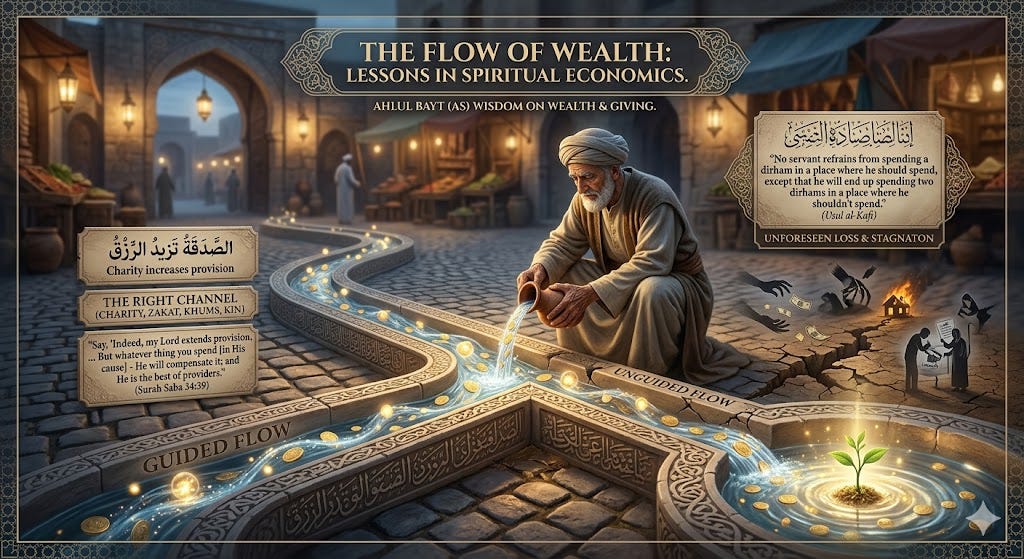
It is said that in the not-so-distant past, an old man stood in the middle of a bustling marketplace, quietly watching the people come and go. He wasn’t standing there out of idleness, but rather in deep contemplation. As he watched the exchange of goods and the clinking of coins, a profound realisation settled over him.
He observed, “Money is like water... If it isn’t guided into the right channel, it will find its way out through a thousand unforeseen ways.”
When a passerby asked him what he meant, the old man shared a profound tradition from Imam Ja’far al-Sadiq (AS), shedding light on the unseen, spiritual reality of our finances.
The Illusion of “Saving”
The old man quoted the 6th Imam (AS):
“No servant refrains from spending a dirham in a place where he should spend, except that he will end up spending two dirhams in a place where he shouldn’t spend.” > — Usul al-Kafi, vol. 3, p. 504
At first glance, human logic tells us that holding onto our money means we have more of it. If we skip paying our obligatory dues—like Khums, Zakat, or Sadaqah (charity)—or if we ignore the financial needs of our family and community, our bank account balance appears higher.
However, the Ahlul Bayt (AS) teach us that wealth is not a static object; it is dynamic. Like a stream of water, if you try to dam it up improperly, the pressure builds. It will inevitably spread, seep through the cracks, and flood into places you never intended. The dirham you “saved” by denying someone their rightful due might end up turning into two dirhams lost through a sudden accident, an unexpected medical bill, or a terrible investment. You lose the money, the energy, and the peace of mind—without gaining any spiritual reward.
Quranic Perspective: The Promise of Flow vs. Stagnation
The Holy Quran frequently contrasts the divine economy with the worldly one. Shaitan encourages stagnation through the fear of poverty, while Allah promises growth through circulation:
“Satan threatens you with poverty and orders you to immorality, while Allah promises you forgiveness from Him and bounty. And Allah is all-Encompassing and Knowing.”
— Surah al-Baqarah, Chapter 2, The Cow, Verse 268
When we direct our wealth into the right channels, Allah acts as the ultimate guarantor of our return. The Quran assures us that what is spent for His sake is never truly lost:
“Say, ‘Indeed, my Lord extends provision for whom He wills of His servants and restricts [it] for him. But whatever thing you spend [in His cause] - He will compensate it; and He is the best of providers.’”
— Surah Saba, Chapter 34, Sheba, Verse 39
Echoes of Wisdom from the Ahlul Bayt (AS)
This profound concept of “spending twice as much in the wrong way” is a recurring theme in the teachings of the Infallibles. It highlights the divine law of cause and effect in our financial lives.
Imam Musa al-Kadhim (AS) reiterated this exact principle, warning his followers about the spiritual consequences of stinginess:
“Refrain from being stingy with your wealth in the way of Allah, for otherwise, you will end up spending twice as much in the disobedience of Allah.” > — Tuhaf al-Uqul, p. 408
Imam Ali (AS) in Nahj al-Balagha emphasises that wealth must be put to purposeful use to be a blessing:
“He who is granted wealth by Allah should spend it on his relatives, use it to improve his hospitality, assist the poor and the indebted... for gaining the rewards of this world and the hereafter.” > — Nahj al-Balagha, Sermon 142
When wealth is hoarded or kept from its rightful purpose, it loses its barakah (divine blessing). The physical currency might remain in your hand, but its benefit is stripped away.
Where Do You Let It Flow?
As the old man in the marketplace noted, the noise of the trading and the clinking of coins didn’t change, but for those who understood the Imam’s wisdom, the sound of the marketplace felt completely different. Every transaction became a question of spiritual alignment.
We often exhaust ourselves trying to plug the unforeseen leaks in our lives—stressing over lost opportunities, sudden expenses, and broken assets. But perhaps the solution isn’t to build higher dams to hoard what we have. Perhaps the solution is to open the gates and ensure we are giving exactly what we owe to those who need it.
In the end, as the old man beautifully concluded: “It isn’t always about how much you have... It’s about where you let it flow.”
Reference: Shaykh Ali Reza Panahian