

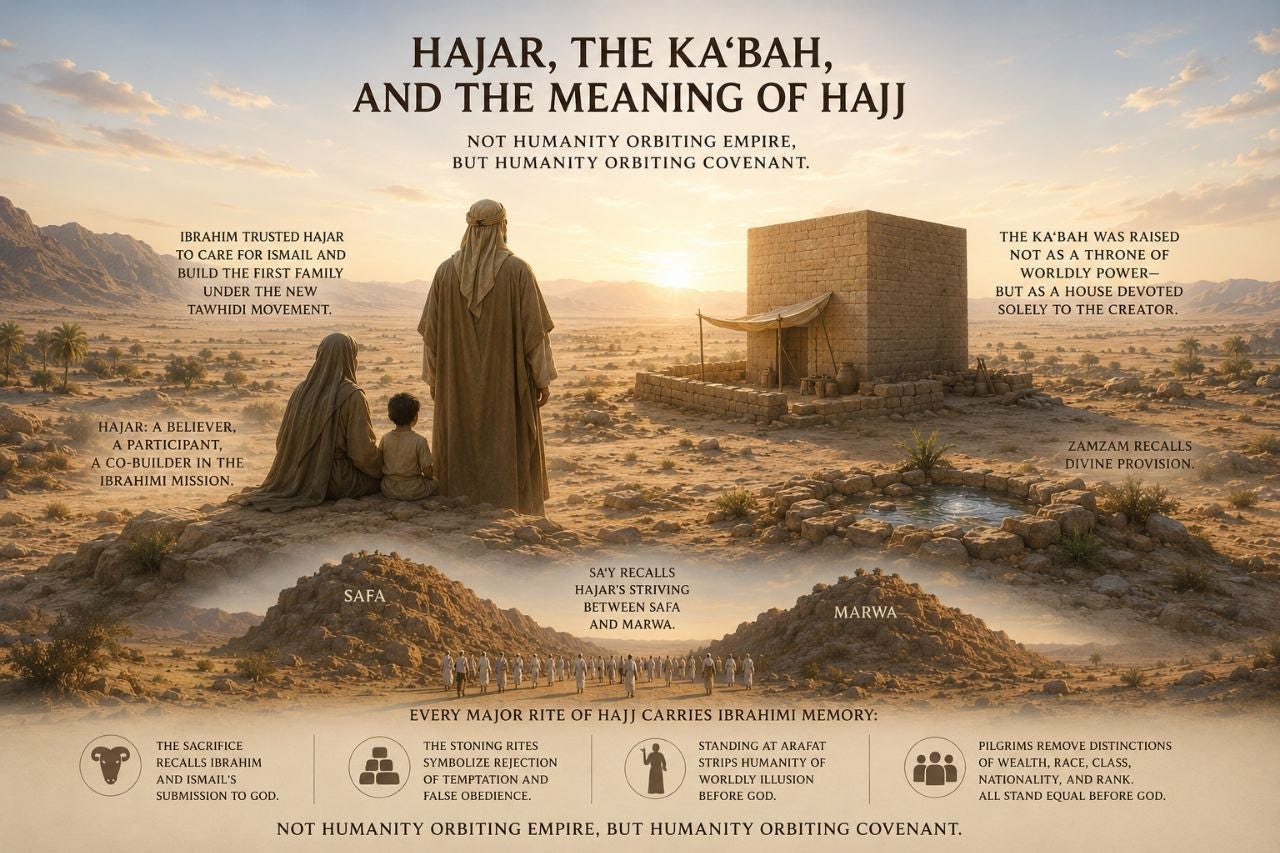
After migrating from Mesopotamia, Prophet Ibrahim’s family spread across the ancient Near East. While Prophet Ishaq remained connected to the Levant, Prophet Ismail and his mother, Hajar, were settled in the barren valley that would eventually become Mecca.
From the perspective of the ancient world, Mecca seemed entirely insignificant compared to the glittering capitals of Babylon, Egypt, Rome, or Persia. But that was precisely the point. Prophet Ibrahim was not building an empire, nor was he founding a royal dynasty. He was establishing a sanctuary centred entirely on God. The Ka‘bah was raised not as a throne of worldly power, but as a house devoted solely to the Creator.
Hajar: Co-Builder of the Ibrahimi Movement
At the centre of that sacred mission stood Hajar. She was not a passive figure in this historical narrative; she was a steadfast believer, a participant, and a vital co-builder in the Ibrahimi movement.
When she asked Ibrahim whether their settlement in the harsh desert had been commanded by God, and he answered yes, her response was not one of despair, but of profound conviction:
“Then He will not forsake us.”
Her desperate striving between the hills of Safa and Marwa became immortalised within the Hajj itself. Every year, millions of pilgrims reenact her movement. A faithful woman’s sacrifice, trust, and striving became one of the permanent rites of one of the world’s greatest religious gatherings.
The Living Memory of the Rites
Every major rite of Hajj carries this deeply rooted Ibrahimi memory:
Sa‘y recalls Hajar’s striving and perseverance.
Zamzam recalls divine provision in the most barren of circumstances.
The Sacrifice recalls Ibrahim and Ismail’s ultimate submission to God.
The Stoning Rites symbolise the active rejection of temptation and false obedience.
Standing at Arafat strips humanity of all worldly illusion before God.
Orbiting the Covenant
Even the outward form of Hajj carries profound revolutionary meaning. Pilgrims meticulously remove all earthly distinctions of wealth, race, class, nationality, and rank. Kings and labourers stand shoulder to shoulder, dressed in simple garments that resemble burial shrouds.
There are no thrones at the centre of Hajj. There are no royal bloodlines and no imperial banners. At the centre stands the Ka‘bah: empty of kings, empty of idols, and centred only on God.
Ultimately, Hajj reverses the normal logic of human history. It is a profound demonstration of not humanity orbiting an empire, but humanity orbiting a divine covenant.
Reference: Shaykh Ali Reza Panahian