

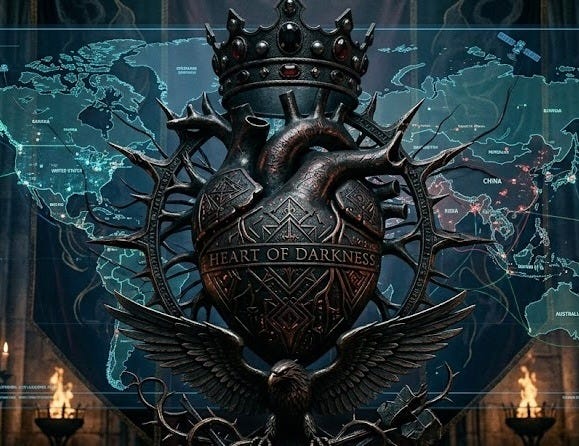
Joseph Conrad’s Heart of Darkness presents a powerful critique of imperialism, exposing the moral contradictions at the heart of European expansion. In his depiction of the Thames, Conrad situates Britain within a long tradition of exploration and conquest: “It had known and served all the men of whom the nation is proud, from Sir Francis Drake to Sir John Franklin…” The river becomes a symbol of national pride, a “waterway leading to the uttermost ends of the earth,” linking the familiar world of Britain to the unfamiliar territories it sought to dominate. Yet beneath this celebratory tone lies an implicit criticism. The same river that carried “adventurers and settlers” also carried those driven by greed, ambition, and the desire for wealth.
While imperial history often glorifies such figures, Conrad invites the reader to question their motives. Many leaders of the past, driven by material gain, were willing to exploit, plunder, and destroy in pursuit of empire. Though ordinary individuals may not always have shared this enthusiasm, they were frequently coerced or enticed—pressured by poverty or the promise of opportunity—into participating in colonial ventures. In this way, the empire was not only sustained by powerful elites but also by broader social and economic forces.
Conrad’s novel was ahead of its time in exposing the hypocrisy of the so-called “civilising mission.” Through Marlow’s narration, he dismantles imperial rhetoric, revealing its underlying brutality: “The conquest of the earth, which mostly means the taking it away from those who have a different complexion… is not a pretty thing when you look into it too much.” This statement strips away the moral justifications of empire, exposing it as little more than organised theft disguised as progress.
This specific brand of hypocrisy—where destruction is rebranded as benevolence—finds a profound parallel in the Quranic warning against Fasad (mischief or corruption). In Surah Al-Baqarah, the text describes a psychological state of the powerful that mirrors Conrad’s critique:
“And when it is said to them, ‘Do not cause corruption on the earth,’ they say, ‘We are but reformers.’ Unquestionably, it is they who are the corrupters, but they perceive [it] not.”
(Quran, Surah al-Baqarah, Chapter 2, The Cow, Verses 11–12)
This verse underscores the “heart of darkness” residing within the global elite: the ability to cloak exploitation in the language of “reform” while remaining blind to the moral disorder they sow. Conrad subverts the expectations of his Western audience, forcing them to confront the uncomfortable reality that what was often framed as enlightenment and duty was, in truth, a spiritual and ethical failure.
Moreover, Conrad explores not only the physical invasion of land but also the invasion of the human mind and conscience. Marlow’s journey along the Congo River becomes a symbolic descent into the depths of the human psyche—the “heart of darkness” that resides within all individuals. Kurtz, the enigmatic imperial agent, embodies this descent. Once an idealistic figure, he becomes consumed by power and detaches himself from all moral restraint. His eventual collapse illustrates how thin the veneer of civilisation truly is when removed from the structures that uphold it.
This exploration of moral darkness extends beyond the historical context of European imperialism and can be linked to contemporary global issues, including those affecting parts of the Islamic world. While the form of domination has evolved, the patterns Conrad critiques remain visible. Modern interventions in regions such as Iraq and Afghanistan have often been justified using the language of stability, security, or humanitarian concern. However, these actions have frequently resulted in prolonged instability, conflict, and suffering for local populations. Much like the imperial rhetoric Conrad exposes, contemporary power structures can cloak material or strategic interests in moral language.
In addition, the “darkness” Conrad describes is not confined to external forces alone. It can also be seen in internal struggles within affected societies, where unchecked authority, corruption, or ideological extremism can mirror the moral collapse represented by Kurtz. In this sense, Conrad’s message is universal: the capacity for moral failure exists wherever power operates without accountability.