

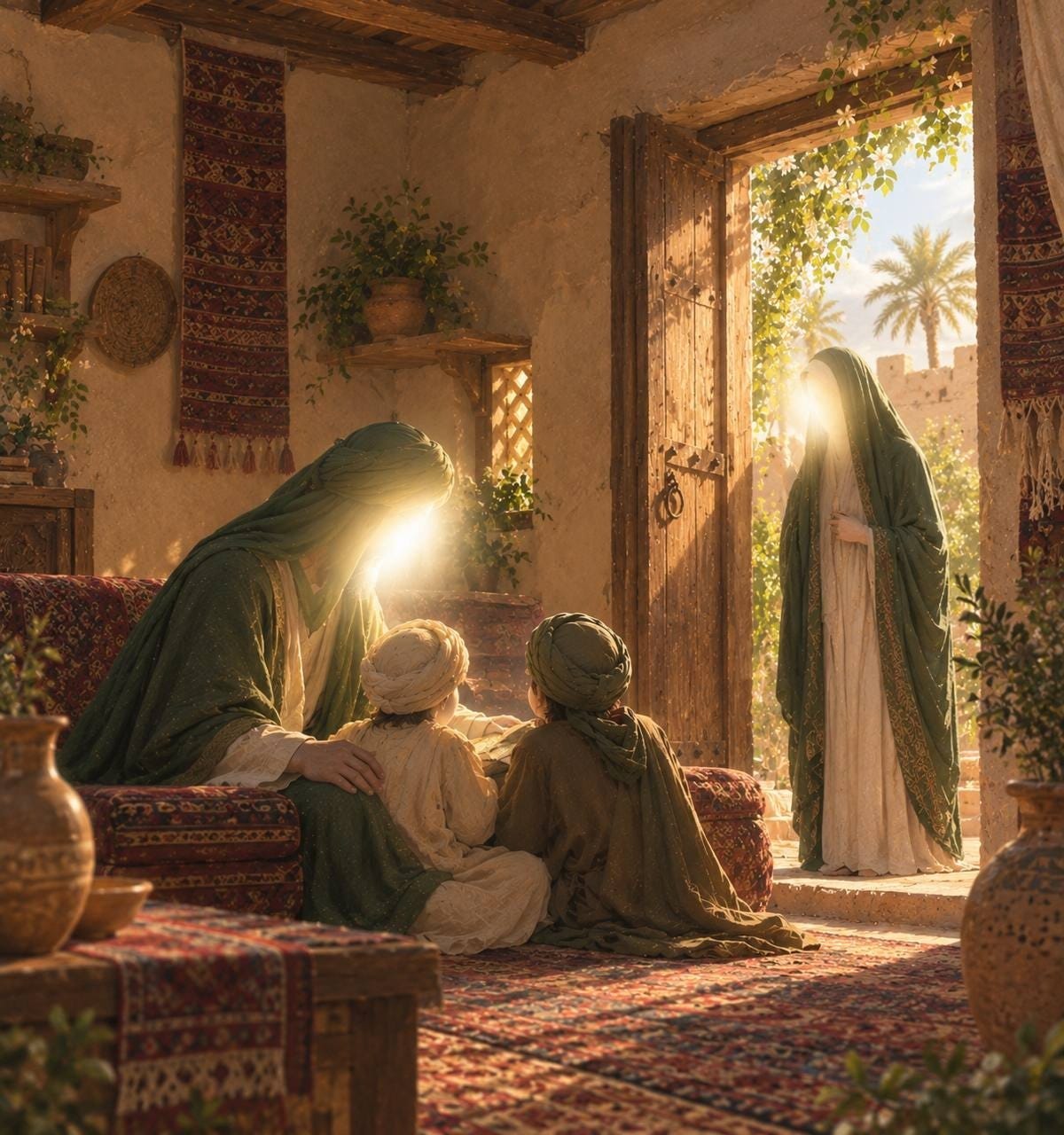
A Home Sanctified by Heaven
The home of Imam Ali ibn Abi Talib (AS) and Sayyida Fatima al-Zahra (SA) was never merely a dwelling of clay and timber. It was, and remains, a sacred sanctuary whose dignity was established by the Almighty Himself — a bastion of purity, truth, and wilayah.
The Quran bears direct witness to the divine status of its inhabitants:
إِنَّمَا يُرِيدُ اللَّهُ لِيُذْهِبَ عَنكُمُ الرِّجْسَ أَهْلَ الْبَيْتِ وَيُطَهِّرَكُمْ تَطْهِيرًا
“Indeed, Allah intends only to remove from you the impurity [of sin], O People of the House, and to purify you with a thorough purification.”
— Surah al-Ahzab, Chapter 33, The Confederates, Verse 33)
As recorded in the celebrated Hadith al-Kisa, the Prophet Muhammad (S) gathered Ali, Fatima, Hasan, and Husayn (AS) beneath his cloak and supplicated to Allah, declaring before the community that these five were the Ahl al-Bayt in the truest, most exclusive sense. This was no ordinary familial gesture; it was a public designation of spiritual and divinely appointed authority.
Sheikh al-Mufid, Al-Irshad, Vol. 1, Ch. 1; also cited in Allama Majlisi, Bihar al-Anwar, Vol. 35, pp. 206–211.
Fatima (SA): The Measure of Faith
The sanctity of this home is inseparable from the person of Fatima al-Zahra (SA). The Messenger of Allah (S) declared:
*” Fatima is a part of me. Whoever angers her angers me, and whoever pleases her pleases me.”*
These words transcend paternal affection. They bind the believer’s relationship with the Lady of the Worlds (SA) to their relationship with the Prophet (S) and, ultimately, with Allah. To honour her home is to honour the very axis around which faith turns.
Sheikh al-Saduq, Al-Amali, Majlis 24, Hadith 5; also in Bihar al-Anwar, Vol. 43, p. 45.
Three Nights, One Loaf: The Verse of Giving
If purity defined the identity of this household, then compassion defined its practice. The highest expression of that compassion is immortalised in Surah al-Insan:
وَيُطْعِمُونَ الطَّعَامَ عَلَىٰ حُبِّهِ مِسْكِينًا وَيَتِيمًا وَأَسِيرًا
إِنَّمَا نُطْعِمُكُمْ لِوَجْهِ اللَّهِ لَا نُرِيدُ مِنكُمْ جَزَاءً وَلَا شُكُورًا
“And they give food, in spite of their love for it, to the needy, the orphan, and the captive — [saying], ‘We feed you only for the sake of Allah. We wish not from you any reward or gratitude.’”
— Surah al-Insan, Chapter 76, The Man, Verse 8–9)
The background of this revelation is narrated in detail in Tafsir al-Qummi:
Imam Ali (AS) had pledged to fast for three days. On the first evening, as the family sat before a modest meal of barley bread, a destitute man appeared at their door. Without hesitation, they placed their entire portion in his hands and broke their fast with water alone. The second evening, an orphan came; the third, a war-weary prisoner. Each time, the family surrendered their only food.
Ali ibn Ibrahim al-Qummi, Tafsir al-Qummi, Vol. 2, commentary on Surah al-Insan, pp. 396–398. Also referenced in Allama Tabatabai, Tafsir al-Mizan, Vol. 20, pp. 112–117.
What makes this act extraordinary is not the volume of what was given, but the scarcity from which it was given. They did not offer surplus. They offered necessity. They gave away the very morsel their own children needed, trusting entirely in Allah’s provision.
The Lesson That Outlives the Loaf
The home of Fatima (SA) teaches a principle that no era can afford to forget: true faith is measured not by what one accumulates, but by what one is willing to release. Their generosity carried no conditions, no expectation of gratitude, no preference for one type of seeker over another. The poor man, the orphan, and the prisoner were received with identical warmth — because in the eyes of this household, every human being is a creation deserving of dignity.
Imam Ja’far al-Sadiq (AS) later reflected on the spirit of this verse, stating that the highest form of charity is to give *” while you yourself are in need of it, preferring the believer over yourself.”*
Sheikh al-Kulayni, Al-Kafi, Vol. 2, Book of Faith and Disbelief, Ch. “Al-Ithar” (Preferring Others), Hadith 3.
An Eternal Address
Centuries have passed, yet the door of that small house in Madinah remains open in the collective conscience of the Ummah. Every act of feeding a hungry stranger, every silent sacrifice made for one who cannot repay, echoes the barley bread placed gently into the hands of a needful visitor.
The home of Ali and Fatima (AS) was not merely where the hungry were fed last. It was where they were fed first — and the family chose, willingly and joyfully, to go without.
That is the standard. That is the legacy. And it belongs to no single age; it belongs to every soul that dares to open its door.