

History is often told by observers, but there is a distinct, spiritual potency in hearing the account of a battle from the victor himself. The Battle of Khaybar stands as one of the most pivotal moments in Islamic history—a moment where the sheer might of faith dismantled the impossible.
While historians have documented the dates and strategies, a rare and intimate perspective exists: a first-hand narration from the man who defined that day, Imam Ali ibn Abi Talib (AS). Drawing from his self-narrated biography, Aan Chahardah Rooz, and supported by the traditions of the Ahl al-Bayt, we relive the day the Lion of God conquered where all others had failed.
The Mountain of Iron and Fear
The context of Khaybar was one of intimidation. The Jewish stronghold was not merely a fort; it was a complex of citadels, heavily guarded and economically powerful.
As Imam Ali (AS) describes in his narration:
“We entered the city... There, we faced the Jewish soldiers. Some were mounted and others were on foot... Because of their many horses and weapons, they appeared to be like a mountain before us.”
The stalemate had dragged on. For days, the Muslim army had attempted to breach the fortress. Different commanders were sent out, carrying the banner of Islam, but they returned defeated, their courage broken by the ferocity of the defenders.
The Imam recounts the psychological state of the army:
“Both their stronghold and dwellings were secure and impenetrable... whoever went forward from among us to fight them was killed until eyes grew red due to the intensity of fear.”
This description aligns with the historical accounts in Al-Irshad by Sheikh al-Mufid, which confirm that before Imam Ali’s arrival, others had fled the battlefield, causing grief to the Holy Prophet (S).
“O Abu al-Hasan, Rise Up!”
It was in this atmosphere of despair—where brave men looked at one another, paralyzed by the instinct for self-preservation—that the trajectory of the battle shifted. The Holy Prophet (S), seeing the failure of previous commanders, made the famous declaration recorded in all major schools of thought but cherished deeply in Shia tradition:
“Tomorrow I will give the banner to a man who loves Allah and His Messenger, and whom Allah and His Messenger love. He is an unrelenting attacker, not one who flees (Karrar ghayr farrar); and Allah will grant victory through his hands.”
The next morning, the call came. As Imam Ali (AS) narrates:
“I was called to the battlefield at a time when everyone was concerned with only saving his own life. Each of my companions was looking at the others and saying, ‘O Abu al-Hasan, rise up!’”
This moment exemplifies the Quranic verse describing the true believers:
“Among the believers are men true to what they promised Allah. Among them is he who has fulfilled his vow [to the death], and among them is he who awaits [his chance], and they did not alter [the terms of their commitment] by any alteration.”
(Holy Quran, Surah Al-Ahzab, The Allies, Chapter 33, Verse 23)
The Charge of the Lion
Empowered by the command of the Prophet (S), Imam Ali (AS) entered the fray. He describes his charge not merely as a military advance, but as a force of nature:
“Then, the Messenger of God (S) sent me into the battlefield. I charged at them like a lion fiercely attacking its prey until I drove them back into their city... and I cut off their way to escape.”
This imagery of the “Lion” mirrors his famous title, Asadullah (The Lion of God). Upon reaching the fortress, the decisive moment arrived—the miracle at the gate.
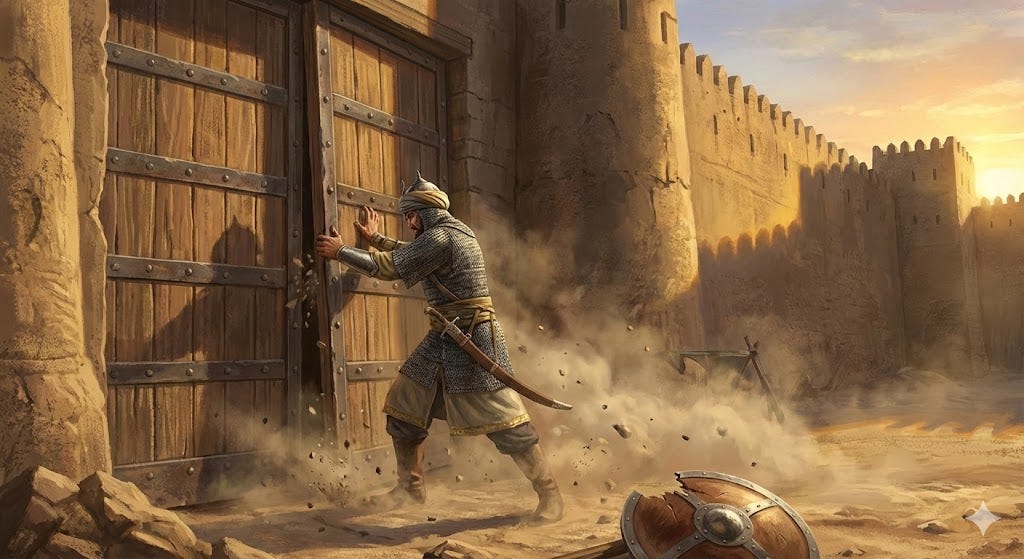
History records that during the duel with the champion of Khaybar, Marhab, Imam Ali (AS) lost his shield. In the heat of combat, he turned to the massive gate of the fortress.
“I tore off the great gate of their fortress with my own hands and entered their city alone. I struck down every man who appeared before me until I had conquered the city by myself.”
Divine Strength, Not Physical Might
The most profound aspect of Imam Ali’s narration is his humility and theological insight. Despite performing a feat that no ordinary human could replicate—historical narrations state that after the battle, it took 40 (some sources say 70) men to lift the gate he had used as a shield—he attributes the victory solely to the Divine.
“I had no helper or anyone to assist me except the One God.”
This aligns with a famous narration in Bihar al-Anwar, where Imam Ali (AS) is asked about this immense strength. He replied:
“I did not rip off the gate of Khaybar by physical strength or bodily power, but rather I ripped it off by the power of the Lord and a soul illuminated by the light of its Lord.”
Conclusion
The narration of Khaybar serves as a timeless reminder of the station of the Commander of the Faithful. When the “eyes grew red with fear” and the material odds were like a “mountain,” it was the spiritual fortitude of Imam Ali (AS) that secured the future of Islam.
As the Prophet (S) rejoiced in the victory, he affirmed Ali’s unique position, a sentiment echoed in the famous Hadith al-Manzila:
“You are to me as Aaron was to Moses, except that there is no Prophet after me.”
At Khaybar, there was Ali, and no one else—a solitary figure of absolute faith, tearing down the barriers between the believers and victory.
Reference: Sheikh Ali Reza Panahian