

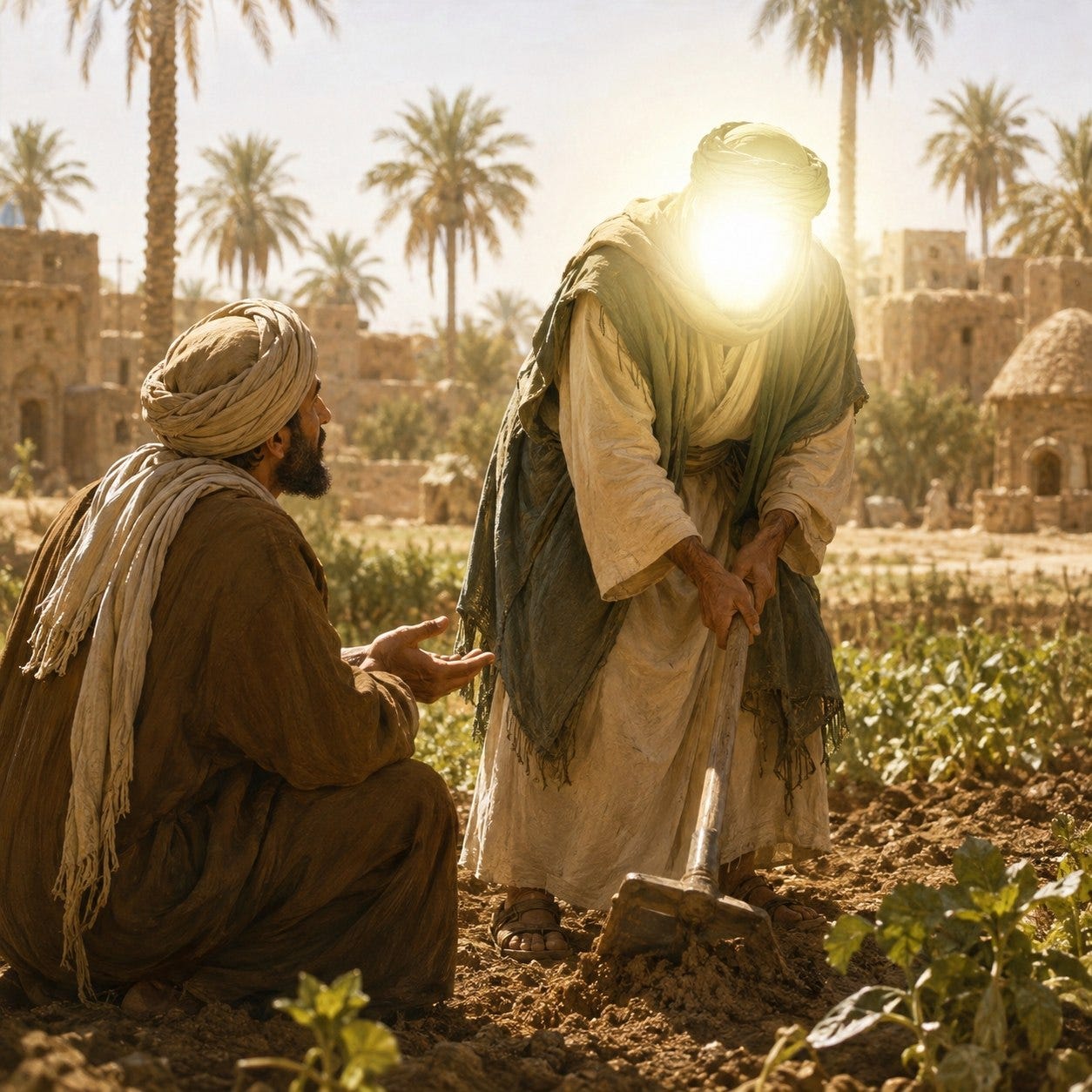
It was the height of a Medina summer. The sun pressed down mercilessly on the open fields, and most sensible souls had retreated indoors long before midday.
Yet there, bent over the soil with sweat streaming down his face, was Imam Muhammad al-Baqir (AS), the fifth Imam and one of the most learned men of his generation.
Muhammad ibn Munkadir, a celebrated ascetic and devoted worshipper of Medina, happened to pass by. Seeing the Imam labouring under such punishing heat, he felt a pang of concern. In his mind, a man of such spiritual station should have been found in the mosque, immersed in prayer — not toiling in the dirt like a common labourer.
Convinced he owed the Imam a gentle correction, Ibn Munkadir walked over, offered his greeting, and asked pointedly:
“O Abu Ja’far, what would your answer be if death were to seize you in this very state?”
The Imam straightened up. He met the man’s gaze calmly and said:
“If death were to come to me in this state, it would find me in the obedience of Allah. I labour so that I need not stretch my hand toward anyone — not even toward you. The death a person should truly dread is the one that finds him steeped in sin and disobedience.”
The words struck Ibn Munkadir like a thunderclap. He had walked over carrying a sermon; he left carrying a lesson.
He later admitted:
“I went to him intending to give advice. Instead, I was the one who received it.”
The Takeaway
Islam does not confine worship to the prayer mat. Honest work pursued with dignity, self-reliance, and reliance on Allah is itself an act of ‘ibādah. The one who earns his bread by his own hands stands in obedience no less than the one who stands in night prayer. And true spiritual rank is not measured by how far one withdraws from the world, but by how purely one moves through it.
Sources: The narration is widely recorded in classical collections, including al-Kulaynī’s al-Kāfī and al-Majlisī’s Biḥār al-Anwār, and is frequently cited in discussions on the Islamic ethic of labour and self-sufficiency.