

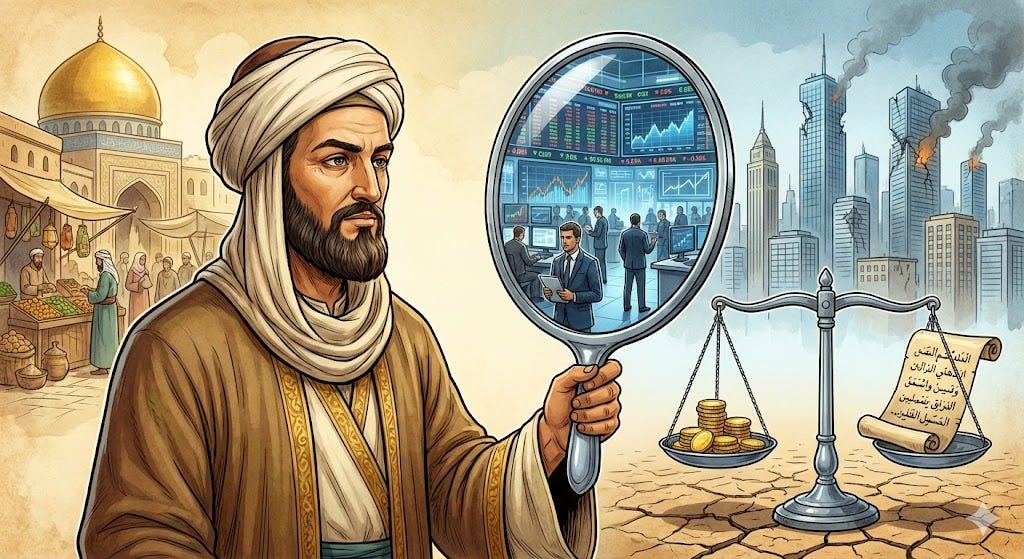
The Medieval Thinker Who Predicted Modern Financial Crises
When we discuss the origins of economic thought, we typically jump to Adam Smith, Karl Marx, or Aristotle. Yet, a profound and often overlooked truth lies in the medieval Islamic world. Long before the invention of capitalism or central banks, Muslim scholars issued warnings about money, morality, and societal decay that resonate deeply with today’s financial landscape.
Among these voices was the 11th-century theologian Abu Hamid al-Ghazali, whose insights on the “moral ecosystem” of money are strikingly parallel to the teachings found in Shia tradition, particularly in the sermons of Imam Ali (A.S.) and the life of Imam Ja’far al-Sadiq (A.S.). Together, these perspectives argue that when money loses its moral compass, societies rot from the inside out.
The World of the Golden Age
To understand these insights, we must look at the world of 1100 CE. While Europe was fragmented, the Islamic world was a financial powerhouse where trade routes pulsed with caravans carrying silk, spices, and silver. In this era of booming commerce, Al-Ghazali asked a question that few dared to ask: “What happens when a civilization gets rich faster than it gets wise?”.
Money as a Mirror, Not a Master
At the core of this economic philosophy is the definition of money itself. Al-Ghazali believed money should not be worshipped or hoarded. He famously compared money to a mirror: a mirror has no value on its own; its worth comes entirely from what it reflects (the goods it can buy).
This view is deeply echoed in Nahj al-Balagha. In Letter 53 to Malik al-Ashtar, Imam Ali (A.S.) warns his governor that the accumulation of wealth often leads to corruption. He describes the merchant class as necessary for “adding to the revenue of the state” and “running the markets,” yet explicitly warns Malik to be wary of their “miserliness, hoarding, and cheating”. For both the scholar and the Imam, money was a tool for social circulation, not an end in itself.
The “Dead Money” of Hoarding (Ihtikar)
One of the most critical insights from this era is the concept that hoarded money is “dead money.” Al-Ghazali argued that wealth locked away in chests was socially destructive, describing it as “freezing the bloodstream of society”. When the wealthy hoard, they create artificial scarcity, causing markets to break down.
This concept is strictly codified in Shia jurisprudence as Ihtikar (hoarding). Imam Ja’far al-Sadiq (A.S.) famously declared, “One who supplies the market receives his sustenance, but a hoarder is condemned”.
The Famine of Medina: During a time of wheat shortage in Medina, Imam Sadiq (A.S.) asked his servant how much wheat they had in storage. When told they had enough for months, the Imam ordered, “Take it to the market and sell it.” He refused to be secure while the people were vulnerable, forcing his household to buy bread daily like the common poor, thereby rejecting the safety of hoarding.
Speculation vs. Honest Profit
Both traditions fiercely critique speculation—profiting from price manipulation rather than value creation. Al-Ghazali viewed speculative behavior as moral corruption, calling it “profit without contribution”.
A striking parallel is found in the life of Imam Sadiq (A.S.).
The Story of Musadif: The Imam gave 1,000 dinars to his servant, Musadif, for trade. Musadif returned with 2,000 dinars (100% profit) because his caravan had colluded to artificially inflate prices during a shortage. When the Imam learned this, he refused the profit entirely, taking back only his initial capital. He told Musadif: “It is easier to fight with a sword than to earn a lawful livelihood”.
This incident underscores a shared economic principle: market trust is more valuable than profit. As Al-Ghazali argued, once trust collapses, the economy collapses with it.
Currency, The State, and Inflation
Al-Ghazali also warned about the state’s role in debasing currency (diluting gold coins), equating it to theft and predicting it would cause people to abandon local money for foreign currency.
Similarly, in Nahj al-Balagha, Imam Ali (A.S.) commands Malik al-Ashtar to ensure that trade is conducted “with generous scales and at prices that do not wrong either the seller or the buyer”. The Imam viewed the state’s role as a guardian of justice, not a manipulator of value. He warned that if rulers allow the “desire to amass wealth” to control their souls, the result is the “destitution of the inhabitants” and the ruin of the land.
A Unified Warning for the Modern World
Ultimately, these medieval voices offer a singular diagnostic report for our modern age of debt, inequality, and inflation.
Al-Ghazali warns that money is a “moral ecosystem” that breaks when detached from responsibility.
Imam Ali (A.S.) warns that a society can survive disbelief, but it cannot survive injustice (zulm).
Whether through the lens of Al-Ghazali’s “mirror” or Imam Sadiq’s rejection of speculative profit, the message is a survival principle: Economies do not collapse just because numbers fail; they collapse when the moral contract between people is broken.
Source Video: Al-Ghazali: The Thinker Who Linked Money to Morality