

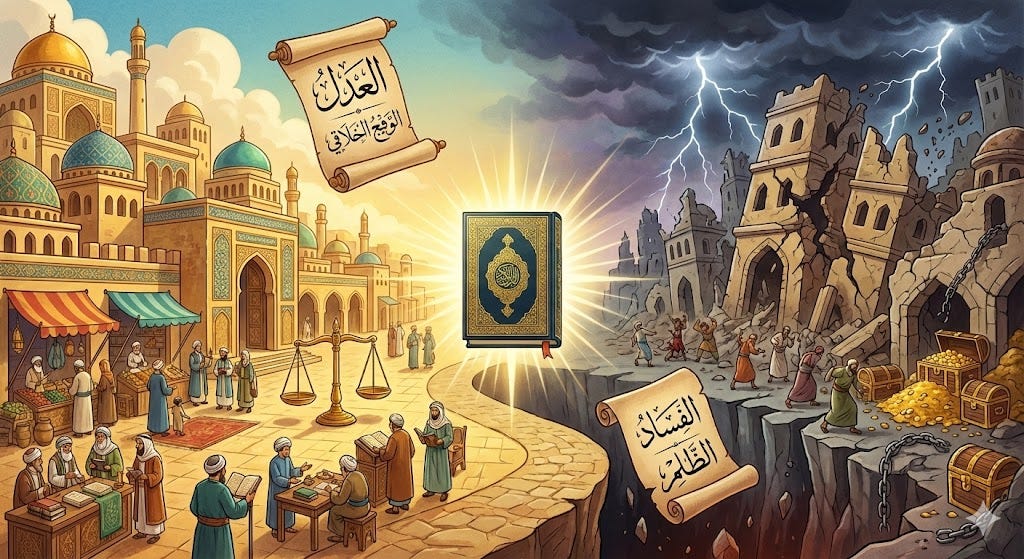
When we recite Surahs like Hud, al-Qasas, and al-Anbiya, a profound realisation often emerges: The Quran is not merely recounting sacred history; it is codifying a moral-civilisational law. It does not treat the past as a collection of folklore, but as a dataset for the future.
This perspective shifts the Quran from being a book of “tales” to a diagnostic manual for the rise and fall of nations. It argues that history is not driven by random accidents or mere military might, but by an unyielding moral physics.
1. A Diagnostic Manual, Not a History Book
The Quran rarely offers dates, timelines, or exhaustive biographies. It omits the “when” to focus entirely on the “why.” It urges the reader to adopt an analytical gaze:
“So travel through the earth and observe how was the end of those who denied.” — (Surah Ali ‘Imran, Chapter 3, The Family of Imran, Verse 137)
The Quranic method identifies patterns that transcend eras. It posits that the survival of a civilisation is never guaranteed by power, wealth, or numbers. Instead, civilisations are sustained by their moral orientation and commitment to social justice.
2. The Internal Mechanism of Collapse
The central thesis of the Quran regarding history is remarkably consistent: Nations collapse from the inside before they fall from the outside. External enemies are often just the final blow to a structure that has already rotted from within.
This is encapsulated in the famous Quranic axiom:
“Indeed, Allah will not change the condition of a people until they change what is in themselves.”
(Surah Ar-Ra’d, Chapter 13, The Thunder, Verse11)
In the Shia tradition, this concept is further elucidated by Amir al-Mu’minin Imam Ali ibn Abi Talib (A.S.). In his famous letter to Malik al-Ashtar, the Governor of Egypt, he issues a direct warning that oppression is not just immoral, it is a declaration of war against the Divine:
“He who oppresses the servants of Allah, Allah becomes his litigant (enemy) instead of His servants... and there is nothing more inductive to the change of Allah’s bounty and the hastening of His retribution than the persistence in oppression.” — (Nahj al-Balagha, Letter 53)
This teaches that a ruler might survive the anger of the people for a time, but he cannot survive the withdrawal of Divine protection, which is triggered immediately by Zulm (oppression).
3. Al-Qasas: Power Without Ethics is Self-Destructive
The story of Fir‘awn (Pharaoh) is the ultimate case study. The Quran does not present his fall as a result of Moses having a stronger army. Pharaoh fell because his power became detached from accountability, law became an instrument of ego, and society normalised injustice.
For Imam Ali (A.S.), justice was not an abstract concept but a terrifying reality of the Next World manifesting in this one. In a famous incident, when his own brother Aqil asked for a small, unmerited portion from the public treasury, the Imam did not lecture him. Instead, he heated a piece of iron and brought it near Aqil’s body.
As Aqil cried out in fear, the Imam said:
“Do you cry on account of this iron heated by a man for fun, while you drive me towards the Fire which the Almighty has heated for His wrath? By Allah, I would rather pass a night in wakefulness on the thorns of Sa’dan (a prickly plant) or be driven in chains as a prisoner than meet Allah and His Messenger on the Day of Judgment as an oppressor over any person...” — (Nahj al-Balagha, Sermon 224)
This is a warning that tyranny is not a sign of strength, but a symptom of imminent collapse, and that a leader who favors his own interests over the public has already destroyed his spiritual standing.
4. The Law of Inheritance: Continuity Depends on Responsibility
In Surah al-Anbiya, the Quran outlines that the “inheritance” of the earth is not genetic or perpetual—it is conditional.
“...My righteous servants shall inherit the earth.”
(Surah Al-Anbiya, Chapter 21, The Prophets, Verse 105)
There is a profound narration often cited in Shia scholarship which summarises this historical law: “A kingdom may endure with disbelief (Kufr), but it cannot endure with injustice (Zulm).”
Conclusion: The Inevitability of Consequences
The Quran does not view the rise and fall of nations as random political theater. It presents them as moral consequences embedded into the fabric of reality.
The insights of the Ahlul Bayt reinforce this: justice is the foundation of the universe. When that foundation is removed, the structure—no matter how grand—must eventually come down. To read the Quran is to see that the “news” of today is simply the history of the ancients repeating itself. The names change, but the law remains.