

Introduction: A Narrative in Need of Correction
For decades, a particular narrative has dominated global discourse—one in which the West positions itself as the sole custodian of “humanity,” “enlightenment,” and “civilisation,” while condescendingly branding non-Western societies, and the Islamic world in particular, with labels of backwardness and stagnation. This narrative, repeated so often in academic halls, political speeches, and popular media, has calcified into assumed truth.
Yet behind this carefully maintained façade lies a fundamental confusion—one that conflates technological comfort with genuine human progress. True advancement is not determined by the sophistication of one’s machines or the abundance of one’s material conveniences. It is determined by the maturity of the spirit, the steadfastness of moral principles, and the depth of respect afforded to every human being. Technology, when severed from ethical grounding, inevitably degenerates into an instrument of plunder and violence.
As Imam Ali ibn Abi Talib (AS) declares in the Nahj al-Balagha:
“Knowledge is better than wealth: knowledge guards you, while you have to guard wealth.” (Sermon 147).
The Islamic civilisational project was, at its root, a project of knowledge in service of the soul—not knowledge in service of dominion.
Purity as Civilisation: The Islamic Standard of Hygiene
History speaks with clarity on matters that propaganda would prefer to obscure. In the Islamic world, taharat (ritual and physical purity) was never merely a recommendation; it was a religious obligation and a daily discipline woven into the fabric of law, architecture, and public life. Hundreds of public baths (hammams), sophisticated water-distribution systems, and hospitals (bimaristans) operated across cities from Baghdad to Córdoba to Cairo.
Shia jurisprudence, as codified in works such as Sheikh al-Tusi’s al-Mabsut and later Allamah al-Hilli’s Tadhkirat al-Fuqaha, devoted extensive chapters to the rulings of taharat, najasa, and the obligation of cleanliness as a precondition for worship—embedding hygiene into the very grammar of faith. Imam Ja’far al-Sadiq (AS) is reported to have said:
“Cleanliness is part of faith, and faith is with Allah.” (Bihar al-Anwar, vol. 73).
By stark contrast, early modern Europe languished in a prolonged sanitary crisis. Until well into the eighteenth century, water was widely feared as a carrier of “miasmas.” Bathing was avoided; filth was masked beneath layers of powder and perfume; superstition substituted for empirical inquiry. The gap was not one of intellect but of civilisational priority: one civilisation legislated cleanliness as worship; the other had not yet overcome the fear of water.
The Great Transfer: Andalusia, Sicily, and the Roots of the Renaissance
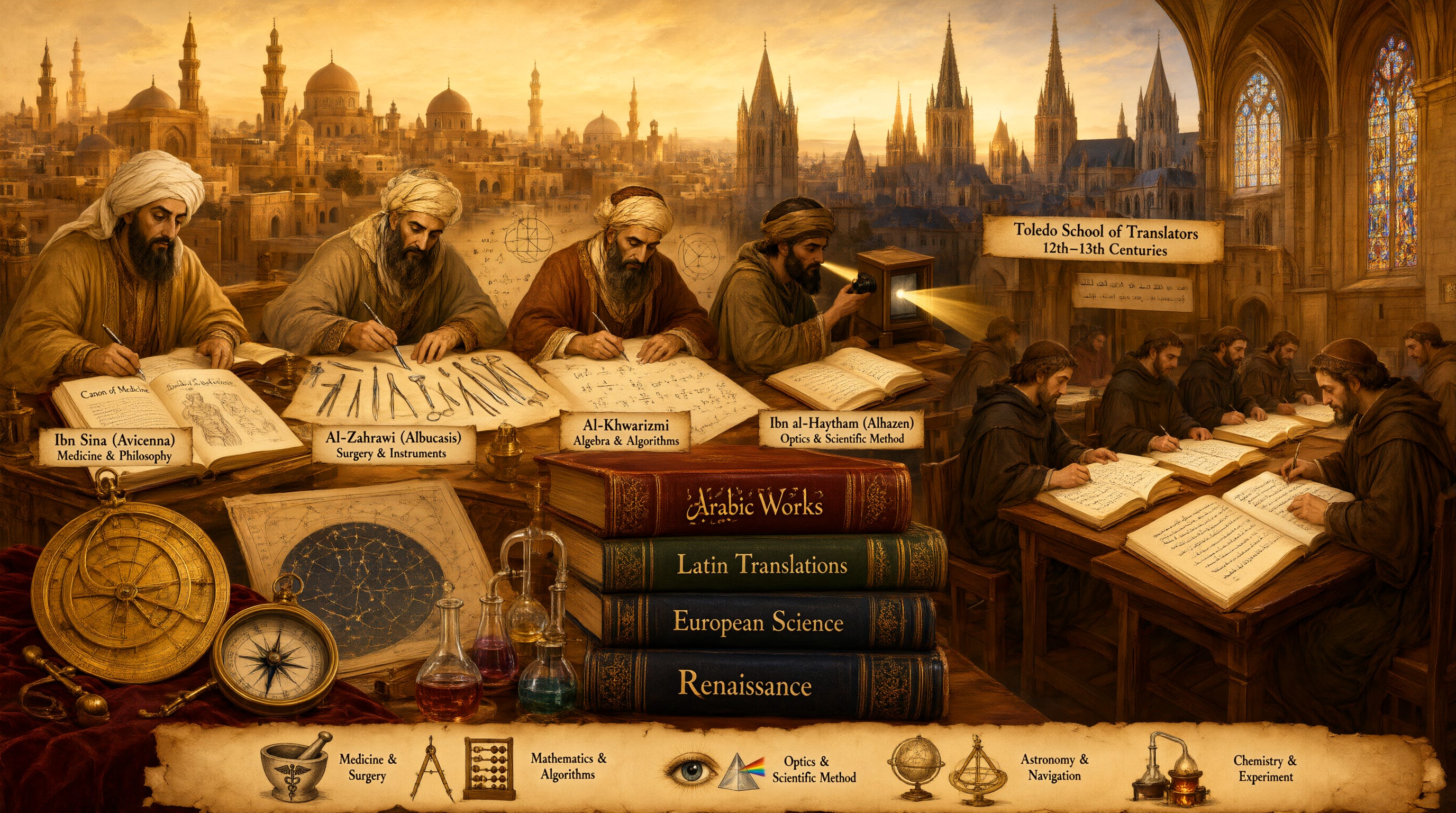
The European Renaissance and the so-called Scientific Revolution did not emerge in a vacuum. They were made possible by a massive, centuries-long transfer of knowledge from the Islamic world into Europe—principally through Andalusia and Sicily between the eleventh and thirteenth centuries.
Muslim scholars did not merely “preserve” the ancient legacy of Aristotle, Plato, Ptolemy, and Galen, shielding it from the amnesia of medieval Christendom. They critically reinterpreted it, corrected fundamental errors, extended its boundaries, and built entirely new applied disciplines upon its foundations. The translation movement centred in Toledo, Palermo, and later the great madaris was not passive copying; it was active, critical, creative scholarship.
Imam Ali (AS) counselled:
“A person’s value lies in what he does well.” (Nahj al-Balagha, Saying 81).
The scholars of the Islamic golden age understood this injunction as a mandate to excel—not in conquest, but in understanding.
Medicine and Surgery: Healing as Sacred Duty
The Qanun fi al-Tibb (The Canon of Medicine) by Ibn Sina (Avicenna) served as the primary medical textbook in European universities until the seventeenth century. Al-Zahrawi (Albucasis), in his Kitab al-Tasrif, described and illustrated more than two hundred surgical instruments and pioneered the use of catgut suture—a technique still foundational to surgery today. Ibn al-Nafis, in his Sharh Tashrih al-Qanun, described the pulmonary circulation of blood three centuries before William Harvey’s celebrated account.
In the Shia tradition, the ethic of healing carries particular theological weight. Imam al-Sadiq (AS) is reported to have stated:
“The best of deeds is to bring comfort to a believer and to remove his suffering.” (Al-Kafi, vol. 2).
Medicine, in this framework, was never a mere trade; it was an act of worship and communal responsibility.
The Exact Sciences: Algebra, Algorithms, and the Language of Numbers
From Muslim mathematicians, Europe received the very vocabulary and architecture of modern computation. The term algebra derives from al-jabr, the title of Al-Khwarizmi’s landmark ninth-century treatise. The word algorithm is itself a Latinisation of his name. The decimal positional system, including the concept of zero, was transmitted through Islamic scholarship, as were the foundations of trigonometry.
These were not marginal contributions. They constituted the mathematical infrastructure upon which the European scientific revolution was subsequently built.
Optics and the Experimental Method: Seeing Clearly
Ibn al-Haytham (Alhazen), in his monumental Kitab al-Manazir (Book of Optics), refuted the emission theory of vision inherited from Ptolemy and Euclid, demonstrated scientifically how light enters the eye, described the camera obscura, and—crucially—insisted on controlled experimentation and reproducible observation as the basis of natural philosophy. He laid the foundations of the experimental scientific method centuries before Francis Bacon and René Descartes received credit for its articulation in Europe.
This insistence on evidence over assumption resonates with the Quranic imperative, frequently cited in Shia tafsir such as Allamah Tabataba’i’s al-Mizan:
“And do not pursue that of which you have no knowledge. Indeed, the hearing, the sight, and the heart—about all those one will be questioned.” (Quran, Surah al-Isra, The Night Journey, Chapter 17, Verse 36).
Astronomy and Chemistry: Mapping the Heavens, Transforming Matter
Muslim astronomers crafted intricate astrolabes, produced detailed navigational charts, and compiled star catalogues of remarkable precision. The very language of celestial science bears their imprint: zenith, azimuth, and nadir are Arabic terms adopted into every European scientific lexicon. Jabir ibn Hayyan, meanwhile, laid the groundwork for experimental chemistry, systematised distillation processes, and described the synthesis of key acids—transforming alchemy into a proto-discipline governed by method.
The Paradox: Knowledge Adopted, Spirit Abandoned
Here lies the civilisational paradox that the dominant narrative prefers not to examine. The West absorbed the Islamic scientific base and used it to engineer an extraordinary technological leap. But instead of coupling that leap with spiritual evolution, moral restraint, and justice, it channelled its newfound power toward colonial subjugation, the artificial suppression of other civilisations’ development, and the relentless extraction of their resources.
The result was a civilisation of astonishing mechanical capability married to profound moral poverty. Railways were built to carry plunder. Telegraph lines were strung to coordinate domination. The printing press, that engine of enlightenment, was deployed to disseminate racial hierarchies and justify conquest.
Imam Ali (AS) warned:
“The world is a carcass; whoever desires it must keep company with dogs.” (Nahj al-Balagha, Saying 131).
The warning was not against knowledge, but against knowledge hijacked by appetite.
Conclusion: Reclaiming the Measure of Progress
The Islamic world does not need to seek validation from a civilisational standard it helped to author. The contributions outlined here are not a plea for recognition; they are a corrective to a historical record that has been deliberately narrowed.
More importantly, they reassert a definition of progress that the modern world has largely forgotten: that a civilisation is judged not by the power of its engines but by the purity of its conscience; not by the reach of its armies but by the dignity it guarantees to the weakest among its people.
As Imam Ja’far al-Sadiq (AS) taught:
“The believer is the mirror of the believer.” (Al-Kafi, vol. 2).
True civilisation is not a monologue of superiority. It is a mirror held up in honesty—and in that mirror, the myth of a singular, Western-authored “progress” dissolves, revealing the many hands, many faiths, and many traditions that built the world we inhabit.
The question before humanity is no longer who invented what. The question is whether we will have the moral courage to build what we invent with justice, humility, and reverence for the human being.