

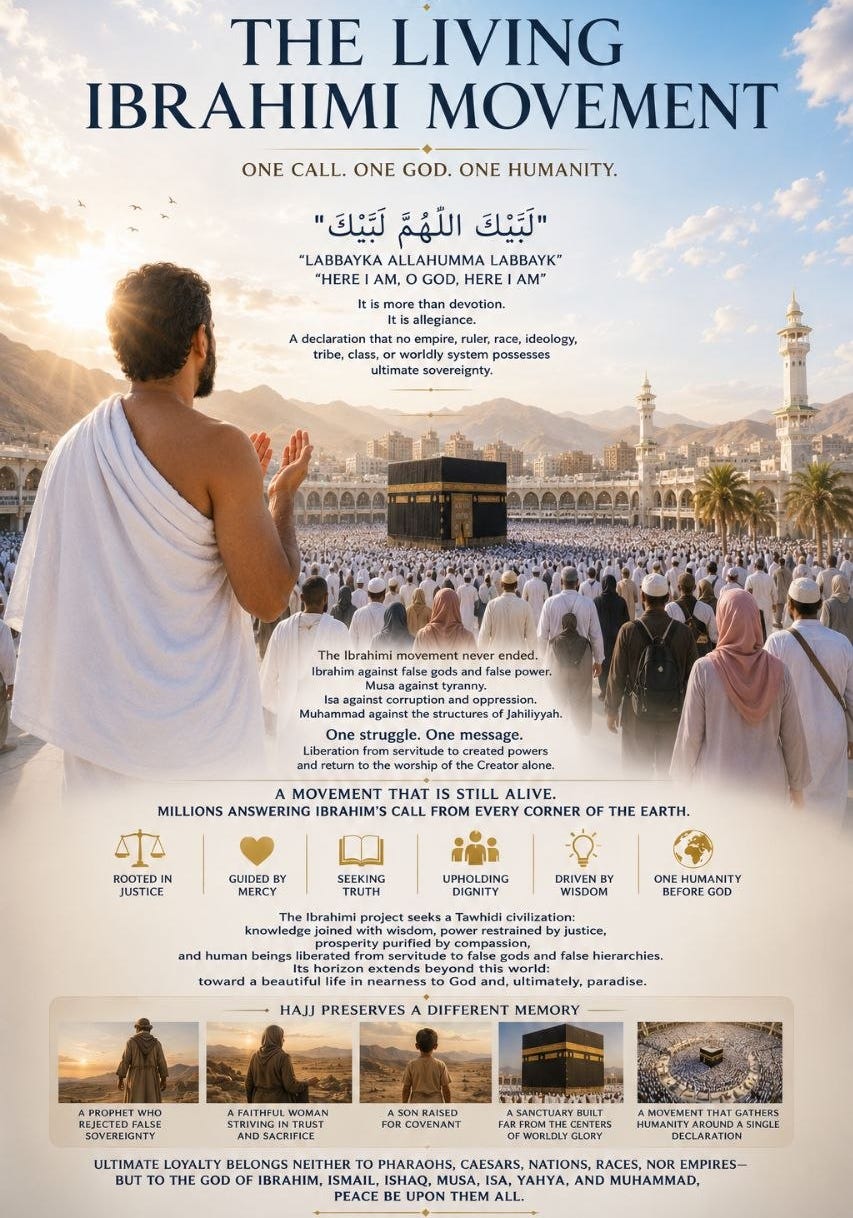
The pilgrim’s cry echoes through the barren valley: “Labbayka Allahumma labbayk”—“Here I am, O God, here I am.” This is far more than an expression of devotion. It is a profound declaration of allegiance. It is a proclamation that no empire, ruler, race, ideology, tribe, class, or worldly system possesses ultimate sovereignty over human life.
The Quran says of Prophet Ibrahim:
“He named you Muslims before…”
In this sense, the Ibrahimi movement never truly ended. It is a continuous thread woven throughout history. Prophet Musa confronting Pharaoh, Prophet Isa challenging corruption and oppressive orders, and Prophet Muhammad confronting the entrenched structures of Jahiliyyah (Ignorance) are all part of the exact same struggle. It is the eternal struggle to free human beings from servitude to created powers and return them to the worship of the Creator alone.
The Vision of a Tawhidi Civilisation
That movement is still vibrantly alive today. Millions continue answering Prophet Ibrahim’s call from every corner of the earth. What began with a prophet standing almost entirely alone against the religious and imperial orders of his age has blossomed into one of the largest continuing movements in human history.
Yet, the goal of this movement is not domination for its own sake, nor is it the mere replacement of one earthly empire with another. The Ibrahimi project seeks a Tawhidi civilisation: a civilisation deeply rooted in justice, mercy, truth, dignity, wisdom, and the absolute sovereignty of God above all worldly powers.
It invites humanity to the best of both worlds. This invitation is not reserved for one race, one tribe, one class, or one privileged people—it is open to all who sincerely seek truth, justice, dignity, and nearness to the Divine.
The Quranic vision does not reject civilisation itself. Rather, it seeks its highest form: a society where knowledge is joined with wisdom, power is restrained by justice, prosperity is purified by compassion, and human beings are liberated from servitude to false gods and false hierarchies. Its horizon extends far beyond this world, looking toward a beautiful life in nearness to God and, ultimately, paradise.
A Different Kind of Memory
Empires attempt to preserve themselves through grand monuments, vast armies, opulent palaces, and carefully crafted myths of worldly supremacy.
Hajj, however, preserves a completely different kind of memory:
A prophet who fundamentally rejected false sovereignty.
A faithful woman striving in unwavering trust and profound sacrifice.
A son raised specifically for a divine covenant.
A sanctuary built intentionally far from the gleaming centres of worldly glory.
Yet, from that barren valley emerged a movement that still successfully gathers humanity around a single, unifying declaration: that ultimate loyalty belongs neither to Pharaohs, Caesars, nations, races, nor empires—but strictly to the God of Ibrahim, Ismail, Ishaq, Musa, Isa, Yahya, and Muhammad, peace be upon them all.
Reference: Shaykh Ali Reza Panahian