

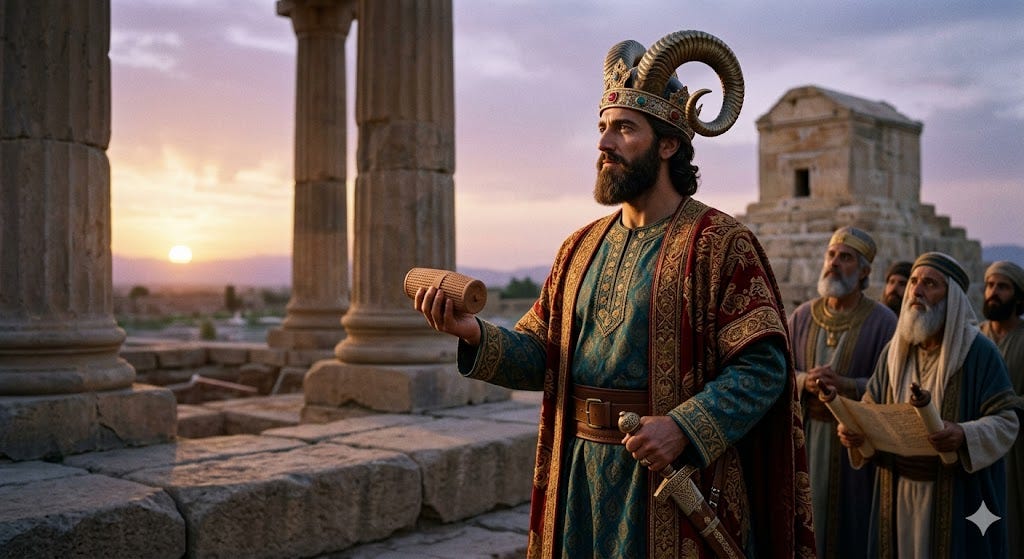
For centuries, the identity of “Dhul-Qarnayn” (The Two-Horned One)—a powerful, just, and monotheistic ruler detailed in Surah Al-Kahf (Chapter 18, The Cave) of the Quran—was one of Islamic history’s great enigmas. Classical scholars, working with limited historical texts, often tentatively identified him as Alexander the Great or an ancient Yemeni king.
However, Alexander was a polytheist with a brutal legacy, which heavily contradicted the Quranic depiction of a righteous, God-fearing king. It wasn’t until the 19th and 20th centuries, with the unearthing of ancient Persian artefacts, that a profound paradigm shift occurred. Guided by the intellectual rigour of modern Islamic and Shia scholars, a new, overwhelmingly supported consensus emerged: Dhul-Qarnayn was none other than Cyrus the Great, the founder of the Achaemenid Empire.
The Origins: Unifying the “Two Horns”
To understand why Cyrus perfectly fits the Quranic profile, we must look at his origins. Born around 600 BCE in Persis (modern-day Fars province in Iran), Cyrus was the son of a Persian king and a Median princess.
At the time, the region was fractured. Cyrus achieved what was previously thought impossible: he rebelled against his Median grandfather and successfully fused the Medes and the Persians into a single, unified powerhouse.
From a theological perspective, this origin story is deeply significant. The title Dhul-Qarnayn literally translates to “He of the Two Horns.” Historically, the symbol of the Medo-Persian empire was a two-horned ram—a detail corroborated by the Biblical Book of Daniel and stone reliefs found at the ancient Persian capital of Pasargadae showing a figure wearing a two-horned headdress. Shia exegetes emphasise that God raised Cyrus from this specific geopolitical background to unify two great nations, bringing stability to a chaotic region.
The Three Quranic Expeditions
The Quran notes that God granted Dhul-Qarnayn immense power and that he undertook three major earthly expeditions. Cyrus’s military campaigns mirror these journeys flawlessly:
The Western Journey: The Quran states he found the sun setting in a “murky spring.” Cyrus conquered the Lydian Empire in Asia Minor (modern-day Turkey), advancing all the way to the Aegean Sea, where the sun would appear to set into the dark, turbulent waters of the coast.
The Eastern Journey: The Quran describes a journey to a people with “no shelter” from the sun. Cyrus expanded his empire eastward into the harsh deserts of Bactria and the Makran coast (modern-day Afghanistan and Pakistan), regions populated by nomadic tribes lacking permanent dwellings.
The Northern Journey: The Quran details a journey to a mountainous pass where the ruler built a massive barrier of iron and copper to protect a vulnerable population from the destructive tribes of Yajuj and Majuj (Gog and Magog). Cyrus campaigned deep into the Caucasus Mountains, where historians note the remains of ancient fortifications in the Daryal Gorge (modern-day Georgia), built to keep out marauding northern nomads.
The Liberation of the Oppressed: Cyrus and the Jews
Perhaps the most compelling argument for Cyrus as Dhul-Qarnayn lies in his profound relationship with the Jewish people. In Shia theology, a ruler’s legitimacy is inextricably tied to their justice (‘Adl). A true leader uses absolute power to protect the innocent and uphold the worship of the One God.
Decades before Cyrus rose to power, the Babylonian king Nebuchadnezzar II destroyed Jerusalem and marched the surviving Jewish people into brutal exile—the Babylonian Captivity. For Islamic scholars, these exiled Jews were the Mustadafeen (the oppressed), holding onto the monotheism of Prophets Moses, David, and Solomon in a land of idol-worshipping tyrants.
In 539 BCE, Cyrus conquered Babylon with almost no bloodshed. Upon taking the city, he issued what is now known as the Cyrus Cylinder, famously freeing the enslaved Jewish people. He allowed them to return to Jerusalem and used Persian state funds to rebuild their sanctuary.
He was not Jewish, but as an early Zoroastrian who worshipped a single Creator, he recognised the Jews as fellow monotheists. By saving them from extinction, Cyrus ensured the survival of the Abrahamic lineage that would eventually lead to Prophet Jesus (Isa) (A) and Prophet Muhammad (S). Prominent Shia scholars note that the Jewish Prophet Isaiah even referred to Cyrus as God’s “Anointed” (Messiah). It is entirely consistent, they argue, for the Quran to praise the same righteous king that earlier divine prophets celebrated.
The Modern Theological Consensus
This historically grounded view of Cyrus was championed by the greatest Shia intellects of the modern era. Allameh Muhammad Husayn Tabatabai, in his monumental 20-volume Quranic commentary Tafsir al-Mizan, meticulously dismantled the Alexander the Great theory and solidified the case for Cyrus. This was further popularised by contemporary authorities like Ayatollah Makarem Shirazi in Tafsir Nemouneh.
For these scholars, establishing Cyrus as Dhul-Qarnayn reinforces the universality of divine guidance. It proves that God sends righteous leaders to all nations throughout history. Cyrus is revered not for the vastness of his empire, but because he was an instrument of divine justice.
A Shared Legacy
Viewing Cyrus the Great through the lens of modern Islamic scholarship profoundly enriches his legacy. It transforms him from a brilliant geopolitical tactician into a timeless spiritual exemplar.
The ancient king praised in the Hebrew Bible for freeing the Jews is the exact same figure honoured in the Quran as the righteous Dhul-Qarnayn. Ultimately, the story of Cyrus stands as a powerful testament to a shared heritage between the Abrahamic faiths, proving that true power is at its greatest when it is anchored in justice, mercy, and faith in the One God.
References:
1. Tafsir al-Mizan
Author: Allameh Muhammad Husayn Tabatabai Location in the Text: Surah Al-Kahf (Chapter 18, The Cave), Exegesis of Verses 83–98.
Original Arabic/Persian Edition: Volume 13.
English Translation Edition: Volume 26 (Published by WOFIS/Tawheed Institute).
How to find it in the text: After giving the theological breakdown of verses 83–98, Tabatabai includes a specific appendix titled “Historical Discourse” (Baḥth Ta’rīkhī). In this section, he systematically analyses the classical claims for Alexander the Great and the ancient Yemeni kings, dismantling them based on historical and theological contradictions. He then extensively quotes the research of the Indian scholar Maulana Abul Kalam Azad to conclusively argue that Cyrus the Great is the only historical figure who fits the Quranic parameters.
2. Tafsir Nemouneh (The Ideal Commentary)
Author: Ayatollah Naser Makarem Shirazi (along with a team of scholars) Location in the Text: Surah Al-Kahf (Chapter 18, The Cave), Exegesis of Verses 83–98.
Original Persian Edition: Volume 12.
English Translation (often published under the title Light of the Holy Quran): Volume 9.
How to find it in the text: In the commentary for verses 83–98, there is a dedicated sub-section specifically addressing the identity of Dhul-Qarnayn. Ayatollah Makarem Shirazi lists the three most prominent historical theories (Alexander, a Himyarite King of Yemen, and Cyrus). He concludes that the first two are deeply flawed and explicitly champions the third theory (Cyrus). He highlights the discovery of the Cyrus Cylinder and the two-horned stone relief at Pasargadae as definitive archaeological proof supporting the Quranic narrative.
With regards to Dhul Qarnayan, do you think it some kind of multiple choice question or a personal preference where every Muslim can choose to have their personal Zul Qarnayn? Some can choose Cyrus, some can say Darius, some will say Alexander .That is not how it works in the real world.
You can choose to reject whatever you want but historians are focused on what it actually is. We know 100% without any doubt, that Zul Qarnyan is based on Christian legends about Alexander the Great found in pre Islamic stories called Syriac Alexander legend.
Christians created these stories around Alexander as they wanted to appropriate a pre Christian famous king in their worldview so they invented these laughable stories where he is going to the end of the world and encountering Gog and Magog and trapping them behind an iron wall. These stories were very popular in the middle east. They were as popular as Batman and Superman are today. Luckily for Christians, they just used these stories as Christians legends and never incorporated them into their holy texts.
Unfortunately, for you Muslims, it became part of your divine revelations and the word of God, called the Quran, so you have no way to hide from this. If this was the hadith, you could have rejected it but it is not, it is as per your religion, a story told to Muhammad by archangel Gabriel which means Gabriel was dictating man made christian fairytales to Muhammad.
This basically shows that Muhammad was a 7th century Charlatan and a scammer who heard stories from Christians and turned them into divine revelations for his illiterate followers. The real Alexander was a Greek polytheist who did none of these things and all these stories were created around him centuries after his death.
There is not even a single western historian or any early Islamic scholar who agrees with you that Cyrus is Zul Qarnain. Cyrus himself was a die hard pagan even more than Alexander and Cyrus cylinder contains prayers to the Babylonian gods and Cyrus calls himself as being appoined by the god Marduk. All your early Islamic scholars who lived during the early period of Islam and were aware of this story, clearly say this is Alexander the Great. There is not even a single western historian who has analyzed the Quran who says this is anyone other than Alexander the Great.
The implication is much more serious for you Muslims. It annihilates your Quran's claims of being the word of God.