

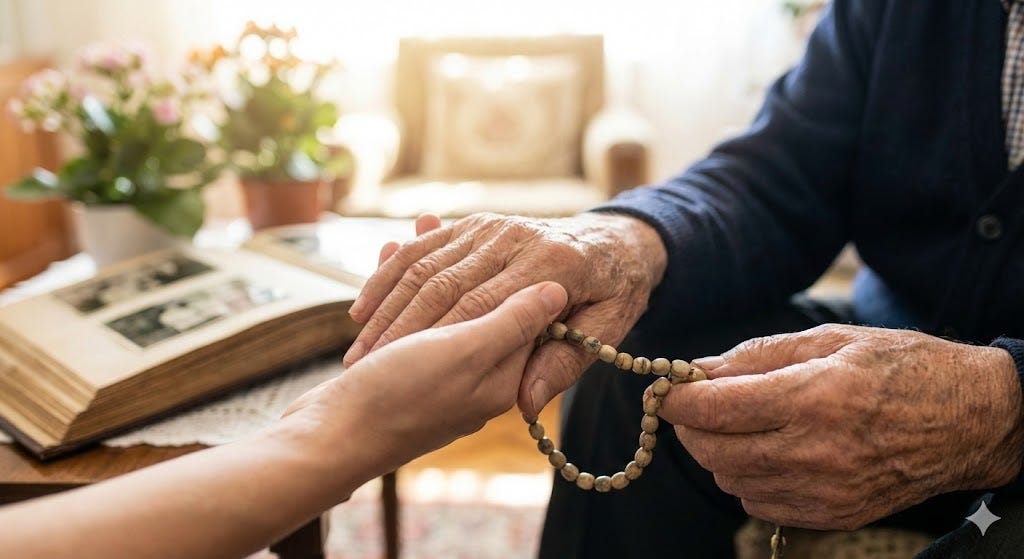
In the rush of our daily lives, it is easy to forget the foundation upon which we stand. We often look forward, chasing goals and future successes, rarely pausing to look back at the hands that held us when we were too weak to stand alone. Recently, Grand Ayatollah Abdullah Javadi Amoli offered a profound reminder of this forgotten duty, framing gratitude toward parents not just as a social nicety, but as a divine imperative interwoven with the very fabric of our souls.
While society often measures contribution by material provision—acknowledging the father’s role in securing shelter and livelihood—there is a deeper, more visceral sacrifice that often goes unspoken. The Ayatollah draws our attention to the unique, physically demanding journey of the mother. It is a path paved with “weakness upon weakness,” a reality where the body itself is offered up to bring forth new life.
From the quiet burdens of pregnancy to the labor of childbirth and the selfless years of breastfeeding, the mother’s experience is one of “debilitating hardship.” Ayatollah Amoli urges us to see this not just as biology, but as a supreme act of endurance. For sons, understanding this reality is the gateway to deep, authentic gratitude. For daughters, it is a lesson in the dignity and immense spiritual weight of motherhood itself.
This perspective is anchored in ancient wisdom. The Ayatollah referenced the Holy Quran to underscore his point, citing verse 14 of Surah Luqman:
“And We have enjoined upon man [care] for his parents. His mother carried him, increasing her in weakness upon weakness, and his weaning is in two years. Be grateful to Me and to your parents; to Me is the final destination.”
This powerful verse explicitly highlights the mother’s suffering and links gratitude to her directly with gratitude to the Creator, a divine testament to her strength.
Ultimately, this message is a call to awaken our conscience. Honoring our parents isn’t limited to polite words on special occasions; it is about conduct, respect, and a continuous flow of care. It is a recognition that strong families—and by extension, strong societies—are built on the acknowledgment of these sacrifices. To look into the eyes of our parents with reverence is to accept a divine command, grounded in the humble admission that we did not get here on our own.
Reference: ABNA