

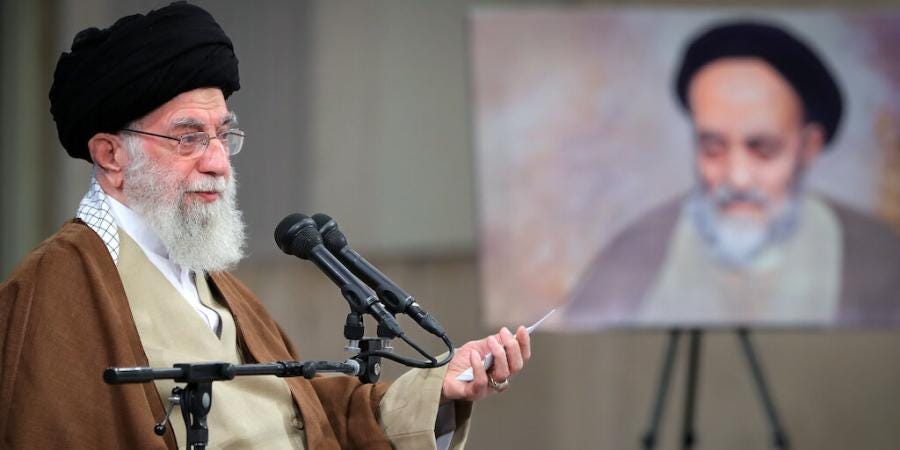
In November 2023, meeting with the organisers of an international congress honouring Allameh Sayyid Mohammad Hossein Tabatabai, Imam Khamenei described a man he called “one of the exceptional wonders of our seminaries in the last centuries.” The address, delivered on 8 November and published a week later, was part tribute, part lesson — and part personal memoir.
Read today, after the speaker’s own martyrdom in the US–Israeli attacks of February 2026, it carries the weight of a testament: the martyred Leader of the Islamic Revolution remembering the teacher of martyrs.
A mind without borders
The first thing Imam Khamenei stressed was the sheer breadth of Allameh Tabatabai’s learning. He was a master of the principles of jurisprudence, an innovative philosopher, and a man with deep understanding of theoretical mysticism. He was a scholar of astronomy and mathematics, a skilled poet, and an authority on genealogy. In Quranic exegesis, Imam Khamenei said, “he was truly unparalleled in this field.”
He was also, remarkably, a proficient architect: the layout of Qom’s prominent Hojjatiyeh Seminary was drawn by his hand.
The Leader shared a family memory to illustrate the point. His late father had been friends with Tabatabai since their years in Najaf, and once wrote asking him to obtain the family tree from a certain well-known genealogist in Qom. Tabatabai replied simply: “I know [genealogy] as much as he does or more.” He then prepared the tree himself. The family tree the Khameneis hold to this day, the Leader noted, was drawn up by Allameh Tabatabai.
Depth, not just breadth
But encyclopaedic range was only one dimension. In philosophy, Tabatabai was not a commentator but an originator — he presented a philosophical system, laid out in The Principles of Philosophy and the Method of Realism and in his two later works, Bidaya and Nihaya.
And in Al-Mizan, his monumental commentary, Imam Khamenei found “a sea of political and social knowledge” — engaging with questions that had not even been raised in Tabatabai’s own time, yet speak directly to the present day.
The teacher of a revolution
Perhaps no scholar’s classroom shaped the Islamic Revolution more. Tabatabai revived philosophy in the seminaries and trained philosophers: Martyr Motahari, Martyr Beheshti, Martyr Qoddusi, and Martyr Agha Sheikh Ali Heydari Nahavandi were all his students, as was the late Ayatollah Mesbah Yazdi. Many of his students went on to play key roles in the Revolution, and many of those who drafted the constitution in the Assembly of Experts had sat in his lessons.
Two lessons for today
Two qualities, Imam Khamenei said, drew him most powerfully to the Allameh.
The first was his exceptional intellectual jihad. Tabatabai lived through an invasion of imported ideologies — Marxism above all — and an atmosphere thick with manufactured doubt, the same doubts Martyr Motahari’s books were written to answer. Against this, Tabatabai did not dig in. “He was able to form a strong intellectual base using an active, offensive approach,” the Leader explained. The lesson he drew for our own time was explicit: “We need to form intellectual bases that fill the voids and have an active, offensive nature toward the other side rather than assuming a passive, defensive position.”
The second quality was that Tabatabai never let knowledge remain in the head. “He grasped those concepts and truths with his noble heart and soul, and he put his knowledge into practice.” His fabled humility, patience and forgiveness — even toward those who argued and disputed with him — flowed from that. “When people saw him, it truly seemed to them that he was not concerned with himself.”
A story captured it perfectly. At Allameh Semnani’s house, Semnani turned to Imam Khomeini and began warmly praising him: “I read your Tafsir Al-Mizan. It is very good. It is excellent. I truly enjoyed it.” He had mistaken Khomeini for Tabatabai. Imam Khomeini, ever composed, listened without a word. It was Tabatabai, sitting on the other side of the room, who gently corrected him: “I am Mr. Tabatabai. He is Mr. Khomeini, my teacher.”
The man behind the books
For all his gravity, Tabatabai was a delight to be around. In private gatherings he was warm, charming and a gifted conversationalist who narrated events “in detail and with color and life.” He loved poetry and literature. He was, in the Leader’s words, a complete and well-rounded personality.
“Mr. Tabatabai is much better known today than he was during his lifetime,” Imam Khamenei observed — known in his day by perhaps a tenth of those who know him now, and honoured today across the world.
He closed with a prayer: “I hope, God willing, the Almighty God will exalt his rank, and make us of those who are appreciative of him.”
The same, it must now be said, is true of the man who spoke these words.
Based on remarks by the martyred Leader of the Islamic Revolution, delivered 8 November 2023 and published 15 November 2023 on en.khamenei.ir.
For additional information on Allameh Tabatabai and more read The Lantern of the Path sessions on Truth Promoters