

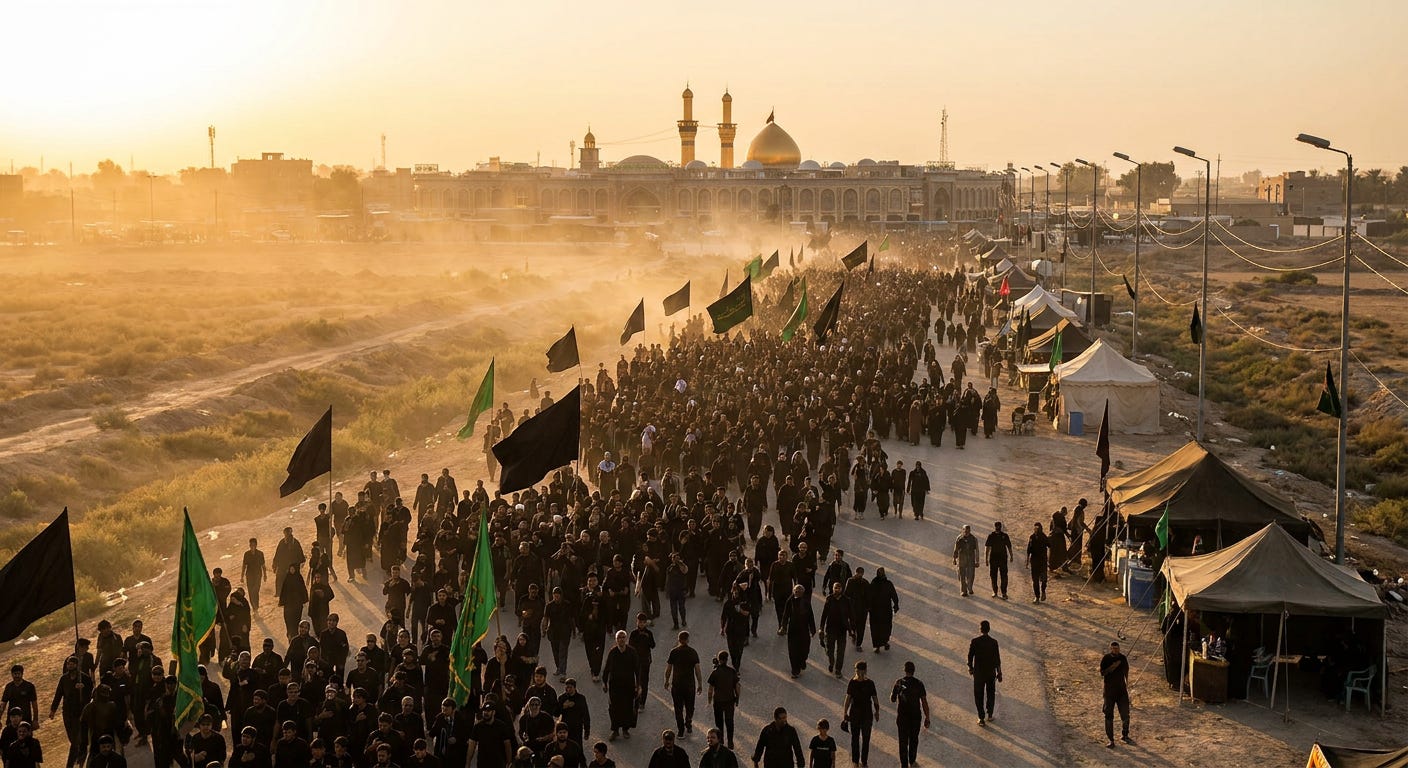
Every year, more than twenty million people converge on the holy city of Karbala for the Arbaeen pilgrimage — by many accounts the largest annual gathering anywhere on earth. It is a breathtaking spectacle of love, devotion, and resilience. But beyond its emotional and spiritual magnitude, Arbaeen carries a very specific theological weight in Shia Islam. It is not merely a recommended act; it is a defining hallmark of a believer.
To understand why, we turn to a famous tradition (hadith) from the eleventh infallible guide, Imam Hasan Askari (AS), which outlines the defining characteristics of a true follower of the Ahl al-Bayt (AS).
The Five Signs of a True Believer
The tradition opens with a phrase every student of Shia hadith recognises — “’alamat al-mu’min khams,” the signs of a believer are five — and is preserved in the works of Shaykh Tusi, including Tahdhib al-Ahkam. Imam Hasan Askari (AS) names them as:
Performing 51 cycles (rak’ahs) of prayer each day — the 17 obligatory rak’ahs together with the 34 recommended daily nawafil.
Visiting Imam Husayn’s (as) shrine on Arba’een (Ziyarat Arbaeen).
Wearing a ring on the right hand.
Prostrating on dust — placing the forehead on the earth or turbah during prayer.
Reciting “Bismillah al-Rahman al-Rahim” aloud during the daily prayers.
This raises an essential question. Why is an annual pilgrimage placed firmly alongside foundational acts like daily prayer and prostration as a mark of genuine faith?
More Than Rituals: A Thread of Identity
At first glance, these five practices seem unrelated. One concerns daily prayer, another an annual journey; one dictates how to wear a ring, others the fine etiquette of worship. But look closer and a single thread runs through all of them: each one makes a person’s identity visible.
Consider them in turn. Wearing the ring on the right hand was a small but deliberate marker that set the follower of the Ahl al-Bayt (AS) apart. Prostrating on bare earth, rather than on fine carpets, was an immediately recognisable feature of Shia prayer. Saying Bismillah aloud, at moments where others lowered their voice, announced a particular understanding of the prayer for anyone standing nearby to hear. None of these is a private devotion sealed inside the heart. Each is a sign worn outward, in the body, in public, where it can be seen.
There is one apparent exception, and it is worth facing directly. The 51 daily rak’ahs are performed largely in private — so how does a hidden act belong to a list about visible identity? The answer is that the two are not opposites. The private discipline is what forms the person; the public sign is what that formed person then carries into the world. A believer prays those cycles alone, and the conviction it builds becomes the very thing they are unwilling to conceal when the world is watching. The inner and the outer are two ends of a single life.
In the Shia tradition, a true believer is not someone who merely keeps faith in the silent confines of the heart. Genuine faith is meant to be woven into one’s actions and manifested in one’s presence within society. In eras when following the Ahl al-Bayt (AS) invited severe persecution, these five acts served as unmistakable identifiers — symbols of a faith that refused to be suppressed. And the greatest of these outward signs, the one that gathers a person into a movement of millions, is Arbaeen.
An Avowal of Allegiance
Throughout history, tyrannical rulers — from the Umayyads to modern dictators — tried to erase Imam Husayn’s (AS) name, his movement, and his resting place from the memory of the people. They understood that Karbala was not merely a historical tragedy but an ongoing revolution against injustice.
As Allah (SWT) promises in the Holy Quran:
“And say, ‘Truth has come, and falsehood has departed. Indeed is falsehood, [by nature], ever bound to depart.’”
— (Quran, Surah al-Isra, Chapter 17, The Children of Israel, Verse 81)
Arbaeen became the ultimate defiance against that erasure. It is a resounding statement that Imam Husayn’s (AS) path can never be extinguished. With every exhausted step on the dusty roads toward Karbala, each pilgrim tells the world: I continue to choose this side.
Arbaeen isn’t only a physical journey. It is an open avowal of where one stands in the eternal contest between truth and falsehood — the announcement that a person has found the truth and refuses to let history forget it.
From Imam Husayn (as) to Imam Mahdi (aj)
Crucially, this stand is not confined to mourning the past. The mission of Ashura is bound to the future. Imam Husayn (AS) is the ancestor of the awaited saviour, Imam al-Mahdi (AJ), and the divine movement that began on the plains of Karbala reaches its fulfilment only with the reappearance of his final descendant.
Whoever consciously chooses to stand beside Imam Husayn (AS) at Arbaeen is declaring loyalty to the Imam of their own time. This transforms Arbaeen from a day of historical remembrance into a living state of awaiting the saviour (Intizar). It is a pledge of readiness.
The Secret of Arbaeen
Here, at last, is the secret of the pilgrimage and the reason it is enshrined as a sign of a true believer.
A believer is not merely someone equipped with correct beliefs. A believer is someone who openly demonstrates that they stand in the camp of truth at the most decisive moments — someone who does not waver when the world is watching.
Every year, the phenomenon of Arbaeen presses a single, echoing question upon us:
“If I hear the call to truth today, on which side will I stand?”
Reference: Sheikh Ali Reza Panahian, Shahada (Witness) Series, Truth Promoters Event (Session 15 - The Covenant of Arbaeen)