

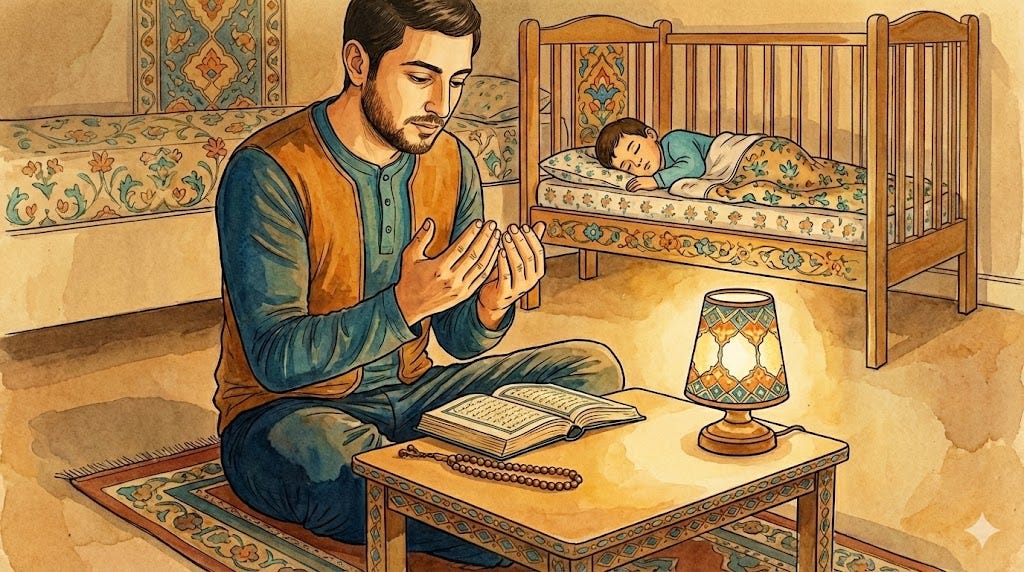
“My child has gone astray.” “I don’t recognise my daughter anymore.” “I fear for my son’s future.”
These are the heavy, tear-filled confessions heard in the homes of the believers and the offices of scholars. They are words born of love, but often spoken in the twilight of desperation. When faced with these heartaches, we must ask ourselves an uncomfortable question—not to condemn, but to heal:
When did we begin praying for them?
Did we wait until the storms of adolescence hit? Did we wait until the silence grew between us, until the habits were set like dried clay? It is human nature to cry out when the calamity arrives, but the way of the Awliya (saints) is to secure the foundation before the house is even built.
From the moment life was but a whisper, when the child was a fetus, an infant, a blank slate—where were our supplications then?
Prevention Before Cure: The Wisdom of Ahl al-Bayt
In the school of the Ahl al-Bayt, upbringing (tarbiyah) begins long before the child can speak. It begins with the spiritual state of the parents.
Amir al-Mu’minin, Imam Ali ibn Abi Talib (peace be upon him), wrote in his famous letter to his son, Imam al-Hasan (peace be upon him):
“I hastened to mold you before your heart hardened and your mind became occupied with other things.” (Nahj al-Balagha, Letter 31)
Just as the Imam hastened to mold the character of his son, we must hasten to mold the spiritual destiny of our children through prayer. To pray after the damage is done is seeking a cure; to pray before is seeking protection (hifz).
A Simple Practice for Profound Protection
Scholars of spirituality have long recommended a specific, consistent practice to encompass our children in divine light. It is not a burden, but a shield.
The Recommended Prayer for Children Time: Every night, any time between Maghrib and Fajr. Structure: Two light Rak‘ahs.
First Rak‘ah: Recite Surat al-Fatihah (Chapter 1) followed by Surat al-Qadr (Chapter 97).
Second Rak‘ah: Recite Surat al-Fatihah (Chapter 1) followed by Surat al-Kawthar (Chapter 108).
Why these Surahs? Surat al-Qadr invokes destiny and divine decree, asking Allah to write a beautiful fate for them. Surat al-Kawthar invokes abundance and the continuity of a blessed lineage—just as it was revealed to console the Prophet (S) regarding his progeny, Lady Fatimah (peace be upon her).
Had this simple act been woven into our nights from the beginning, how many of today’s crises might have been softened by the mercy of Allah?
The Humility of “Hab Lana” (Grant Us)
The Quran teaches us the etiquette of asking in Surat al-Furqan, Chapter 25, The Criterion, verse 74:
وَالَّذِينَ يَقُولُونَ رَبَّنَا هَبْ لَنَا مِنْ أَزْوَاجِنَا وَذُرِّيَّاتِنَا قُرَّةَ أَعْيُنٍ وَاجْعَلْنَا لِلْمُتَّقِينَ إِمَامًا
“And those who say, ‘Our Lord, grant us from among our wives and offspring comfort to our eyes and make us an example for the righteous.’”
The verse uses the specific verb Hab (from Wahb), meaning “to grant a gift.” A gift is not a salary. It is not earned through labour. It is given purely out of the giver’s generosity.
By using this word, we make a startling admission to Allah:
“O Lord, we have fallen short. We may have made mistakes in their upbringing. We may have neglected them or misunderstood them. We have no claim over their guidance. So we ask You—purely out of Your grace—to fix what we could not perfect.”
This is the humility of the sinner asking the All-Merciful. It transforms parenting from a checklist of tasks into a reliance on Divine intervention.
Raising Leaders, Not Just Followers
Many parents today find comfort in the bare minimum: “Alhamdulillah, my son prays,” or “My daughter fasts.”
While these obligations are vital, the ambition of a follower of the Ahl al-Bayt must be higher. The verse does not say “Make us leaders of the Muslims,” but rather: “Make us leaders for the God-conscious (Muttaqīn).”
We are not raising children just to fit in; we are raising the standard-bearers of the next generation. We are praying for children who:
Have moral clarity when the world is confused.
Influence their peers rather than being influenced by them.
Create circles of faith and integrity in their universities and workplaces.
In the Sahifa Sajjadiyya, Imam Zayn al-Abidin (peace be upon him) prays for his children with this exact high ambition:
“O God... make them righteous, pious, possessing sight, hearing, and obedience to You, and lovers and well-wishers of Your friends, and bear obstinate hate against all Your enemies.” (Supplication 25)
The Long Prayer: A Lineage of Light
Even if our children struggle, we must never despair. Our vision must extend beyond the immediate moment, looking forward to the generations to come.
We look to the example of Abu Talib (peace be upon him). Through his lineage and protection, the light of Islam was safeguarded. From his loin came Ali ibn Abi Talib, and from Ali came Al-Husayn (peace be upon them both).
When a father prays, “O Lord, grant me among my descendants someone like Abu Talib,” he is praying for a lineage that protects the Truth. He is praying that from his bloodline, helpers of the Imam of the Time (AJ) will arise.
No prayer is wasted. The tear you shed for your child today may water the seed of a grandchild who becomes a scholar, a martyr, or a saint.
Start Tonight
The past is gone, but the doors of the heavens remain open.
If you feel you started late, remember that Allah is Al-Mujib (The Responder). Begin tonight.
In your Sujud (Prostration).
In your Qunut.
In the quiet moments before dawn.
Repeat the prayer of the Qur’an. Perform the two rak’ahs. Pour your heart out to the One who loves your children more than you do.
“Our Lord, grant us...”
Perhaps this sincere du‘a, made with a broken heart, is the turning point that will rewrite the destiny of your family.