

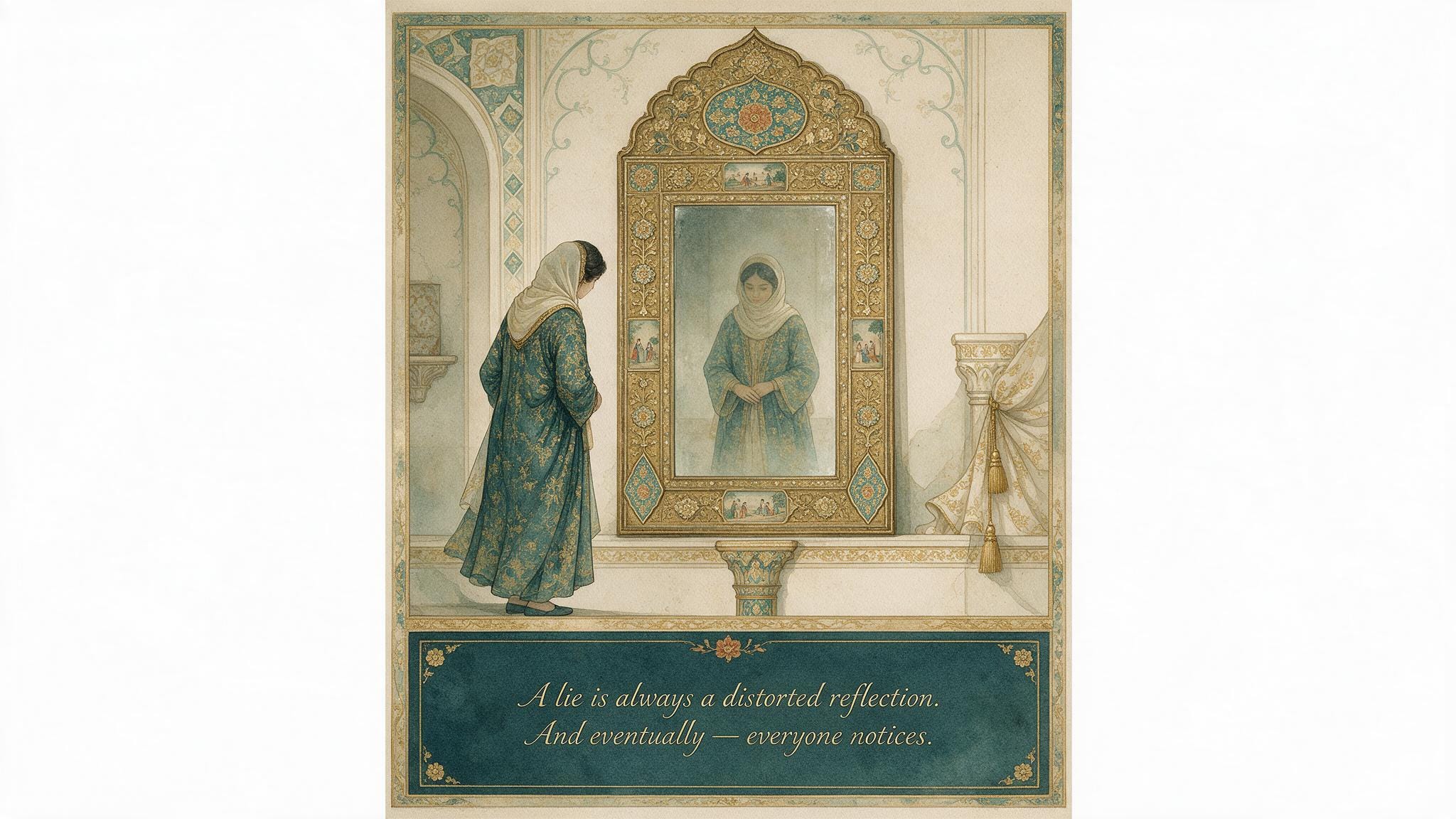
The Most Universal Sin on This Entire List
Of all the greater sins we have covered so far — murder, usury, gambling, sodomy, false accusation — there is one that every single reader of this article has committed. Without exception. Without a single doubt.
Lying.
Not once. Not twice. Many times. In small ways and sometimes large ones. In moments of fear, of convenience, of self-protection, of wanting to appear better than we are. With deliberate calculation and sometimes without even thinking. To strangers, to colleagues, to friends — and sometimes to the people we love most.
Lying is the most democratic sin in existence. It crosses every culture, every religion, every age group, every social class. And yet here it sits — the seventeenth greatest sin — classified by the Ahlul Bayt in the same list as murder, Shirk, and usurping orphans’ property.
Why? What is it about lying that places it in such grave company?
By the end of this article, the answer will be undeniable.
What Is a Lie?
This sounds like a question with an obvious answer. But Islamic scholarship is precise where common sense is often lazy.
Lying is classified among the greater sins in the narration of Fazl ibn Shazan from Imam Ja’far al-Sadiq (AS). The famous scholar Shaykh al-Ansari writes in his book Makasib al-Muharrama: “Common sense suggests lying is haram; all the revealed religions also say so — particularly Islam. The Quran is explicit in this regard. The corpus of hadith, the opinion of the majority of jurists, and reason all verify this.”
A lie, in its essence, is a deliberate statement of something you know to be untrue, made with the intention of creating a false belief in the listener. Three elements — deliberate, known untruth, and intention to deceive. This is what distinguishes a genuine lie from a mistake, from a story, from a metaphor, from a misunderstanding.
And it is this deliberate, intentional quality that makes lying so serious. Because a lie is never just an incorrect statement. It is a choice — a conscious decision to replace reality with a fabrication. Every time a person lies, they are making an active decision about truth. And the Ahlul Bayt teach that those decisions, accumulated over a lifetime, shape the very nature of the soul.
What Does the Quran Say?
The Quran addresses lying from multiple angles — and the picture it paints is consistently severe.
In Surah at-Tawbah (Chapter 9, The Repentance, Verse 77), Allah describes what happens to the heart that chooses lying:
“So He penalised them by putting hypocrisy in their hearts until the Day they will meet Him — because they broke their promise to Allah and because they used to lie.”
Hypocrisy in the heart — nifaq — as a direct consequence of lying. We saw this same connection in the article on music, where the Prophet (S) said that music causes hypocrisy to grow in the heart. Here Allah Himself makes the connection explicit: lying plants hypocrisy in the heart. The gap between inside and outside — between what is and what is presented — begins with the first lie and grows with every one that follows.
In Surah al-Imran (Chapter 3, The Family of Imran, Verse 61), Allah curses the liars directly. In Surah al-Ghafir (Chapter 40, The Believer, Verse 28), a believing man from Pharaoh’s court argues: “Allah does not guide one who is a transgressor and a liar.” In Surah az-Zumar (Chapter 39, The Companies, Verse 3), those who lie about Allah are described as among the most unjust of all people.
And in Surah at-Tawbah (Chapter 9, The Repentance, Verse 119), Allah gives the antidote in a single, luminous command:
“O you who believe — fear Allah and be with the truthful.”
Be with the truthful. Not just be truthful yourself — but surround yourself with truthful people. Make truthfulness your community, your standard, your atmosphere. Because the company of the truthful protects and the company of liars corrupts.

What the Ahlul Bayt (AS) Taught — And the Language Is Extraordinary
The Imams (AS) spoke about lying with a consistency and a clarity that leaves nothing ambiguous. And they connected it to something that goes far beyond mere dishonesty — they connected it to the very structure of faith and disbelief.
The Holy Prophet (S) said: “Beware of lying — for lying leads to wickedness, and wickedness leads to the Fire. A man keeps telling lies until he is recorded with Allah as a great liar.”
That progression — lie, wickedness, Fire — is described as a path. Not a single catastrophic fall but a journey taken step by step. Each lie makes the next one easier. Each act of wickedness that follows a lie makes the next wickedness feel more natural. The person doesn’t suddenly become a great liar. They are recorded as one — because Allah has watched every small lie, every convenient untruth, every gradually lowered threshold.
Imam Ja’far as-Sadiq (AS) said something that stands as one of the most profound statements in all of Shia literature on this topic:
“Lying is the key to every evil.”
The key to every evil. We saw in the gambling article that alcohol is the key to the room of all evils. Now the Imam tells us that lying is the key itself. These statements work together — lying is the instrument, alcohol is the door, and Ghina is the invitation. Together they describe a spiritual ecosystem in which evil flourishes when these three things are present and collapses when they are removed.
Why is lying the key to every evil? Because almost every other sin requires lying to sustain it. The person committing Zina lies to their spouse. The person dealing in Riba lies about the nature of their transactions. The person stealing lies about what they have taken. The person who broke a family tie lies to themselves about why they were justified. Lying is not just a sin among sins — it is the scaffolding that holds most other sins in place.
The Inner Destruction of Lying
Ayatollah Dastaghaib Shirazi discusses something that is among the most spiritually important aspects of this sin — what lying does to the inside of the person who lies, not just to the relationships around them.
Imam Ali (AS) said: “The person who lies loses the beauty of his character.” Not his reputation. Not his relationships. His character. The internal architecture of who he is begins to crumble.
This is something anyone who has lied habitually recognises — though they may not have words for it. There is an internal cost to lying that goes beyond the fear of being caught. Something in the self becomes unreliable. The person begins to lose track of what is true and what is fabricated. They begin to lose trust in their own perceptions because they have spent so long manipulating those perceptions for others. The inner life becomes as distorted as the outer presentation.
The Ahlul Bayt described the truthful person as someone whose inner and outer life are aligned — what they feel, what they think, and what they say are one. That alignment is called sidq — truthfulness — and it is one of the highest stations of the believer. The liar is the precise opposite — a person fragmented, whose inside and outside have been deliberately separated. And that fragmentation, sustained over time, produces exactly the hypocrisy that Allah described in Surah at-Tawbah.
The Types of Lying — More Than We Think
One of the most important contributions of Ayatollah Dastaghaib Shirazi’s discussion of this sin is how broadly he defines what constitutes lying. Because many of us have mentally categorised certain kinds of untruth as acceptable — and the Ahlul Bayt challenge almost every one of those categories.
Lying about others. This is the most obvious form — saying something untrue about another person. It can be malicious and deliberate or casual and careless. Both are lying.
Lying about oneself. Presenting oneself as more pious, more knowledgeable, more generous, more capable than one actually is. This is perhaps the most socially acceptable form of lying — the carefully curated social media profile, the inflated CV, the exaggerated story told at a dinner table. But the Ahlul Bayt considered self-aggrandisement through falsehood as serious as any other form of lying.
Lying in promises. Making commitments one has no intention of keeping. The Prophet (S) described this as one of the three signs of the hypocrite — along with breaking trust and lying in speech.
Lying in praise. Praising someone for qualities they do not have — telling someone their work is excellent when it is mediocre, calling someone generous when they are known for their stinginess, complimenting for the sake of social lubrication rather than truth. The scholars were careful to distinguish this from genuine, heartfelt encouragement — which is not lying. But empty, flattering praise that creates false impressions is a form of falsehood.
Lying to children. This is one the Ahlul Bayt specifically warned about. The Prophet (S) once saw a woman call her child with the promise of something she was not actually going to give him — a casual, thoughtless domestic lie. He told her firmly: “If you had not given him what you promised — a lie would have been written against you.” The habit of lying to children — broken promises, hollow threats, convenient untruths to manage behaviour — plants the seed of dishonesty in the very people we are supposed to be raising toward truth.
Joking lies. Some people habitually exaggerate, fabricate, or distort in the name of humour. The Ahlul Bayt drew a clear line here. A story everyone knows is fictional — a parable, an analogy, a clearly fictional narrative used to illustrate a truth — is not a lie. But a false statement presented as true, even in jest, even to get a laugh — is still a lie. And the Prophet (S) warned specifically against the person who “lies to make people laugh.” The laughter is real. So is the sin.
Are There Exceptions? When Is It Permitted to Lie?
This is the question almost everyone asks — and the Ahlul Bayt addressed it honestly and specifically.
Yes — there are narrow, well-defined circumstances where an untruth is not only permitted but may be obligatory. The scholars identify three main categories:
To save a life. If telling the truth will directly result in someone being killed or gravely harmed — an innocent person being handed to an oppressor, a persecuted believer being handed to their enemies — lying to protect them is not only permitted; it is required. The principle is that human life outweighs the prohibition on lying.
To make peace between people. If two Muslims are estranged from one another and a well-intentioned person conveys slightly adjusted versions of each person’s words to the other in order to rekindle their relationship — the scholars permit this. Not to deceive for personal gain, but to restore what was broken. The Prophet (S) specifically mentioned this exception.
Between spouses in matters of love and affection. The scholars permit a husband telling his wife she is the most beautiful woman in the world, or similar expressions of love and devotion that may not be literally true but are expressions of genuine feeling rather than deceptive statements of fact. These are understood as the language of love, not deception.
Outside these narrow exceptions — the prohibition is firm. And even within them, the scholars caution against allowing exceptions to become habits, or allowing the concept of “good intentions” to expand indefinitely to justify whatever lie is convenient.
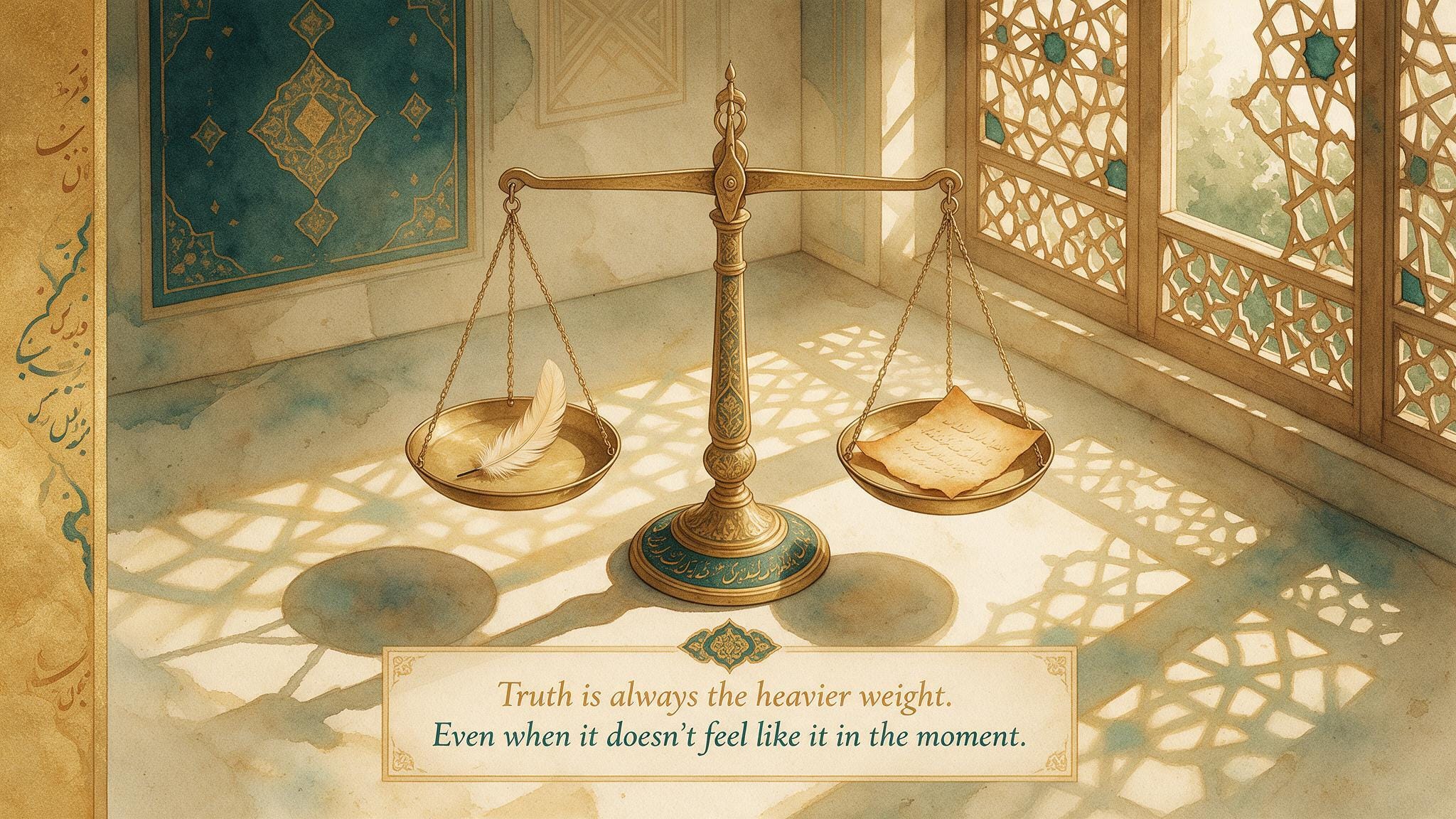
Truthfulness and the Ahlul Bayt — The Living Example
One of the most beautiful dimensions of this topic in Shia tradition is how the Ahlul Bayt themselves embodied sidq — absolute truthfulness — as a way of being, not merely a rule to follow.
Imam Ali (AS) is famously recorded as never having told a lie in his entire life — not in childhood, not in the heat of battle, not under political pressure, not even when the truth cost him everything. His commitment to truth was so absolute that it shaped his entire character — and it is precisely this quality that made him, in the Prophet’s (S) description, “with the truth and the truth with Ali.”
The Quran in Surah at-Tawbah (Chapter 9, The Repentance, Verse 119) commands us to be with the truthful — and the scholars of tafsir, including Allama Tabatabai in Tafsir al-Mizan, explain that the truthful ones referred to in this verse are specifically the Ahlul Bayt (AS). Being with the truthful is not just about honesty in our own speech. It is about attaching ourselves to the people whose very being is rooted in truth — and allowing that attachment to reshape us.
This is why the Imam said: “A true Shia of the Ahlul Bayt is known by their truthfulness.” Not by their black clothing in Muharram. Not by their attendance at majlis. Not by their recitation of ziyarat. By their truthfulness. By the alignment of what they say with what is real. By the fact that when they make a promise, they keep it. When they make a claim, it is true. When they speak about someone, it is fair and accurate.
That is the Shia the Imams described. And that description begins and ends with truth.
The Road Back — Tawbah From Lying
For those of us who have lied — habitually, casually, or in specific moments we regret — the path of tawbah from this sin has some specific requirements.
Remorse and resolution are the starting points, as with all tawbah. But because lying frequently involves harming others — creating false impressions that affected their decisions, their trust, their lives — genuine tawbah often requires more than an internal turning toward Allah.
Where a lie caused material harm — a financial loss, a damaged reputation, a broken relationship — making amends wherever possible is part of the tawbah. Not always easy. Not always possible. But the intention and effort matter enormously to Allah.
And the practical commitment that follows tawbah from lying is simply this: tell the truth. Even when it is uncomfortable. Even when it costs you something. Even when the lie seems harmless. Build the muscle of truthfulness in small moments so that it is there in the large ones.
Imam Ali (AS) said: “Accustom your tongue to truthfulness and do not accustom it to lying — for lying is a base characteristic.” Accustom. Train. Habituate. Truthfulness, like everything else in the spiritual life, is built through practice — one honest moment at a time.
A Closing Thought
Lying sits seventeenth on this list — and its placement here, after music and singing, is quietly profound. Sins 15 and 16 were about what we fill our ears with. Sin 17 is about what comes out of our mouths. The Ahlul Bayt are building a picture of a complete human being — whose inputs and outputs are both aligned with Allah, whose interior and exterior are both rooted in truth.
The liar lives in a permanent state of internal fragmentation — managing versions of reality, maintaining fabrications, trying to remember what they told whom. The truthful person lives in a kind of interior freedom that the liar cannot access. What they think, what they feel, and what they say are one thing. There is nothing to maintain, nothing to manage, nothing to fear being exposed.
That freedom — the freedom of sidq — is what the Ahlul Bayt were pointing toward when they made truthfulness not just a rule but a way of being. A complete, integrated, internally coherent way of existing in the world.
“Be with the truthful.” It is perhaps the simplest, most actionable command in the entire Quran. And it begins with the most ordinary, everyday choice: to say what is true, even when what is untrue would be easier.
May Allah make our tongues instruments of truth, our hearts free from the fragmentation of dishonesty, and our characters worthy of the company of the truthful — the Prophet, the Ahlul Bayt, and all who walked in their footsteps. Ameen.