

Didn’t We Just Cover This?
If you read the last article on music, you might be wondering — aren’t singing and music essentially the same thing? Why does Ayatollah Dastaghaib Shirazi treat them as two separate greater sins?
It is a fair question. And the answer reveals something important about how Islamic scholarship approaches this topic with far more precision than a simple blanket ban on sound.
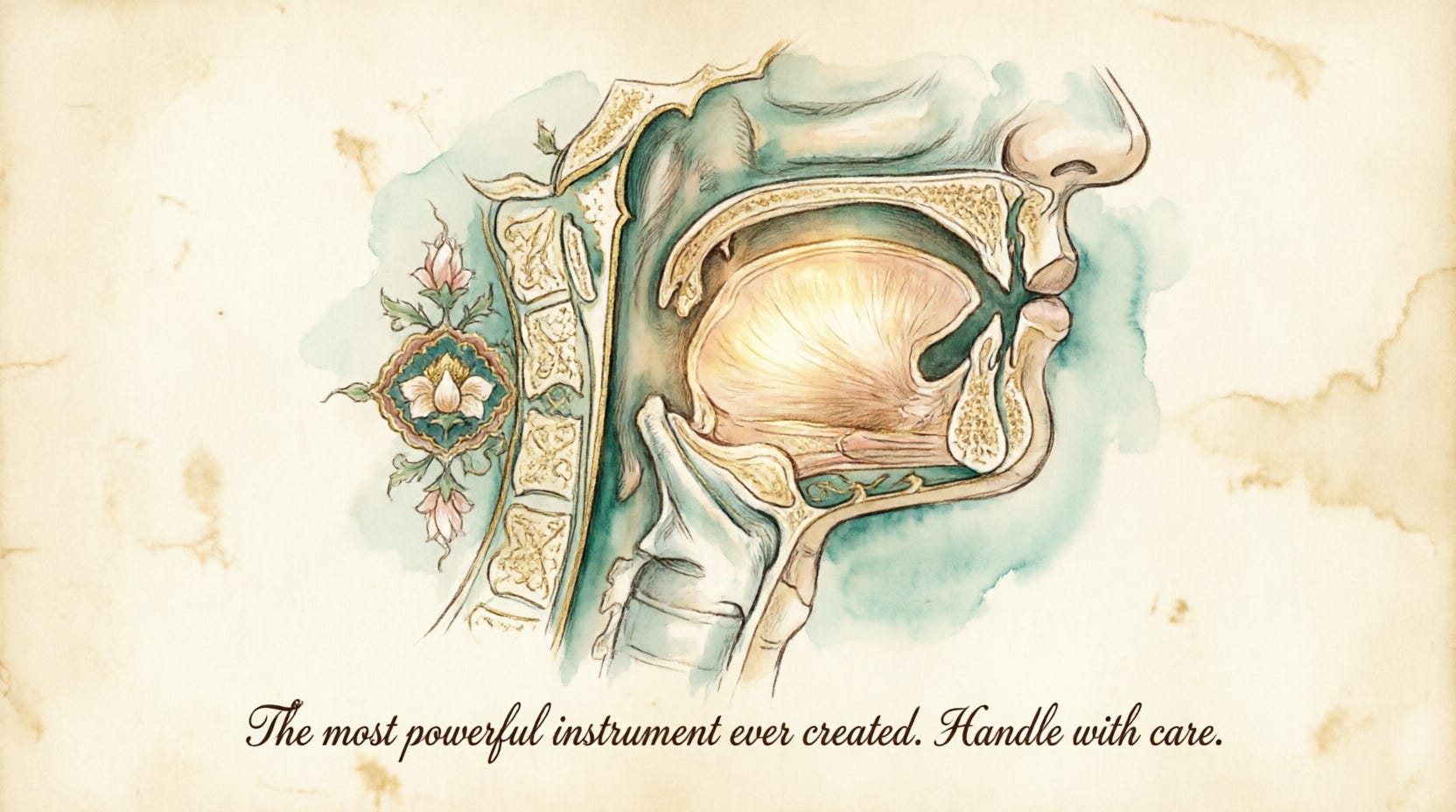
Music — as we discussed in Sin 15 — refers primarily to instruments, to the composition and performance of sound. Singing — Ghina — is specifically the human voice used in a particular way. And the Ahlul Bayt treated the human voice as something uniquely powerful, uniquely sacred, and therefore uniquely dangerous when misdirected.
The voice is not just an instrument. It is the most intimate expression of the human soul. It is what we use to recite Quran, to make dua, to call the adhan, to say La ilaha illallah with our last breath. The same instrument that can carry a person to the highest spiritual stations — when turned toward Ghina — becomes something the Ahlul Bayt described with extraordinary severity.
The sixteenth greater sin is singing songs. Traditions have graded it amongst the mortal sins. This fact is clear from the narration of Imam Ja’far al-Sadiq (AS). Muhammad Ibn Muslim relates that Imam Muhammad al-Baqir (AS) said:
“Singing is that sin which has been promised a penalty of fire (Hell) by Allah.”
Hell is specifically promised for this sin. By name. That alone tells us how seriously the Ahlul Bayt regarded what we are discussing today.
What Exactly Is Singing — As a Sin?
As we established in the last article, the Arabic term here is Ghina — and it carries a very specific meaning. A pleasing sound or reciting something in a pleasing way in itself does not constitute Ghina. Rather, Ghina can be explained as prolonging the sound, along with a change in the pitch in such a way that is suited to vain and futile gatherings and assemblies of music and sinning.
So the three elements that together constitute Ghina are: a particular vocal style, a particular emotional effect, and a particular context or atmosphere. Not just any singing. Not a mother humming to her child. Not a child reciting Quran in a melodious voice. Not a reciter of marsiya whose voice breaks with grief for Imam Husayn (AS).
Ghina specifically is the kind of singing that belongs to, creates, and sustains an atmosphere of heedlessness — where the heart is pulled away from Allah and into the world of desire, entertainment, and spiritual emptiness.
And the Ahlul Bayt were emphatic that this kind of singing is among the most effective tools Shaytan has ever deployed against the human soul. Not because the voice is evil. But because the voice is so powerful — so direct a path to the heart — that when it is weaponised against taqwa, the damage it causes is deep and lasting.
What the Quran Says
The Quranic foundation for the prohibition of Ghina comes most clearly from Surah Luqman (chapter 31, verse 6) — the same verse we referenced in Sin 15:
“And of the people is he who buys the amusement of speech to mislead from the way of Allah without knowledge — and who takes it in ridicule. Those will have a humiliating punishment.”
The phrase lahw al-hadith — amusement of speech — is interpreted by Ayatollah Dastaghaib Shirazi and the classical Shia scholars as referring directly to Ghina. The word buys is significant — it implies that this is something people actively seek out, spend money on, invest in. They are not accidentally exposed to it. They pursue it deliberately.
And Allah’s description of its effect is precise — it misleads from the way of Allah. Not immediately. Not dramatically. But gradually, consistently, in the way that water carves stone — the constant exposure to Ghina reshapes the interior landscape of a person’s heart until the path to Allah becomes harder to find, harder to walk, harder to even desire.
In Surah An-Najm (chapter 53, The Star, verse 59-62), Allah rebukes those who laugh, take amusement, and do not weep — and then asks: “Do you sing while you are heedless?” The scholars of tafsir note that the Arabic word used here — tsamidoon — refers specifically to singing and to a state of heedless entertainment. It is not just a rebuke of frivolity. It is a direct connection between the act of singing in this manner and the state of heedlessness that is one of the most spiritually dangerous conditions a believer can be in.
What the Ahlul Bayt (AS) Taught — And the Severity Is Real
The traditions of the Imams on Ghina are among the most unambiguous in all of Shia hadith literature. There is very little nuance here — the language is direct, the consequences described are severe, and the consistency across multiple Imams is striking.
Imam Muhammad al-Baqir (AS) said: “Singing is that sin for which Allah has promised the Fire.” This is a direct statement linking Ghina to one of the specific categories of sins that the Ahlul Bayt defined as greater sins — those for which Hell is explicitly promised as punishment.
Imam Ja’far as-Sadiq (AS) was asked about singing — about earning a livelihood from it, about listening to it, about keeping company with those who practise it. His response covered all three: the singer, the one who pays for singing, the one who listens to it, and the one who makes a living from it — all are implicated. The sin is not contained within the performer. It spreads to everyone who participates in its ecosystem.
The same Imam said: “The house in which Ghina is practised, in which sin is committed — that house will not be safe from sudden tribulations. And du’a made therein will not be accepted.”
Unanswered dua. This consequence comes up repeatedly in the traditions on both music and singing — and it is the one that should give every believer the most pause. Because du’a is our lifeline. It is the direct connection between the servant and the Lord. And the Ahlul Bayt are telling us that a home consistently filled with Ghina is a home where that lifeline becomes strained and weakened.
Think about what that means practically. The du’a you make for your sick child. The du’a for your parents’ health. The du’a for rizq and provision. The du’a to pass an exam or save a marriage. These prayers — rising from a heart and a home where Ghina has become the constant backdrop — face a barrier that the Imams described clearly and repeatedly.
The All-Evils Room — A Hadith That Explains Everything
Ayatollah Dastaghaib Shirazi includes in this chapter one of the most remarkable traditions in the entire book — a hadith that places Ghina in a context that explains everything about why the Ahlul Bayt treated it with such gravity.
The tradition states: “All the evils are locked in a room — and the key to that room is lying in the hands of wine. And singing is the caller toward fornication.”
Two extraordinary statements in a single narration.
First — all evils locked in one room, with alcohol as the key. We discussed this when we covered drinking liquor — the idea that alcohol opens the door to every other sin. But now the Imam adds: and singing is the one calling people toward that room. Singing is the invitation. The advertisement. The thing that makes the room look appealing and the door worth opening.
This is a profound insight into how sin operates — not as isolated incidents but as an ecosystem. Ghina creates an atmosphere. That atmosphere normalises certain feelings, certain desires, certain states of heart. And those states, once sufficiently cultivated, make the next sin — whether alcohol, Zina, gambling, or heedlessness of Allah — feel natural, even desirable.
This is why the Ahlul Bayt did not treat Ghina as a minor matter. They saw it clearly as the entry point — the seduction that begins the journey toward far more serious violations.
Singing and the Female Voice — An Important Clarification
Ayatollah Dastaghaib Shirazi addresses a specific dimension of this sin that requires clear discussion — the question of women singing in the presence of non-mahram men.
The scholars are unanimous that a woman singing in Ghina style in the presence of non-mahram men carries additional layers of prohibition — because it combines two separate sins: Ghina itself, and the specific haram of a woman’s voice being used in a manner that excites non-mahram men toward desire.
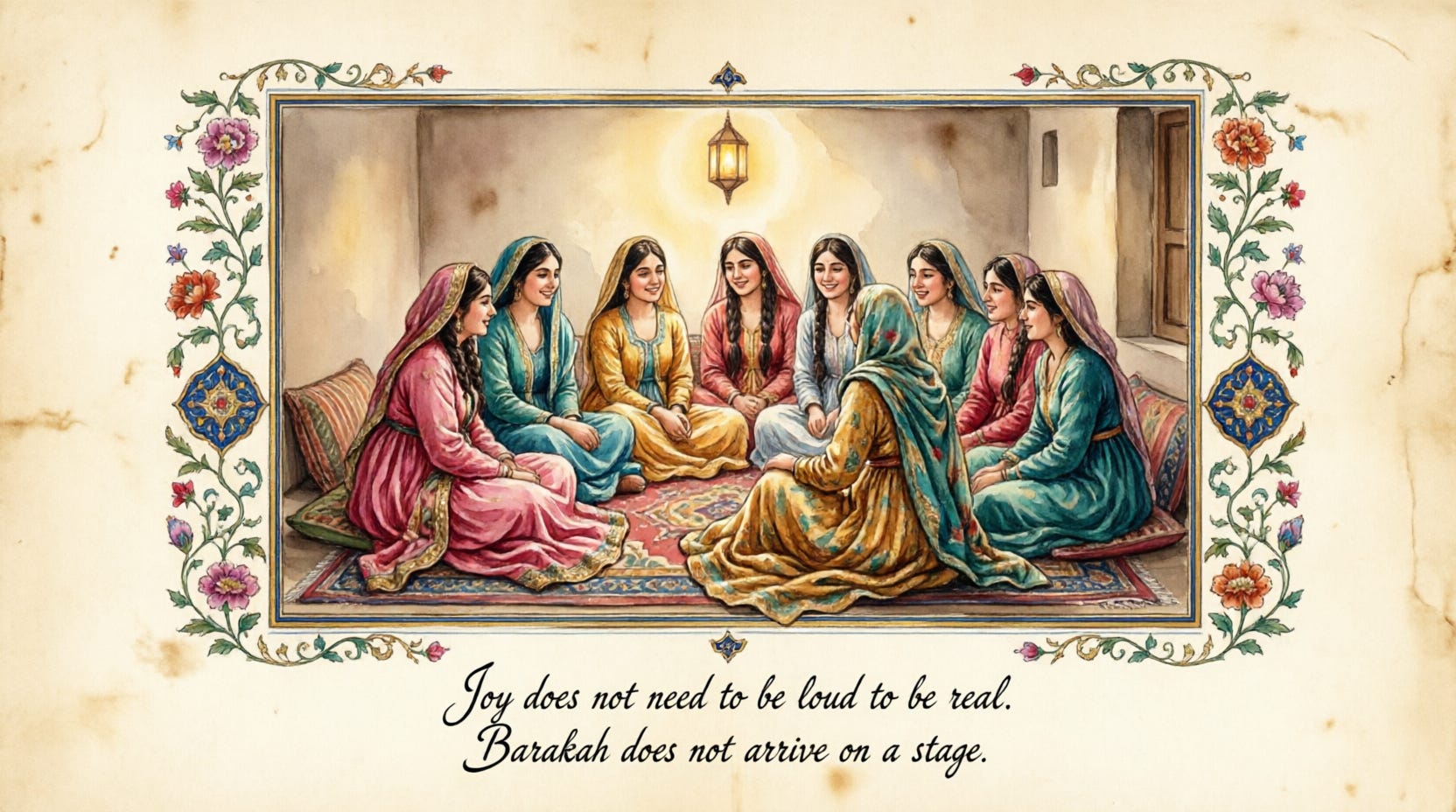
This is not a statement that the female voice is inherently sinful or lesser. Quite the contrary — the restrictions exist precisely because of its power. The female voice, when used in recitation of dua, in the recitation of Quran for other women, in the latmiyya of Muharram, in the teaching of knowledge — is a vessel of enormous spiritual beauty and barakah. Islam is not diminishing the female voice. It is protecting it from misuse.
And the same principle applies in reverse — men’s singing for mixed audiences in the style of Ghina carries the same prohibition. The sin is in the nature of the act and its effect, not in which gender is performing it.
The Question of Wedding Singing
One of the most practically relevant questions in Muslim communities — and one that comes up at almost every wedding — is whether singing is permitted at weddings.
The scholars acknowledge that there is a general permission for appropriate celebration at weddings. The Prophet (صلى الله عليه وآله) encouraged announcing marriages publicly and permitted certain forms of celebration. But the key word is appropriate.
Wedding singing that remains within the bounds of Islamic decency — no inappropriate lyrics, no mixed gatherings where it becomes a vehicle for excitement and heedlessness, no style that constitutes Ghina — sits in a different category from the entertainment of corrupting gatherings.
But the wedding celebrations of our time — where professional singers perform in the style of Ghina, where the atmosphere becomes indistinguishable from a nightclub, where the presence of Allah is the last thing anyone in the room is thinking about — those celebrations have moved far from the simple, joyful announcement of marriage that Islam encourages.
The question for every Muslim family planning a wedding is not simply is singing is allowed at weddings — it is: what atmosphere are we creating? What are we filling our guests’ hearts and minds with on this blessed occasion? And will the barakah we are seeking for this marriage be nurtured or undermined by the choices we make in its celebration?
What the Voice Was Made For
This is perhaps the most important section of this article — because the prohibition of Ghina is not the whole story of the human voice in Islam. It is only one half of it.
The Ahlul Bayt’s warnings about singing exist within a much larger and much more beautiful context — a tradition that elevates the human voice to extraordinary spiritual heights when it is directed toward Allah.
The Prophet (s) said: “Beautify the Quran with your voices.” Not a whisper. Not a monotone. A beautified voice — the most beautiful sound you can produce — directed at the most beautiful words ever revealed.
Imam Ali (AS) said that the adhan — the call to prayer — is among the most beloved sounds to Allah. Five times a day, a human voice rises and calls the entire community toward Allah. That voice is doing the opposite of everything Ghina does. Instead of creating heedlessness — it calls to consciousness. Instead of pulling toward Shaytan’s room — it opens the door of the masjid.
The recitation of the Quran in a moving, beautiful voice is described in the traditions as making the angels gather to listen. The same angels who will not enter a house where Ghina is practised — they come, and they gather, and they listen when the Quran is recited beautifully. The same voice, directed differently, produces completely opposite spiritual effects.
And then there is the marsiya — the elegies of Karbala. The reciter who raises their voice in grief for Imam Husayn (AS), whose voice breaks with love for the Ahlul Bayt, who moves an entire gathering to tears for the sacrifice that was made on the plains of Karbala — that person’s voice is doing something the Imams described as immeasurably precious. Not Ghina. Its precise opposite. Not heedlessness but the most profound remembrance. Not desire but grief and love that leads directly to Allah.
The voice Allah gave you is not neutral. It is one of the most powerful spiritual instruments in existence. The question Gunah-e-Kabira is asking you is simply this: in whose direction are you pointing it?
The Connection Between This Sin and All That Follows
Ayatollah Dastaghaib Shirazi places singing as Sin 16 — right after music as Sin 15 — and together they form a pair that deserves to be understood as a unit. Sound, melody, and voice — these are the atmosphere-creators of human experience. They shape the interior world of the heart more powerfully and more subtly than almost anything else.
A home where the constant sound is Quran, du’a, nasheeds of the Ahlul Bayt, and the adhan — that home produces a certain kind of heart. A home where the constant sound is Ghina — where the music streaming through earphones is the music of desire and heedlessness, where the voice that fills the rooms is the voice of singers performing for the atmosphere of sin — produces a completely different kind of heart.
And the heart is everything. It is the thing Allah will ask about on the Day of Judgement. Not your playlist. Not your Spotify account. Your heart — and what you filled it with.
A Closing Thought
Singing — the human voice raised in Ghina — sits sixteenth on this list because the Ahlul Bayt understood what every honest musician and every honest listener knows: that voice reaches places nothing else can reach. It bypasses the rational mind. It goes directly to the emotional core. It can move a person to tears or to ecstasy or to desire in a way that no argument, no image, and no written word can match.
Islam does not fear that power. It honours it. It says: this extraordinary thing — this voice, this capacity to move the human soul with sound — is far too precious and too powerful to be spent on heedlessness. Point it toward Allah. Recite His words with it. Cry for Husayn (AS) with it. Call His name with it. Use it to open the hearts of your children to faith and love of the Ahlul Bayt.
Because on the Day of Judgement — when every deed is weighed, when every moment is accounted for — what will matter is not how your voice sounded to the world, but what it was saying to Allah all along.
May Allah bless our voices with His remembrance, fill our homes with sound that draws us closer to Him, and protect us from every use of this extraordinary gift that distances us from the One who gave it. Ameen.