

The Sin That Lives Under Our Own Roof
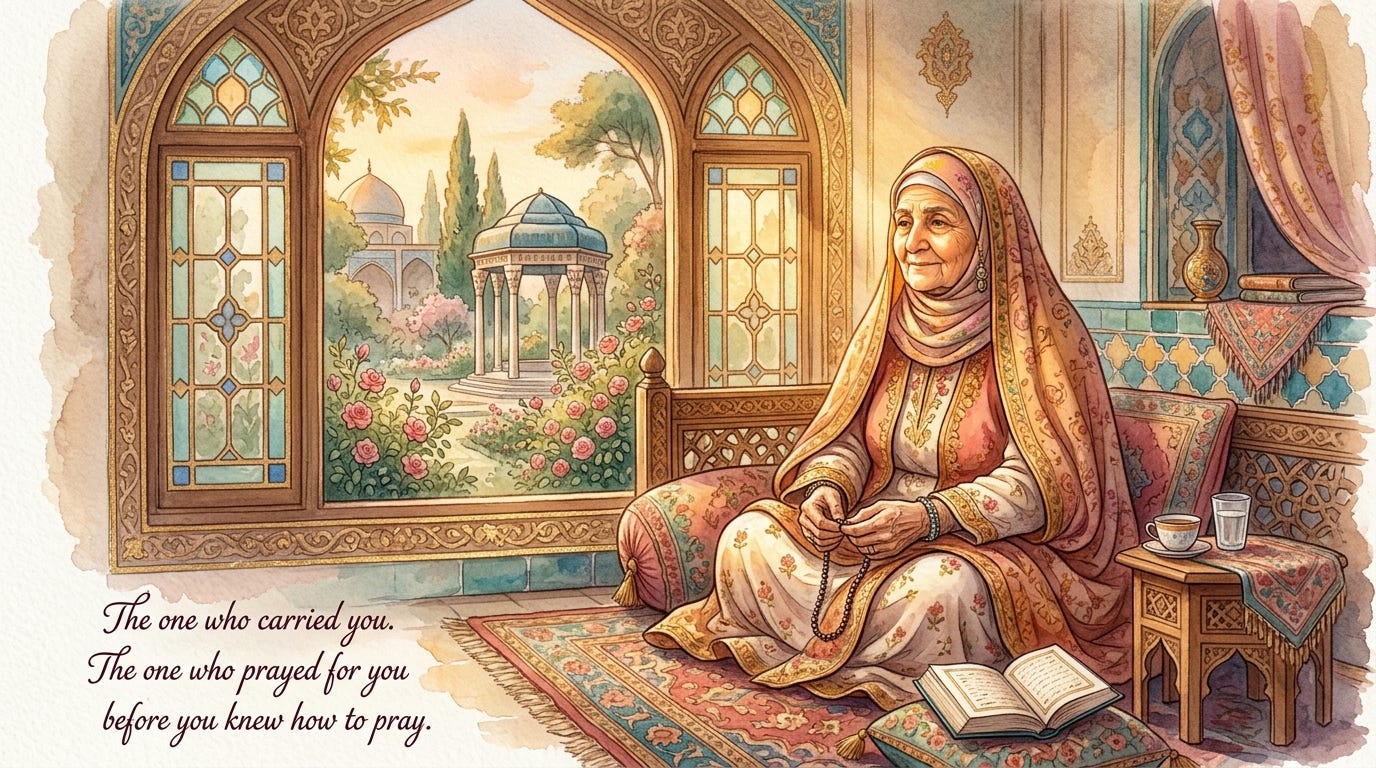
Most of the greater sins we’ve covered so far feel distant from everyday life. Shirk, despair, murder — these feel like big, dramatic, exceptional events. But the sixth greater sin? This one is uncomfortably close to home. Literally.
Aq al-Walidayn — disobedience and disrespect toward parents — is a sin that plays out in kitchens, phone calls, tone of voice, and eye rolls. It doesn’t need a weapon or a courtroom. Sometimes it needs nothing more than a sigh of frustration or a door slammed a little too hard.
And according to Ayatollah Dastaghaib Shirazi, it is one of the gravest sins a human being can commit.
What Does Āq al-Walidayn Actually Mean?
The word ‘Āq’ (عاق) comes from the Arabic root meaning to cut — to sever something. So Āq al-Walidayn literally means cutting off one’s parents — severing the bond of love, respect, and duty that a child owes to their mother and father.
In the traditions of the Ahlul Bayt, this sin refers to any form of annoying or hurting one’s parents, by tongue or by action. Even an angry look directed at them, trampling their rights, not fulfilling their requests, disobeying their orders, and failing to respect them are all considered examples of this sin.
And then there is this extraordinary detail from the Quran. In Surah Al-Isra, Chapter 17, The Children of Israel, Verse 23, Allah forbids even the smallest expression of frustration toward parents — and uses a single Arabic word to illustrate it: “Uff.”
Just uff. That little sound of impatience we make without even thinking. The scholars note that if Allah specifically prohibited that — the most trivial expression of annoyance — then everything above it is even more firmly forbidden.
It has been said: if there were any expression of disgust less than “uff”, Allah would have prohibited that too. The point is not the word — it’s the attitude behind it. Any gesture, however small, that communicates to your parents that they are a burden, an irritation, or beneath your patience — that is where this sin begins.
What Does the Quran Say?
The positioning of parents in the Quran is unlike almost anything else. Allah places the duty toward parents immediately beside the duty toward Himself — not as an afterthought, but as a direct pairing.
In Surah Al-Isra, Chapter 17, The Children of Israel, Verse 23:
“"Your Lord has decreed that you worship none but Him, and that you be good to your parents. Whether one or both of them reach old age with you, do not say to them even 'uff' — and do not repel them — but speak to them noble words.”
Worship Allah. And be good to your parents. Side by side. In the same breath.
In Surah Luqman, Chapter 31, Verse 14:
“Be grateful to Me and to your parents.”
Gratitude to Allah. And gratitude to parents. Again — side by side.
This deliberate pairing is not accidental. It is telling us something profound about the structure of our obligations. The scholars explain it this way — after Allah, who gave us our souls, it is our parents who gave us our bodies, our nurturing, our first experience of love and sacrifice. The debt is immeasurable. The duty is enormous.
And yet there is one clear limit the Quran sets. In Surah Luqman, Chapter 31, Verse 15, Allah says:
“And if they contend with you that you should associate partners with Me, do not obey them. But keep their company with kindness in this world.”
Even if your parents ask you to commit Shirk — the greatest sin of all — you do not obey them in that. But even then, keep their company with kindness. Disobedience to parents in religious matters has its boundaries. But cruelty, coldness, and cutting them off? Never.
What the Ahlul Bayt (AS) Taught Us
The teachings of the Imams on this topic are some of the most moving in all of Shia literature — full of tenderness, precision, and wisdom.
Imam Ali al-Sajjad (AS) — Imam Zayn al-Abidin — is reported to have never eaten at the same table as his mother. When asked why, he replied: “I fear that my hand may reach for a morsel she had intended for herself — and that would be disrespectful to her.”
Think about how refined that is. Not a harsh word. Not a raised voice. Just the quiet, constant awareness of a heart that refused to take even the smallest comfort at a parent’s expense. This is the standard that the Imams modelled for us.
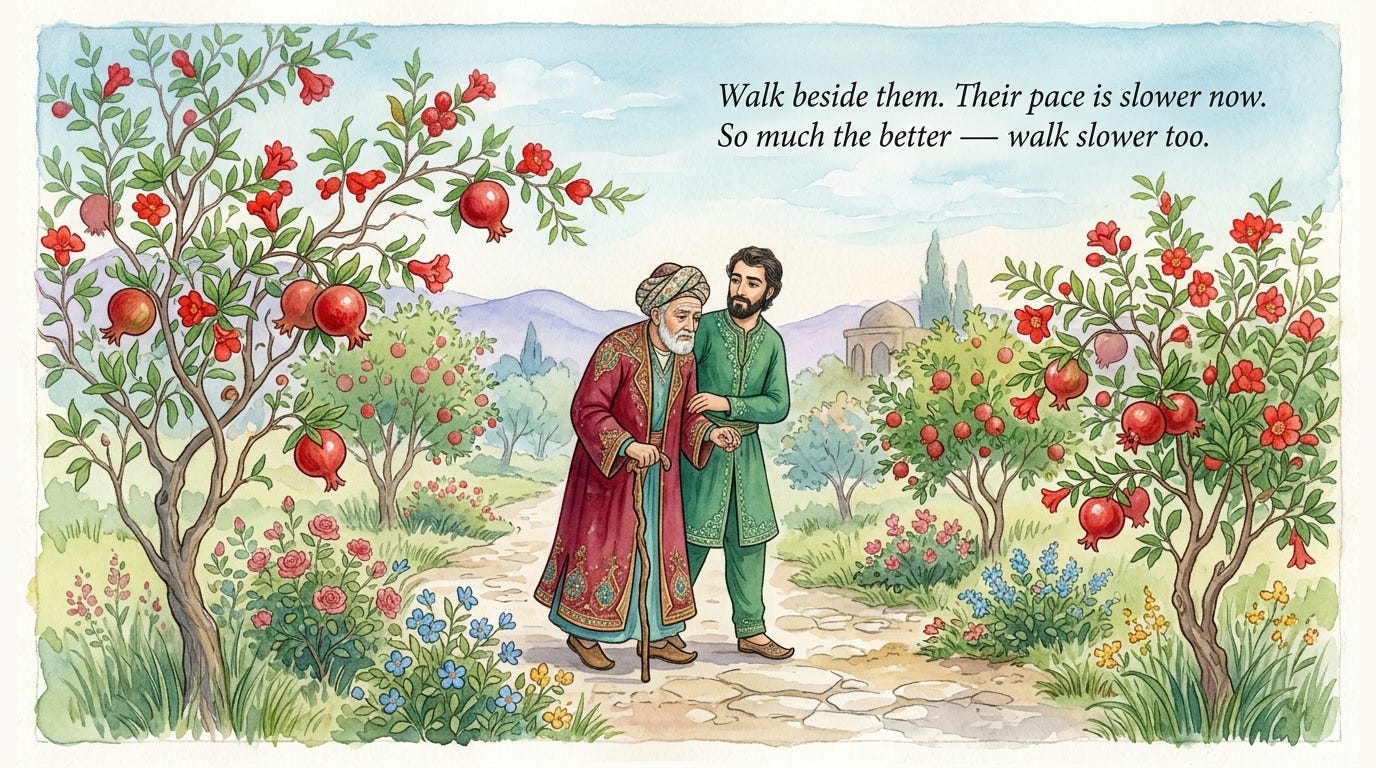
The Ahlul Bayt also gave us a detailed, practical list of how to honour our parents in daily life. One must not address parents by their first names. One must not walk ahead of them or sit before them. One must not raise one’s voice above theirs. One must never sit with one’s back to them in a gathering. And one must never do anything that would cause others to criticise or mock one’s parents — including not insulting the parents of others, lest they retaliate against yours.
These are not suggestions. They are the minimum — the floor of respectful behaviour, not the ceiling.
The Consequences Are Severe — And They Arrive in This World Too
One of the things that makes Āq al-Walidayn particularly sobering is that its consequences are not limited to the Hereafter. The Ahlul Bayt warned that this sin has real, immediate effects in this life.
Among the consequences listed in the traditions are deprivation from paradise, entry into Hell, punishment in the grave, prayers not being accepted, and supplications going unfulfilled. Some scholars of ethics also mentioned the shortening of life and the intensifying of the agony of death as worldly consequences of disrespecting parents.
That last point is worth pausing on. If you have ever wondered why your du’as feel unanswered, why barakah seems absent from your life, why things feel blocked and difficult, the Ahlul Bayt point to this sin as one of the most common causes. A prayer sent up from a heart that has caused pain to its parents faces a serious barrier before it even begins its journey.
The Holy Prophet (S) said:
“Allah the Most High has sent me as a mercy to the worlds — except to the Āq of parents.”
Mercy for everyone. Except the one who breaks their parents’ hearts.
A Story That Will Stay With You
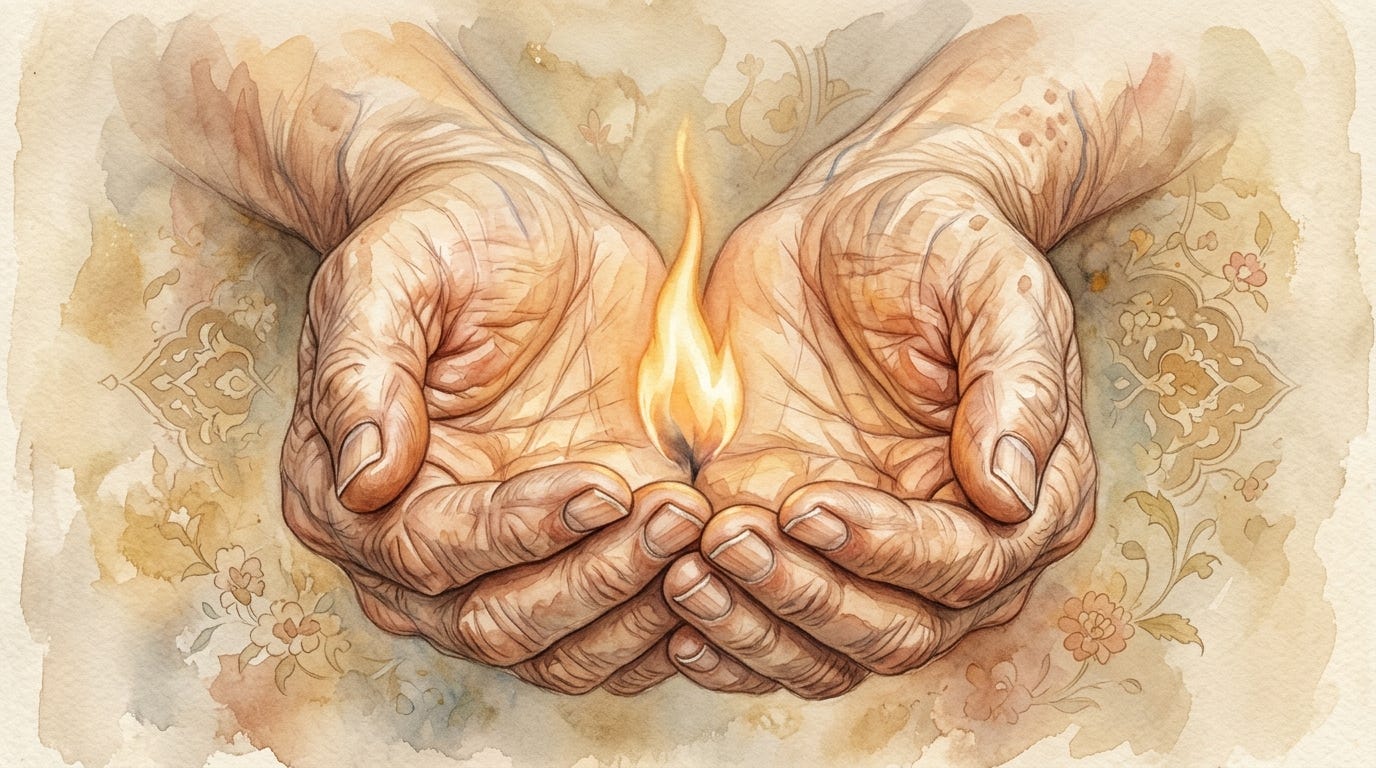
Ayatollah Dastaghaib Shirazi narrates a powerful account in this chapter. A young man came to the Holy Prophet (S) in a state of dying, but he was unable to recite the Shahada. His tongue would not move. The Prophet asked if his mother was alive. She was — and she was deeply hurt by him. The Prophet asked her to forgive her son. She refused at first. The Prophet then ordered a fire to be lit and told her: “Would you prefer to see your son burn in that fire?” She said no, of course not. “Then forgive him.” She forgave him, and immediately the young man was able to recite the Shahada and passed away in peace.
The mother’s forgiveness literally unlocked his tongue at the moment of death. This is not a metaphor. This is how seriously Islam treats the spiritual weight that parents carry over their children — and what it costs when that weight turns from blessing to burden.
But What If My Parents Are Difficult?
This is the question many people carry quietly. What if your parents are unfair? What if they hurt you? What if they have made serious mistakes?
Islam does not ask you to pretend those things didn’t happen. It does not ask you to be a doormat or accept abuse. There is a difference between honouring your parents and allowing yourself to be harmed.
But it does ask you to hold onto kindness even when it is hard. Even when they are wrong. Even when they are not Shia, not Muslim, not what you wish they were spiritually.
Imam Ja’far as-Sadiq (AS) was asked: “My parents are against the truth — they are not Shia.” The Imam replied simply: “Be good toward them, just as you would be toward our Shias.”
No exceptions based on their beliefs. No permission to withhold kindness because of theological differences. Be good to them — full stop.
If your parents have passed away, this duty does not end with their death. A person can still become Āq of their parents after they are gone — by failing to pay their debts, by not seeking forgiveness on their behalf, by abandoning prayers for them. Similarly, a person who was Āq during their parents’ lives can still make amends after their death through sincere du’a, charity given on their behalf, and acts of goodness dedicated to their souls.
The Spiritual Parents — A Uniquely Shia Dimension
Ayatollah Dastaghaib Shirazi adds a dimension to this sin that is particularly profound in Shia theology. He reminds us that the Holy Prophet (S) said: “I and Ali are the fathers of this Ummah.”
The spiritual fathers — the Prophet and the Ahlul Bayt (AS) — are superior to biological parents in the way that the soul is superior to the body. The rewards for kindness to the spiritual father are immeasurably greater than kindness to one’s real parents. And the Āq of a spiritual father — rejecting their guidance, severing connection with them, ignoring their commands — carries consequences far more severe.
This is a beautiful and challenging teaching. Loving the Ahlul Bayt is not just reciting salawat at majlis. It is following their guidance, living by their teachings, keeping their connection alive in your daily choices. To claim their love while ignoring their instructions is, in a very real sense, a form of Āq.
How Do We Make This Right?
Start with reflection.
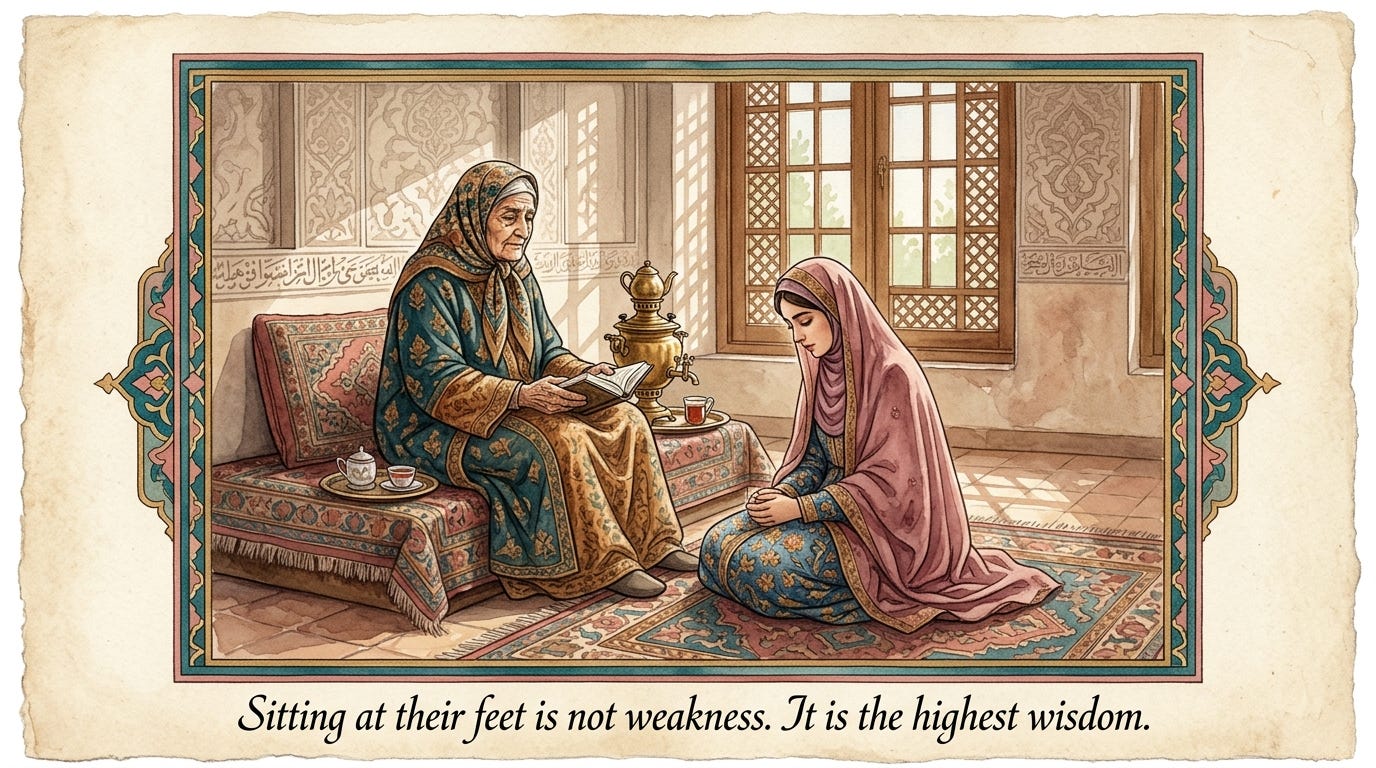
Think honestly — when did you last speak to your parents with genuine warmth? When did you last do something for them without being asked? When did you last make du’a specifically for them by name?
Lower your voice.
Literally. The Ahlul Bayt were specific about this. It costs nothing — and it means everything to an ageing parent who senses the impatience in your tone even when you don’t say a word.
Visit them. Call them.
In our busy, distracted lives, parents often sit alone — waiting. The phone call you keep meaning to make. The visit you keep postponing. There will come a day when those calls can no longer be made, and those visits can no longer happen. Don’t let that day arrive with regret sitting beside it.
Make du’a for them.
The Quran itself teaches us this du’a in Surah Al-Isra, Chapter 17, The Children of Israel, Verse 24:
“My Lord, have mercy on them both, as they raised me when I was small.”
Four words of theirs shaped your whole childhood. A lifetime of du’a is the least we can offer in return.
A Closing Thought
There is a reason Allah placed parents beside Himself in the Quran — not once, but repeatedly. It is because the experience of being loved and cared for by a parent is the closest most human beings will ever come, in this world, to understanding what it means to be loved by Allah. Unconditionally. Before you deserved it. Before you even asked for it.
To honour that love is to honour the One who designed it. To break it — carelessly, impatiently, with a sigh or a slammed door or a years-long silence — is to break something that cannot easily be rebuilt.
They will not always be here. The time you have with them is shorter than you think. Use it well.
May Allah grant our parents long lives filled with ease and joy. May He forgive us for every moment we fell short in our duty to them. And may He reunite us with them — in this world with love, and in the next with His mercy. Ameen.