

Every year, millions of human beings leave behind their homes, wealth, status, nationality, race, and worldly identity to gather around a simple cube in a barren desert valley.
There is no emperor seated there. There is no throne, and no single nation owns the call. Yet humanity continues to answer a summons first proclaimed thousands of years ago by Prophet Ibrahim. As the Quran beautifully captures this enduring invitation:
“And proclaim the pilgrimage among mankind: they will come to you on foot and on every lean camel; they will come from every distant path.”
(Surah al-Hajj,, Chapter 22, The Pilgrimage, Verse 27)
To truly understand Hajj is to understand one of the deepest civilizational movements in human history.
The Illusion of Ancient Supremacy
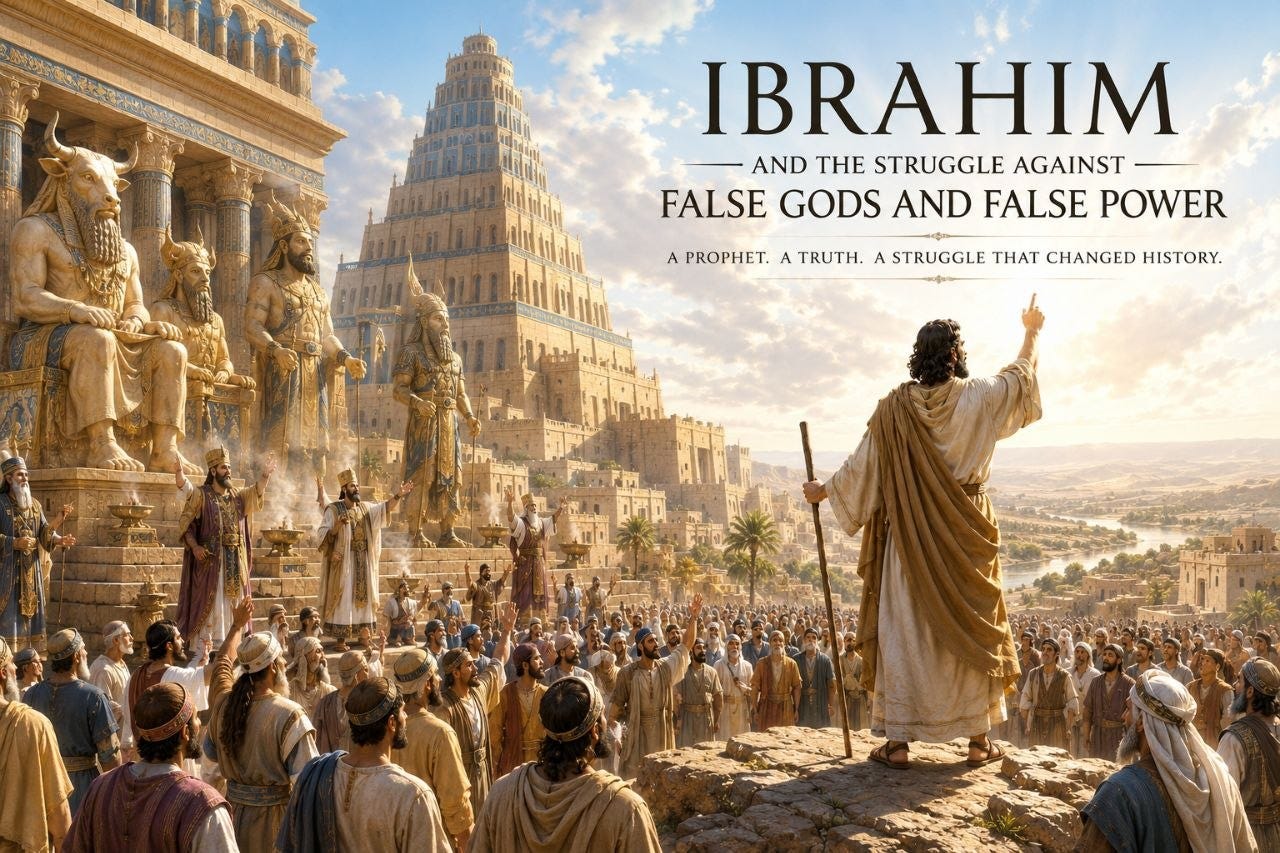
Many imagine Ibrahim as a figure emerging from a primitive or isolated society. In reality, he appeared within one of the world’s earliest and most sophisticated civilisations: ancient Mesopotamia. It was a world characterised by mighty cities, entrenched priesthoods, towering temples, advanced astronomy, and sprawling empires.
In this ancient epoch, political power and religion were deeply fused. Kings could be treated as divine, and empires demanded absolute, unquestioning loyalty. Priesthoods operated as gatekeepers, controlling access to both truth and the sacred, while inherited hierarchies rigidly defined human worth.
Ibrahim challenged all of it.
Tawhid as Ultimate Liberation
His message was not merely the rejection of idols carved from stone; it was the rejection of every false sovereignty standing between human beings and God. Tawhid—the oneness of God—was not just abstract theology. It was an active mechanism of liberation.
Through this paradigm, humanity finds liberation from rulers who exalt themselves, from priesthoods monopolising truth, and from the arbitrary divisions of race, tribe, class, and inherited hierarchy. It is a fundamental liberation from every worldly power that dares to claim an authority belonging only to God.
This is exactly why the prophets repeatedly confronted corrupt orders and false gods (Tāghūt). Their resistance was not because civilisation, knowledge, or power are inherently evil. Rather, it is because human beings repeatedly absolutise these constructs, elevating them above truth and divine guidance.
Revelation from the Margins
Again and again throughout history, revelation has emerged not from the grand imperial capitals, but from the margins—among migrants, shepherds, slaves, desert peoples, and the oppressed. The Quran emphasises this profound historical pattern:
“And We desired to show favour to those who were oppressed in the land, and to make them leaders, and make them inheritors.”
(Surah al-Qasas, Chapter 28, The Narrative, Verse 5)
And so, Ibrahim migrated away from the great centres of worldly power. He did not leave to build another empire or to found a dynasty. He left to begin something entirely different: a movement centred purely on surrender to God alone.
As the Hajj season commences once more, that movement remains vibrantly alive today, continuing to draw millions away from the illusions of earthly power and back to the profound simplicity of divine submission.
Reference: Shaykh Ali Reza Panahian