

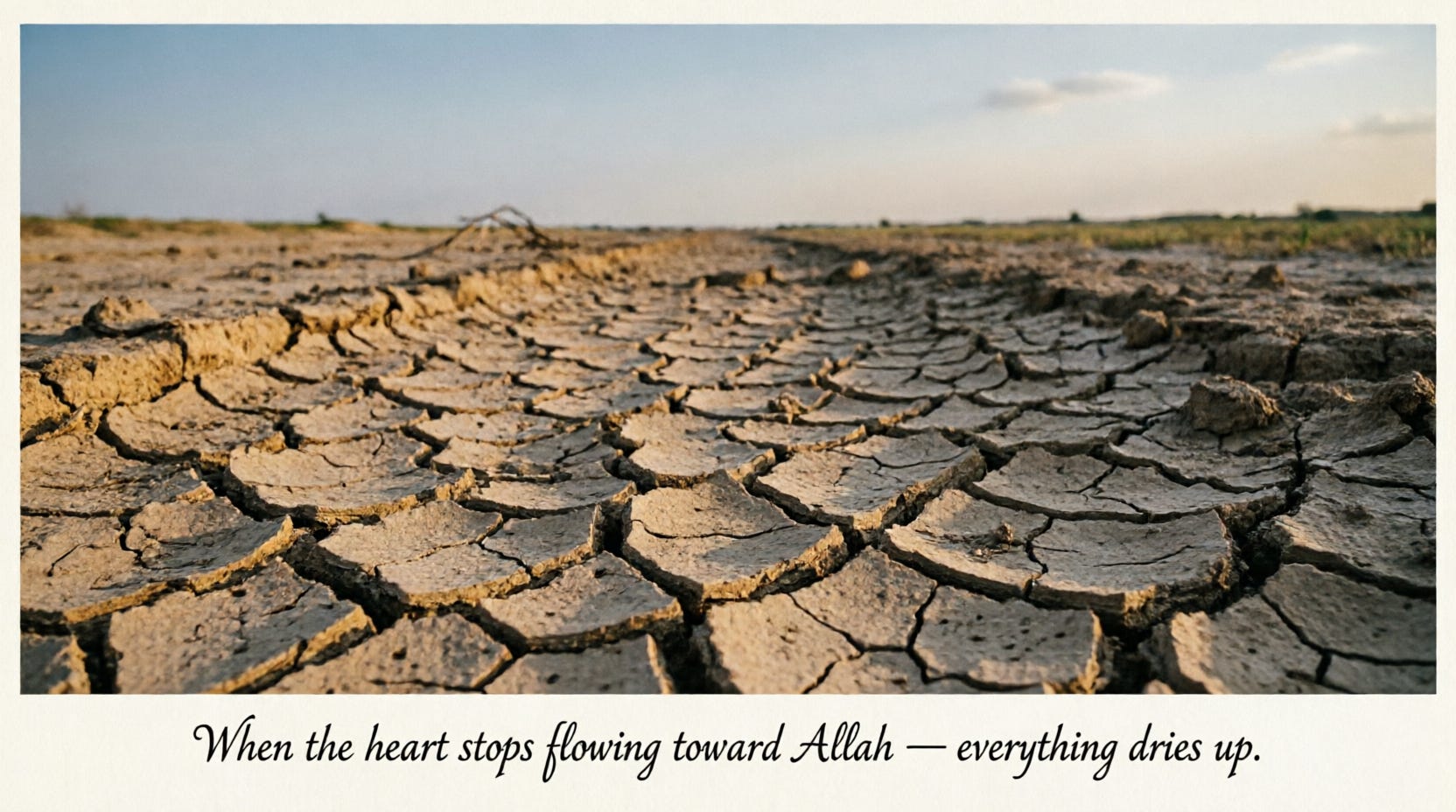
Wait — Didn’t We Just Cover Despair?
If you read the last article on Yā’s, you might be wondering — haven’t we already talked about losing hope? Why is there another sin about the same thing?
That’s actually a brilliant question, and the answer reveals something incredibly precise about how Islamic scholarship understands the human heart.
Yā’s and Qunut are related — they’re like two stages of the same illness. But Qunut is more serious. More settled. More dangerous. And understanding the difference between them might be one of the most important spiritual lessons in this entire series.
So What Exactly Is Qunut?
The word Qunut (قنوط) comes from an Arabic root meaning to be completely cut off — severed, disconnected. In the context of this sin, Qunut describes the condition where one’s heart loses hope of Allah’s mercy and, crucially, that person does not even dislike the hopelessness.
That last part is everything.
With Yā’s — despair — a person feels hopeless, but somewhere deep inside, there’s still a flicker of discomfort about it. Some part of them wishes they could believe in Allah’s mercy. They feel the loss. They’re troubled by it.
But Qunut is when even that flicker goes out. Scholars explain the difference this way: Yā’s describes the internal condition of the heart. But when that internal hopelessness intensifies to the point where it becomes visible outwardly — in a person’s speech, their actions, their whole way of being — that is Qunut.
In other words, Yā’s is the thought. Qunut is when that thought has moved in, unpacked its bags, and made itself at home.
Did You Know:
Qunut in Salah refers to the special dua you raise your hands for during prayer, particularly in the Witr prayer or the second raka’ah of Fajr in some schools. In this context, it means devotion, humility, and standing obediently before Allah. It’s a beautiful act of submission.
Qunut as a Greater Sin comes from the same root but takes on the opposite spiritual meaning — it describes a person who has become completely cut off from Allah, settled into hopelessness, no longer reaching out to Him at all.
So here’s the beautiful irony — the cure for the sin of Qunut is literally built into your prayer. When you raise your hands in Qunut during salah, you are doing the exact opposite of the sinful state of Qunut. You are saying — I haven’t given up. I am still here. I am still reaching toward You.
It’s almost like the scholars and the Imams (AS) embedded the antidote right into the daily worship. Every time you perform Qunut in your prayer, you are actively fighting off the spiritual disease of Qunut in your heart.
The Difference That Changes Everything
Let’s put this in real terms, because this distinction matters deeply for all of us.
Imagine two people. Both have been struggling with their faith. Both feel distant from Allah. Both have committed sins they’re not proud of.
The first person feels crushed by despair. They lie awake at night thinking “I don’t deserve Allah’s mercy.” But there’s a restlessness in them — a pain — because part of them still wants that connection. They haven’t stopped caring. They haven’t stopped feeling the pull toward Allah. That is Yā’s — painful and serious, but not yet the end of the road.
The second person? They’ve been feeling that way for so long that they’ve stopped caring altogether. They’ve stopped making du’a — because why bother? They’ve stopped feeling guilty about missing prayers — because what difference does it make? They’ve stopped even wanting to get better. The silence inside has become comfortable. That is Qunut.
Ayatollah Dastaghaib Shirazi explains it powerfully: Qunut means that a person accuses Allah of not being merciful and not accepting repentance. They think that every hardship they face is simply the punishment for their sins — a sign that Allah has already closed the door on them.
This is why scholars say Qunut is more dangerous than Yā’s. Yā’s can be forgiven, but Qunut — in its full form — does not deserve forgiveness, because it falls under the category of Shirk itself. A person in Qunut has, in effect, made a judgment about Allah’s character and decided: He won’t forgive me. And that judgment — that limiting of the Unlimited — is where Qunut touches the edges of Shirk.
What Does the Quran Say?
Allah addresses Qunut directly in the Quran — and He addresses it in the context of some of the most desperate human moments imaginable.
In Surah al-Hijr, Chapter 15, The Stoneland, Verse 56, when Prophet Ibrahim (AS) is told he will have a son in his old age and expresses amazement, the angels respond:
“And who despairs of the mercy of his Lord except those who are astray?”
And in Surah az-Zumar, Chapter 39, The Companies, Verse 53 — the same verse of mercy we quoted in the last article — the word used by scholars to interpret the depth of that command (”do not despair”) specifically targets Qunut. Allah is not just telling us not to feel hopeless in a passing moment. He is forbidding us from settling into that hopelessness.
Then there is this stunning verse in Surah ash-Shura, Chapter 42, The Council, Verse 28:
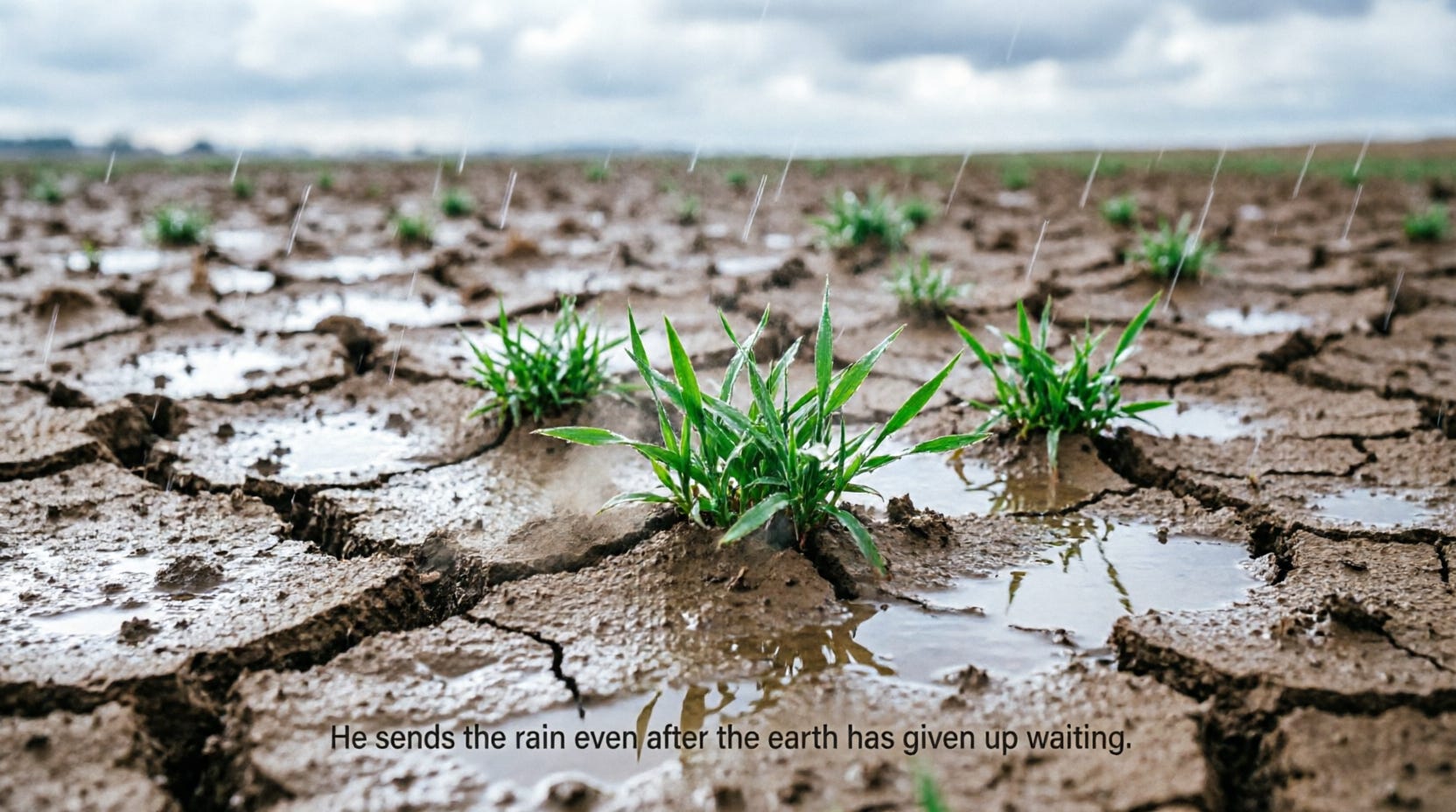
“And He it is Who sends down rain after they have despaired — and He unfolds His mercy.”
Notice the imagery. Rain after despair. Not before. Not during. After. There is something deeply intentional in this. Allah sends His mercy precisely into the places that have given up on receiving it. The fields that had cracked open in drought. The hearts that had gone silent. He sends the rain anyway.
What Did the Ahlul Bayt (AS) Teach Us?
The Imams (AS) connected Qunut very directly to the abandonment of du’a — supplication. And this is such an important point for our daily lives.
Many scholars hold that to discontinue invocation and dua is itself a sign of despair — and therefore a symptom of Qunut. Think about that. If you’ve stopped making du’a — not because you’re busy, not because you forgot, but because you genuinely feel it doesn’t matter, that Allah isn’t listening, that it’s pointless — that is Qunut quietly at work in your heart.
Imam Ali al-Sajjad (AS), one of the most spiritually profound of the Imams, captures the correct state of the believer beautifully in the 39th Dua of Sahifa Sajjadiyya — one of the most treasured du’a collections in Shia Islam. He says:
“I neither despair of Your mercy, nor am I in despondence regarding You. But I am aggrieved because my good deeds are few in number and my bad deeds numerous. Otherwise, Your position is so high that not a single creature turns away dejected from You.”
Read that again slowly. Imam Zain al-Abidin (AS) — the son of Imam Husayn (AS), a man who witnessed Karbala, who carried the grief of the greatest tragedy in Islamic history — is teaching us how to feel. Not crushed. Not cut off. Sorrowful, yes. Aware of shortcomings, absolutely. But never, never in Qunut.
If the Imam who survived Karbala refused to fall into Qunut, what excuse do any of us have?
The Sign You Might Not Notice
Here is something worth pausing on — because Qunut doesn’t always announce itself loudly. It often sneaks in through the back door, disguised as realism, or practicality, or even humility.
It can sound like:
“I’ve tried making tawbah before. It doesn’t work for me.” “I’m just not the kind of person who gets close to Allah.” “Other people can be spiritual, but that’s not really me.” “I’ve done too much. There’s no point anymore.”
None of these feel like a theological statement about Allah. But every single one of them is, at its root, placing a limit on His mercy. Every one of them is Qunut dressed up in everyday language.
Ayatollah Dastaghaib Shirazi warns that Qunut causes the severing of the relationship between the creature and Allah, and that the root cause of this despondence is the extinguishing of the original flame of creation that had been alive in the heart. Even if a little light had remained, a person would not lose hope completely.
That flame — the fitra, the original nature Allah placed in every human soul — is the antidote to Qunut. Reconnecting with it is the cure.

How Do We Come Back From Qunut?
The beauty of Islam — and especially of the Ahlul Bayt’s teachings — is that there is always a way back. Even from Qunut. Here’s where to begin:
Start with dua — even if it feels hollow:
The very act of raising your hands and opening your mouth to Allah is itself a crack in the wall of Qunut. You don’t need to feel it at first. Just begin. Imam Ja’far as-Sadiq (AS) said: “Dua is the shield of the believer.” Pick up the shield, even with shaky hands.
Sit with Sahifa Sajjadiyya:
The duas of Imam Zain al-Abidin (AS) are specifically crafted for the broken-hearted. They speak the language of someone who is struggling but refusing to give up. Reading them — especially the du’as for repentance — is like receiving direct guidance from the Imam himself on how to navigate the darkest states of the soul.
Remember: hardship is not rejection:
One of the core mistakes that leads to Qunut is interpreting life’s difficulties as proof that Allah is angry with you, has abandoned you, or has closed the door. But the Quran is clear — hardship is a test, a purification, a means of elevation. It is not a punishment disguised as life. The rain comes after the despair. The drought is not the end of the story.
Reconnect with the stories of the Prophets:
Prophet Ayyub (AS) lost his health, his wealth, and his family — and still called out to Allah. Prophet Yunus (AS) sat in darkness inside a whale at the bottom of the sea — and still called out to Allah. Prophet Ibrahim (AS) was thrown into a fire — and still trusted Allah completely. These are not fairy tales. They are a manual for the human heart in its worst moments.
A Closing Thought
Yā’s is losing hope. Qunut is accepting the loss. And that acceptance — that quiet, settled surrender to hopelessness — is what makes Qunut so spiritually grave.
But here is what Imam Ali al-Sajjad (AS) gives us — a model of how to be human in all its struggle and grief without ever cutting the thread that connects us to Allah. He was sorrowful. He acknowledged his shortcomings. He felt the weight of everything. And yet he looked up and said: Not a single creature turns away dejected from You.
Not one. Not ever.
Not even you.
May Allah protect our hearts from the quiet settling of Qunut, rekindle the flame of hope within us, and keep us forever reaching — even weakly, even imperfectly — toward His mercy. Ameen.